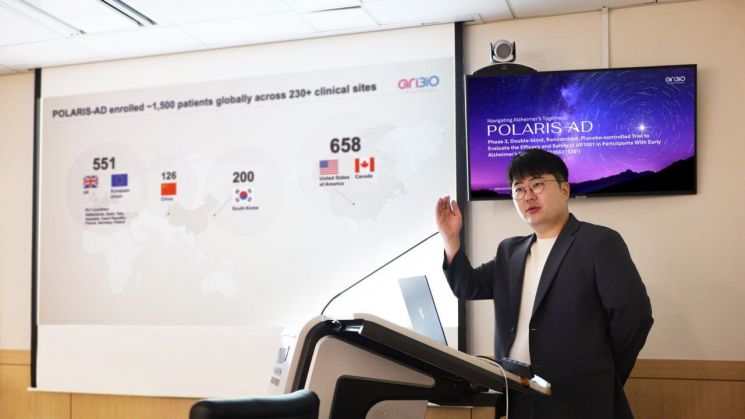
 Fred Kim, head of the US branch, is explaining related details at the interim result analysis clinical researcher seminar held at Bundang Seoul National University Hospital. Aribio
Aribio has announced interim results from the global Phase 3 clinical trial of its oral Alzheimer's treatment, AR1001.
On August 5, Aribio stated that a positive trend was observed in 41.6% of all patients, with either maintenance or improvement in cognitive function and daily living abilities. This analysis was based on double-blind data from 300 patients who completed the trial.
The clinical trial is currently recruiting 1,535 early-stage Alzheimer's patients at 230 sites across 13 countries worldwide. This interim analysis focused on efficacy, patient group appropriateness, and safety.
For the primary endpoint, the Clinical Dementia Rating Scale Sum of Boxes (CDR-SB), 86 patients (28.6%) showed improvement in symptoms, and 39 patients (13.0%) exhibited a tendency toward stability. Changes in scores ranged from -0.5 to -8.5 points. For secondary endpoints?including the Alzheimer's Disease Assessment Scale-Cognitive Subscale 13 (ADAS-Cog13), Amsterdam Instrumental Activities of Daily Living Questionnaire (A-IADL-Q), Geriatric Depression Scale (GDS), and Mini-Mental State Examination (MMSE)?similar trends of improvement or maintenance were observed.
The composition of the patient group was also assessed as appropriate. The number of participants (1,535) is similar to that of Eisai (Leqembi, 1,795) and Lilly (Kisunla, 1,182), and the baseline average CDR-SB score (3.47) shows little difference. This structure, in which rapid symptom worsening is expected in the placebo group, is considered favorable for demonstrating the drug's efficacy.
Only 1.2% of patients discontinued the trial due to side effects, and there were no reported cases of brain edema (ARIA-E) or brain hemorrhage (ARIA-H), which are common with antibody therapies. In the Leqembi and Kisunla treatment groups, ARIA incidence rates were 21.5% and 36.8%, respectively, with 6.9% of Leqembi and 13.1% of Kisunla patients discontinuing due to side effects.
An Aribio representative stated, "Based on ease of administration, perceived efficacy, and high safety, 96% of patients voluntarily participated in the extension trial after 52 weeks of dosing."
Kim Sangyun, Professor of Neurology at Seoul National University Bundang Hospital and clinical director, emphasized, "Since many patients are still in the clinical stage, we need to approach the final results with caution. Given that there have been no serious side effects such as brain edema or brain hemorrhage, and that more than 40% of the entire patient group showed maintenance or improvement in both primary and secondary endpoints?an exceptional outcome?it is essential to ensure thorough quality control, including dosing evaluation, until the completion of Phase 3."
Aribio plans to announce topline results in the first half of next year and submit a New Drug Application (NDA) to the U.S. Food and Drug Administration (FDA) in the second half. The company also noted that clinical data from AR1001 was most extensively used in the approval documentation for 'Lumipulse,' a blood-based Alzheimer's diagnostic marker recently approved by the FDA, further increasing confidence in the clinical quality.
Meanwhile, Aribio is pursuing a merger with Kosdaq-listed company Solux. The merger date is set for November 4.
© The Asia Business Daily(www.asiae.co.kr). All rights reserved.
![Clutching a Stolen Dior Bag, Saying "I Hate Being Poor but Real"... The Grotesque Con of a "Human Knockoff" [Slate]](https://cwcontent.asiae.co.kr/asiaresize/183/2026021902243444107_1771435474.jpg)
















