Trump Warns of '25% Plus Alpha' High Tariffs on Social Media
Pressures Russia for Ceasefire by Threatening 'Secondary Tariffs'
U.S. President Donald Trump warned on August 4 (local time) that he would "significantly increase tariffs" on imports from India, citing India's large-scale purchases of Russian oil.
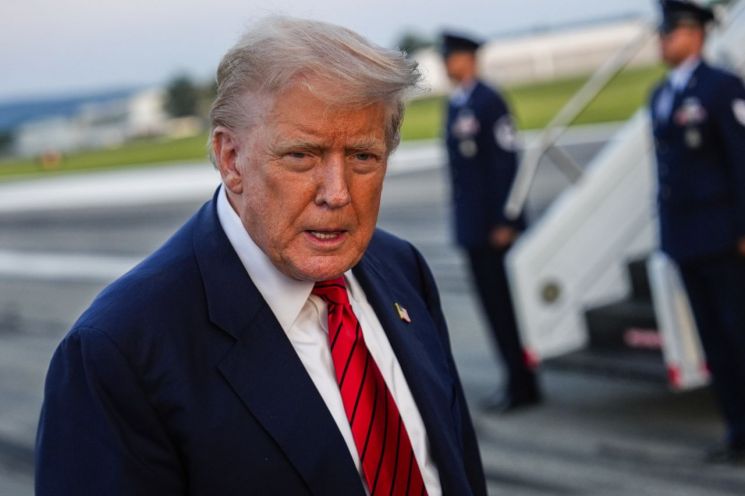
President Trump made this statement in a post on his own social networking service, Truth Social, claiming, "India is not only purchasing large quantities of Russian oil, but is also reselling much of it on the open market for substantial profits."
He continued, "Countless people are losing their lives in Ukraine due to Russia's war machine, but India does not care at all about this," adding, "In response, I will significantly raise tariffs on India."
Previously, on July 30, President Trump also pointed out the same issue regarding India and announced that he would impose additional penalties on top of the 25% country-specific reciprocal tariff. His remarks on this day, made ahead of the implementation of reciprocal tariffs on August 7 and amid stalled trade negotiations with India, are interpreted as increasing pressure on India by suggesting the possibility of additional tariffs beyond the already announced 25% tariff.
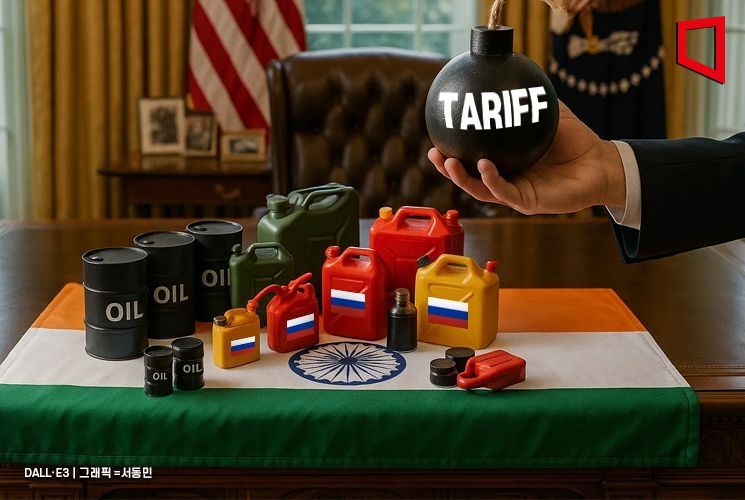
Additionally, by warning of a "secondary tariff" on buyers of Russian oil, there is also an aspect of pressuring Russia to take a more active role in ceasefire negotiations related to the war in Ukraine.
On July 28, President Trump warned Russian President Vladimir Putin, "I will set a new deadline about 10 to 12 days from today," stating that if a peace agreement with Ukraine is not reached within the next two weeks, secondary tariffs will be imposed. He moved up the originally proposed ceasefire negotiation deadline from September 2 to around August 9, urging Russia to respond more swiftly.
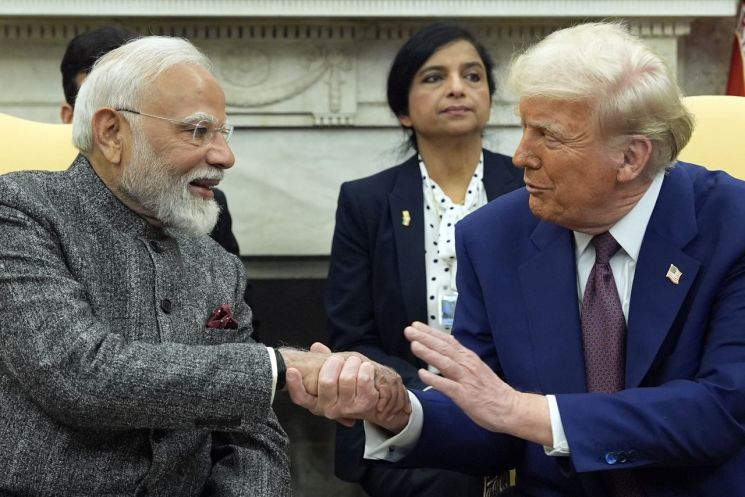 On February 13 (local time), Indian Prime Minister Narendra Modi (left) visited the White House in the United States and shook hands with U.S. President Donald Trump. / AP·Yonhap News
India, which relies on imports for about 90% of its crude oil, responded immediately. In particular, India questioned the fairness of the measure, noting that countries such as China and Turkey continue to import Russian crude oil but are not subject to similar sanctions.
Randhir Jaiswal, spokesperson for India's Ministry of External Affairs, criticized the move in a statement posted on X (formerly Twitter), saying, "Targeting India is neither justified nor reasonable."
Spokesperson Jaiswal stated, "Since the outbreak of the Russia-Ukraine armed conflict, India has been targeted by the United States and the European Union (EU) due to its imports of Russian oil," adding, "However, India began importing oil from Russia after its previous supply volumes were redirected to Europe following the Russia-Ukraine conflict." He further argued that imports of Russian oil are "intended to ensure predictable and affordable energy costs for Indian consumers" and that "this is an unavoidable measure dictated by global market circumstances."
He also emphasized, "The United States continues to import uranium hexafluoride for its nuclear industry and palladium for its electric vehicle industry, as well as fertilizers and chemicals from Russia," and added, "Like other major economies, India will take all necessary measures to protect its national interests and economic security."
The Wall Street Journal (WSJ) reported that as President Trump's attitude toward Prime Minister Narendra Modi has cooled, the relationship between U.S. President Donald Trump and Indian Prime Minister Narendra Modi?once referred to as a 'bromance'?is now showing signs of strain. The atmosphere has shifted as bilateral trade negotiations have stalled, and conflicts surrounding the ceasefire mediation following the armed clash between India and Pakistan in May have also contributed to the rift between the two leaders.
© The Asia Business Daily(www.asiae.co.kr). All rights reserved.
![User Who Sold Erroneously Deposited Bitcoins to Repay Debt and Fund Entertainment... What Did the Supreme Court Decide in 2021? [Legal Issue Check]](https://cwcontent.asiae.co.kr/asiaresize/183/2026020910431234020_1770601391.png)

















