Weak Companion Index Rises to 130.6 in 2024
Indices for Medical and Health, Livelihood and Care, Education and Culture, and Safety Sectors Increase
Slight Decline in Housing and Social Integration Indices
The Weak Companion Index, which evaluates the effectiveness of policies aimed at supporting the vulnerable?a core philosophy of Seoul Mayor Oh Sehoon's administration?has shown improvement compared to last year. In particular, the index for the medical and health sector saw a significant increase as the city implemented policies tailored to the era of population aging.
On August 4, the Seoul Metropolitan Government announced that the 2024 Weak Companion Index reached 130.6, a 17.7% rise from last year's initial evaluation of 111.0. Compared to the base year of 2022, which was set at 100, the index rose by 30.6%.
Developed in October 2023, the Weak Companion Index consists of six main areas?livelihood and care, housing, medical and health, education and culture, safety, and social integration?measured by 50 detailed indicators. The index uses 2022, the year when the city declared its commitment to supporting the vulnerable, as the baseline. An index above 100 indicates that the policy effects have improved.
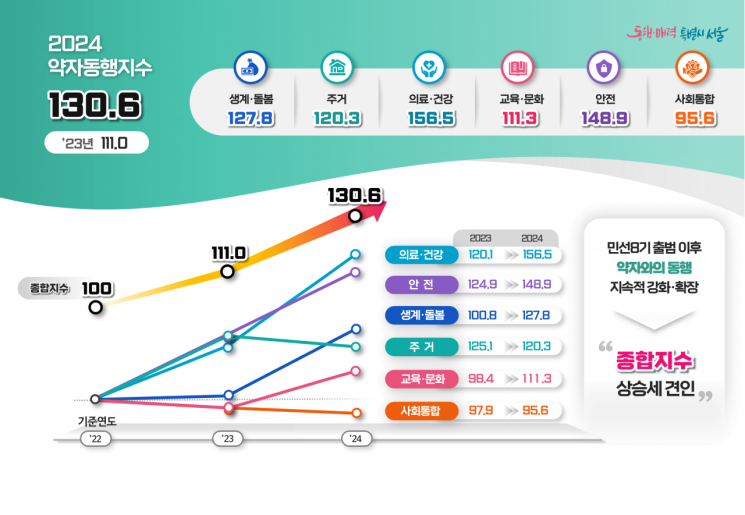
By sector, the medical and health area showed the largest increase, reaching 156.5. A city official explained, "This is the result of a swift response to demographic changes such as aging, as well as to social risks like dementia and mental health issues." Comprehensive measures centered on metropolitan and district dementia centers proved effective, as the dementia patient case management rate rose from 19.30% to 20.65%. Support for the mental health of children, adolescents, and young adults also increased by more than 30%, from 17,331 to 22,721 individuals.
The next highest index was in the safety sector, which recorded 148.9. The city attributes this improvement largely to the implementation of the "Seoul Without Loneliness" initiative, the nation's first comprehensive plan to address loneliness, isolation, and social withdrawal. The number of isolated and withdrawn youth identified and supported rose from 557 in 2023 to 891 last year. In addition, the number of people with disabilities using public transportation increased by about 28%, from 26.15 million to 33.46 million during the same period.
The livelihood and care index rose from 100.8 to 127.8 last year. The number of young adults receiving welfare services linked to family care tripled, and the scale of discovering and supporting small business owners in crisis increased by more than 30%. These results reflect expanded support for the self-reliance of vulnerable groups, increased public care, and efforts to address policy blind spots.
The education and culture sector surpassed 100 for the first time last year, reaching 111.3. Policies such as the Youth Theater and the Seoul Youth Culture Pass led to an increase in the participation rate of vulnerable groups in cultural activities, from 38.22% to 43.25%. The "Seoul Learn" program, which supports learning for disadvantaged students, also helped reduce private education costs by an average of 347,000 won per month.
On the other hand, the indices for the housing and social integration sectors declined over the past year. The housing index fell from 125.1 in 2023 to 120.3 last year. A closer look at the detailed indicators shows that the number of housing units improved for vulnerable households decreased from 2,694 to 2,157. The proportion of young households facing excessive housing costs increased from 38.39% to 39.60% during the same period. The city plans to strengthen policies based on customized housing services by expanding support for housing-vulnerable groups.
The social integration index dropped from 97.9 to 95.6. This was due to declines in some indicators, such as the volunteer participation rate and donation experience rate among Seoul citizens. The sense of social belonging among multicultural members also decreased, from 7.36 points to 6.33 points. The city attributed the drop in the social integration index to a combination of factors, including the deepening of individualism and the breakdown of neighborly relations. The city analyzed that restoring trust among citizens and encouraging voluntary participation in social contribution activities are necessary.
This year, the city increased the related budget by 1.0883 trillion won compared to the previous year and raised the proportion of Weak Companion projects from 29.9% to 30.7% in order to continue advancing the value of supporting the vulnerable.
Jung Sanghoon, Director General of Planning and Coordination at the Seoul Metropolitan Government, stated, "The Weak Companion Index is more than a slogan; it is a standard that shows how 'supporting the vulnerable' is changing the daily lives of citizens and guiding the direction of Seoul's administration. We will continue to expand tangible changes that citizens can feel in their daily lives and meticulously address invisible blind spots to ensure that no one is left behind."
© The Asia Business Daily(www.asiae.co.kr). All rights reserved.

![Clutching a Stolen Dior Bag, Saying "I Hate Being Poor but Real"... The Grotesque Con of a "Human Knockoff" [Slate]](https://cwcontent.asiae.co.kr/asiaresize/183/2026021902243444107_1771435474.jpg)















