Elected Party Leader at the August 2 National Convention
Accelerating Three Major Reforms, Including Prosecutorial Reform, Before Chuseok
Taking a Hardline Stance Against the Opposition by Emphasizing "Overcoming Rebellion"
Jeong Cheongrae has been elected as the new leader of the Democratic Party of Korea, which became the ruling party following its victory in the presidential election. With Jeong, known for his bold and breakthrough leadership style, taking the helm, discussions on reforms such as prosecutorial reform are expected to accelerate.
At the Democratic Party's national convention held on August 2 at KINTEX in Goyang, Gyeonggi Province, Jeong stated, "I will take the lead and set an example when it comes to difficult, unpleasant, or confrontational tasks." Regarding relations with the opposition, he emphasized overcoming "rebellion" and declared that he would "not shake hands," signaling a hardline stance.
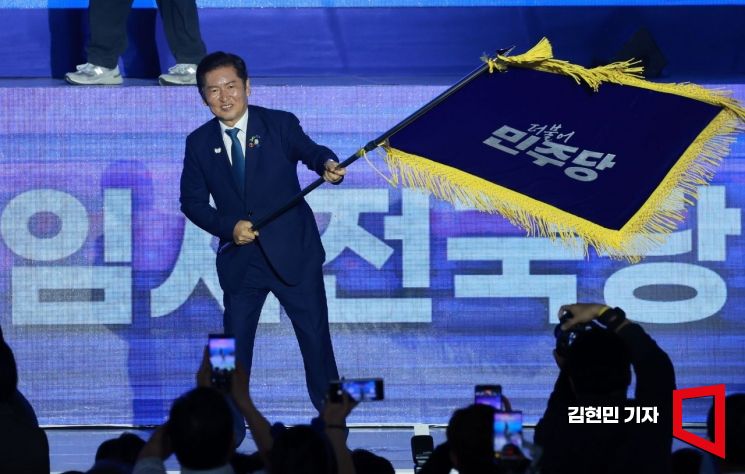 Jeong Chungrae, the newly appointed party leader of the Democratic Party of Korea, is waving the party flag received from Kim Byunggi, the acting party leader and floor leader, at the National Party Members' Convention held on August 2, 2025, at KINTEX in Goyang, Gyeonggi Province. Photo by Kim Hyunmin
With Jeong, who had pledged to expedite reform legislation, now elected, he is expected to spearhead the push for prosecutorial reform and other key reforms. During his candidacy, he presented a blueprint to complete prosecutorial reform before Chuseok. It is already known that a reform task force within the party has drafted a prosecutorial reform plan. Accordingly, the party is expected to formalize the task force's proposal as the party's official position and then launch a rapid push for reform.
Other reform-related legislative initiatives are also expected to gain momentum. On August 4, when Jeong begins his official duties, the Democratic Party plans to bring the Broadcasting Act amendments, the Commercial Act amendment, and the Yellow Envelope Act (amendments to Articles 2 and 3 of the Trade Union and Labor Relations Adjustment Act) to a vote in the National Assembly plenary session. All of these bills are opposed by the main opposition party, the People Power Party.
Defining relations with the opposition is another challenge. Setting the relationship with the main opposition, the People Power Party, remains a key task. In his policy speech at the convention, Jeong declared, "We must uproot the party of rebellion," and stated, "Overcoming rebellion comes before cooperation." He further pledged, "We must thoroughly punish and hold accountable Yoon Sukyeol, the main suspect and leader of the rebellion who shows no remorse, along with his supporters." In a meeting with reporters, Jeong also questioned, "How can we join hands if there is no sincere reflection, apology, or self-examination, and if there are still those who defend former President Yoon?"
Relations with the Cho Kuk Innovation Party are also an unresolved issue. The Innovation Party, which supported President Lee's campaign in the last presidential election, is demanding a Liberation Day pardon for former Innovation Party leader Cho Kuk. Since this issue is also a subject of debate within the Democratic Party, candidates did not present clear positions during the party leader TV debates. However, after taking office as party leader, Jeong will need to clarify his stance.
As the ruling party, defining relations with the presidential office is also a challenge. President Lee has shown a cautious attitude, refraining from any actions that could be seen as supporting a particular candidate in the Democratic Party convention. Jeong expressed his intention to cooperate, stating in a meeting with reporters, "First, I would like to thank President Lee Jaemyung." However, it appears that coordination will be needed between the party members' demands for reform and President Lee's direction in state affairs going forward.
© The Asia Business Daily(www.asiae.co.kr). All rights reserved.
![Clutching a Stolen Dior Bag, Saying "I Hate Being Poor but Real"... The Grotesque Con of a "Human Knockoff" [Slate]](https://cwcontent.asiae.co.kr/asiaresize/183/2026021902243444107_1771435474.jpg)
















