Simultaneous Processing of the Yellow Envelope Act, Commercial Act, and Broadcasting Three Laws
People Power Party: "We Will Strive to Remove Harmful Provisions"
Ruling Party Pushes Forward Despite Strong Opposition from Business Circles and Opposition Parties
On August 1, the Democratic Party of Korea and other ruling parties are set to process several bills in the National Assembly’s Legislation and Judiciary Committee. These include the Yellow Envelope Act (Trade Union and Labor Relations Adjustment Act), an amendment to the Commercial Act mandating cumulative voting for companies with assets of 2 trillion won or more, and the Broadcasting Three Laws, which would expand the boards of public broadcasters. The People Power Party, which has no effective means to stop the bills except for delaying tactics such as filibusters (unlimited debate), stated that it will attempt to remove as many “toxic clauses” as possible during the review process.
The Legislation and Judiciary Committee’s agenda for the day includes a large number of bills that were previously blocked during the Yoon Suk-yeol administration, such as those subject to the exercise of the right to request reconsideration (veto). Since the inauguration of the Lee Jaemyung administration, the so-called reform bills of the ruling party, which had been postponed, are now being pushed forward.
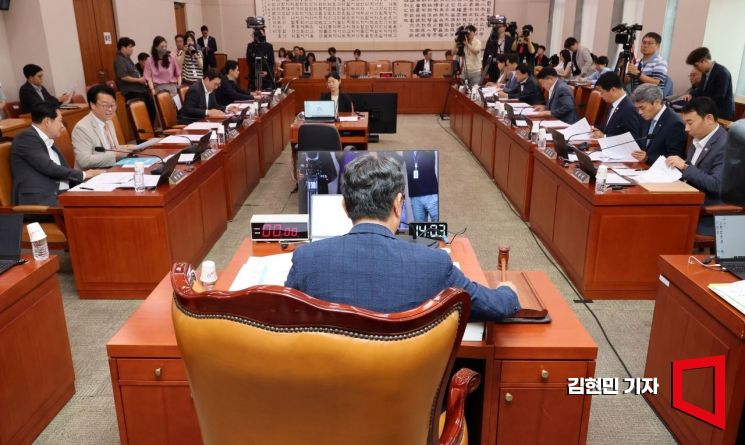 On the 22nd, at the 4th plenary meeting of the Legislation and Judiciary Committee held in the National Assembly, Chairman Lee Chunseok is striking the gavel. 2025.7.22 Photo by Kim Hyunmin
The People Power Party has decided to participate in the committee discussions and present counterarguments. Park Sunghoon, chief spokesperson for the People Power Party, told reporters after a party policy meeting, “We cannot prevent the bills from being brought to the committee, but we plan to thoroughly point out the problems with the bills at the committee level.” He added, “Since we still have time, rather than boycotting everything, we will focus on removing as many harmful provisions as possible and supplementing parts that must be revised from the perspective of business, management, and the national interest.” Regarding the Broadcasting Three Laws, he said, “Many people are concerned, so we will do our best to address those concerns in the bills.” Park Hyungsoo, who serves as the People Power Party’s secretary for the committee, stated during a procedural speech, “We must ensure there is enough time for a thorough review until the afternoon.”
The Yellow Envelope Act passed the Environment and Labor Committee on July 28. In addition to limiting claims for damages resulting from lawful labor disputes, the bill expands the definition of “employer” to include those who have substantial control or decision-making power over working conditions, even if they are not direct parties to the employment contract. Business circles are concerned that continued labor disputes and increased bargaining burdens will result from these changes.
The amendments to the Commercial Act and related laws are also strongly opposed by the business community. The Commercial Act, which passed the first subcommittee of the Legislation and Judiciary Committee on July 28, mandates cumulative voting for listed companies with assets of 2 trillion won or more, and expands the separate election of audit committee members from at least one to at least two. The Democratic Party explains this as part of a “value-up” initiative to raise the value of the domestic stock market, but business groups have expressed concerns that these changes could threaten management rights.
The Broadcasting Three Laws are also being addressed in the committee. Passed by the Science, ICT, Broadcasting and Communications Committee on July 7, these laws expand public broadcasting boards, diversify the right to recommend board members, and mandate the establishment of equally composed labor-management programming committees at terrestrial, general programming, and news channels. The People Power Party has objected, claiming that the Democratic Party and labor unions are attempting to seize control of broadcasting.
Other bills to be processed by the committee include the Grain Management Act, which aims to stabilize rice prices by requiring the government to compensate farmers if the selling price of rice falls below the average level and to purchase surplus rice. While the ruling and opposition parties have reached some agreement on the Grain Management Act, the opposition is pushing back against the Agricultural and Fishery Products Distribution and Price Stabilization Act (the Agricultural Price Stabilization Act), which would introduce a “price stabilization system for agricultural and fishery products.” This system would require the government to partially compensate for the price difference if the market price of major agricultural and fishery products, including rice, falls below a certain threshold.
The Democratic Party plans to complete the committee review on this day and attempt to bring the bills to a vote at the plenary session on August 4.
© The Asia Business Daily(www.asiae.co.kr). All rights reserved.












