Ministry of Health and Welfare Holds Jungsaengbowi Meeting for Deliberation and Approval
Record-High Growth Rate for Five Consecutive Years
About 40,000 New Recipients Expected for Livelihood Benefits
Expansion of Youth Earned Income Deduction Eligibility
The "standard median income," which serves as the foundation for various welfare programs such as the Basic Livelihood Security System, has been set at 6,494,738 won for a four-person household next year, marking a 6.51% increase compared to this year. The growth rate of the standard median income will reach a record high for the fifth consecutive year through next year. As the standard median income rises, the number of people eligible for welfare programs is also expected to increase.
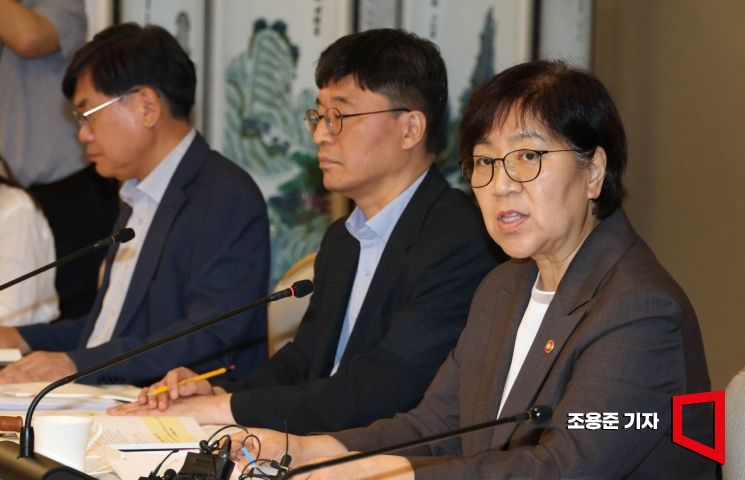 Jeong Eunkyung, Minister of Health and Welfare, is attending and speaking at the Central Livelihood Security Committee held at the Government Seoul Office in Jongno, Seoul on the 31st. 2025.7.31 Photo by Jo Yongjun
On July 31, the Ministry of Health and Welfare held the 77th Central Living Security Committee (Jungsaengbowi) meeting at the Government Complex Seoul and deliberated and approved the 2026 standard median income, the selection criteria for recipients of Basic Livelihood Security benefits, and the minimum guarantee level for each benefit. As a result of the decision, next year’s standard median income for a four-person household will be 6,494,738 won, up 6.51% from this year’s 6,097,773 won.
The growth rate of the standard median income for four-person households was 5.02% in 2022, 5.47% in 2023, 6.09% in 2024, and 6.42% in 2025, marking a record high for five consecutive years.
For one-person households, which account for 74% of Basic Livelihood Security recipient households (and 80% of those receiving livelihood benefits), next year’s standard median income will increase by 7.20%, a higher rate than for four-person households, rising from this year’s 2,392,013 won to 2,564,238 won next year.
The standard median income refers to the income of the household in the middle when all households are lined up by income. It serves as the criterion for determining eligibility and support levels for welfare benefits. The standard median income is, in principle, calculated by multiplying the previous year’s standard median income by the basic growth rate, which is the average growth rate of the median income from the Household Finance and Welfare Survey over the past three years, and by an additional growth rate (temporarily applied until 2026). The basic growth rate can be adjusted by Jungsaengbowi, taking into account economic conditions and other factors.
Currently, the standard median income is used as the selection criterion for 80 welfare programs across 14 government ministries, including the Basic Livelihood Security System, National Scholarships, and the supply of Happy Housing.
For each type of Basic Livelihood Security benefit, the livelihood benefit (for those with incomes at or below 32% of the standard median income) will increase from 1,951,287 won this year to 2,078,316 won next year for a four-person household. For a one-person household, it will rise from 765,444 won this year to 820,556 won next year. Jungsaengbowi also decided to expand the scope of youth labor and business income deductions to help young people become self-reliant. Currently, for general recipients, 30% of labor and business income is deducted, and for those aged 29 or younger, an additional deduction of "400,000 won + 30%" is applied. Starting next year, the additional deduction will be extended to those aged up to 34, as defined by the Framework Act on Youth, and the additional deduction amount will increase from 400,000 won to 600,000 won.
Jungsaengbowi also decided to ease the automobile asset criteria. Currently, automobile assets are generally subject to a 100% income conversion rate, but in exceptional cases, the general property conversion rate (4.17%) is applied, so only part of the vehicle’s value is counted as income. From next year, the criteria for applying the general property conversion rate will be relaxed for vans, trucks, and vehicles owned by multi-child households. The general property conversion rate, which currently applies only to vans and trucks under 1,000cc and valued at less than 2 million won, will be expanded next year to include small vans and trucks valued at less than 5 million won. For multi-child households, the criterion for applying the general property conversion rate will be relaxed from "three or more children" to "two or more children." The Ministry of Health and Welfare expects that, with the increase in the 2026 standard median income and these policy improvements, about 40,000 people will newly qualify for livelihood benefits.
The medical benefit program (for those with incomes at or below 40% of the standard median income), which was scheduled to switch to a "proportional payment system," will remain a "fixed payment system" until next year. The medical benefit program is a system in which the government supports medical expenses for low-income citizens who are unable to support themselves or are in financial difficulty. In July last year, the Ministry of Health and Welfare decided through Jungsaengbowi to change the copayment system for medical benefits from a fixed payment to a proportional payment system, and in early June this year, it announced a draft amendment to the Medical Care Assistance Act reflecting this change.
However, due to strong opposition from civil society organizations to the proportional payment reform, the government recently decided to halt the process. As a result, next year, medical benefit recipients will continue to pay fixed copayments of 1,000 won at clinics for outpatient care, 1,500 won at hospitals and general hospitals, 2,000 won at advanced general hospitals, and 500 won at pharmacies. However, for outpatient visits exceeding 365 times per year, a 30% copayment rate will apply. In addition, the support allowance, which is considered as living expenses provided by the person responsible for supporting the recipient, will be relaxed to expand eligibility, and the copayment rate for long-acting injectable antipsychotic medications will be reduced from 5% to 2%. The housing benefit (for those with incomes at or below 48% of the standard median income), which provides rent, repair and maintenance costs, and other necessary items for housing stability, will increase the standard rent for rental households by 17,000 to 39,000 won (4.7% to 11.0%) depending on region and household size. The education benefit (for those with incomes at or below 50% of the standard median income) will increase the annual education activity support allowance by an average of 6% compared to this year, to 502,000 won for elementary school, 699,000 won for middle school, and 860,000 won for high school.
Jeong Eun-kyeong, Minister of Health and Welfare and chair of Jungsaengbowi, said, "At this committee meeting, we decided to not only increase next year’s standard median income but also actively pursue meaningful policy improvements and increases in benefit levels for each type of benefit."
© The Asia Business Daily(www.asiae.co.kr). All rights reserved.












