Glacier Expert Ayako Abe-Ouchi, University of Tokyo Professor
"Glaciers Near Russia Are Melting Faster"
Due to climate change, the melting of Arctic glaciers is opening up new Arctic shipping routes, and scientific projections suggest that routes near Russia are more promising than those near Canada. This indicates that the Arctic route, which passes from Asia through Russia to Europe, including via South Korea, has significant potential.
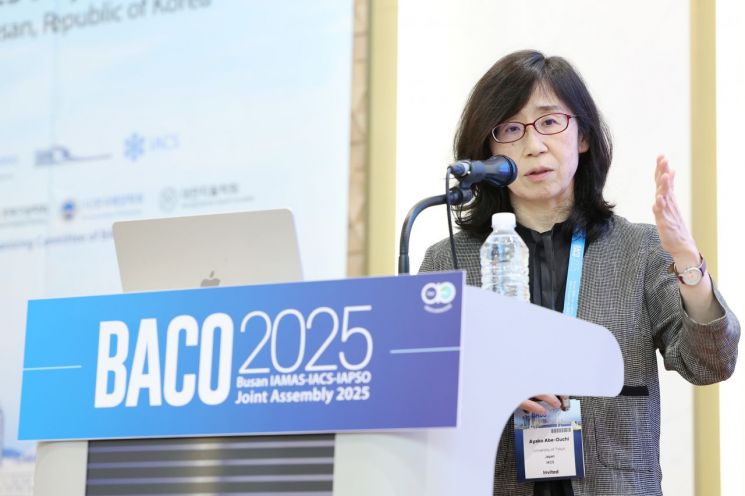 Ayako Abe Ouchi, a professor at the University of Tokyo in Japan, is delivering a keynote speech at the BACO2025 event held in Busan on the 25th of last month. Photo by BACO 2025 Secretariat.
At the 'BACO 2025' International Climate and Polar Conference held in Busan on July 25, Ayako Abe-Ouchi, a professor at the University of Tokyo, delivered a keynote speech stating, "Most climate models commonly predict a reduction in Arctic sea ice during the summer in the near future," and analyzed that "in particular, the Russian route has thinner sea ice than the Canadian route, making it relatively more navigable."
Professor Abe-Ouchi is affiliated with the Atmosphere and Ocean Research Institute at the University of Tokyo and is a world-renowned expert in high-latitude climate modeling, including glaciers and sea ice.
Professor Abe-Ouchi explained, "Due to the influence of winds and ocean currents, thinner sea ice is distributed on the Russian side compared to the Canadian side, and at present, the Russian route is practically more accessible than the Canadian route."
Regarding the timing and sustainability of the Arctic shipping route’s opening, she said, "It is still difficult to pinpoint the exact timing because predictions vary depending on the model." She added, "Scientists are continuing efforts to improve the reliability of these projections."
Professor Abe-Ouchi’s outlook can be interpreted as suggesting that the Northeast Passage (NSR) among Arctic routes has a more realistic potential for navigation than the Northwest Passage (NWP), which starts from the United States or Canada and passes through the Canadian Arctic Archipelago.
The Arctic Ocean route is a much shorter path from Asia to some regions of Europe compared to other options. For example, the route from Busan Port to Rotterdam, a key European port in the Netherlands, is about 22,000 kilometers via the Suez Canal and takes approximately 40 days, but through the Arctic route, it is only 15,000 kilometers and can be completed in 30 days.
The Arctic route, while limited to summer due to the effects of climate change, is still considered effective. This is because the summer, when sea ice coverage is at its lowest, coincides with the period before the year-end shopping season, when the largest volumes of cargo flow from Asia to Europe and North America. Even if the route is operated only during peak season, it can still yield significant benefits.
This year, as of March, Arctic sea ice reached its lowest winter extent on record. The US National Snow and Ice Data Center (NSIDC) announced that the size of Arctic sea ice in the winter of 2025 was the smallest since satellite observations began. Professor Abe-Ouchi explained, "Arctic sea ice increases in winter and melts in summer, but because this winter had the lowest extent, the rate of melting in spring and summer could accelerate even further."
Professor Abe-Ouchi said that it is not easy to predict exactly when the Arctic route will become usable. However, she noted, "Sea ice responds most sensitively to summer temperatures, and high-latitude regions are experiencing greater temperature increases than the global average," adding, "The Arctic is a sensitive indicator of climate change and could serve as a major variable in the future of maritime routes."
Lee Wonsang, a researcher at the Korea Polar Research Institute, stated, "Due to the intensification of climate change, extreme weather events such as heatwaves and heavy rainfall are occurring more frequently, which in turn increases uncertainty regarding the stability of sea ice and navigation in high-latitude waters, including the Arctic route." He predicted, "The multidisciplinary climate change research discussed at BACO 2025 points toward expanding international cooperation, including AI-based monitoring and prediction technologies and the establishment of polar digital infrastructure, which could not only facilitate the development of the Arctic route but also create opportunities for the digital marine industry and sustainable growth."
© The Asia Business Daily(www.asiae.co.kr). All rights reserved.

















