Trump: "Complete Agreement with South Korea... 15% Tariff"
15% Tariff, Same as Japan and the EU, but Korea-US FTA Effectively Nullified
South Korea Pledges $450 Billion in Investments and Purchases in the US
South Korea and the United States have reached a dramatic agreement on tariff negotiations. South Korea has pledged a total of $450 billion (approximately 625 trillion won) in investments and energy purchases from the United States, while the United States has agreed to lower mutual tariffs and automobile tariffs from 25% to 15%. This trade agreement, reached just two days before the expiration of the mutual tariff suspension on August 1, means that South Korea will now be subject to the same tariff rates as Japan and the European Union (EU), which is considered a positive outcome. However, there is an assessment that the Korea-US Free Trade Agreement (FTA), which had served as the basis for mutual tariff-free exports, has been effectively abolished.
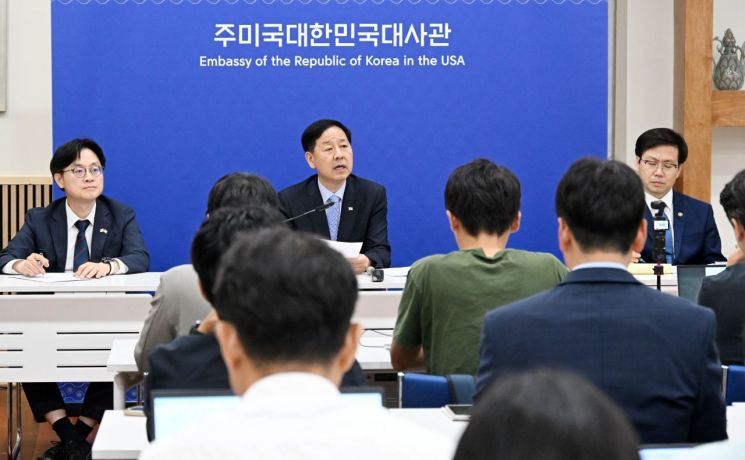
On July 30 (local time), US President Donald Trump, after meeting with the South Korean trade negotiation delegation including Deputy Prime Minister and Minister of Economy and Finance Koo Yooncheol, announced on his social networking service (SNS) Truth Social, which he created, "I am pleased that the United States has concluded a full and comprehensive trade agreement with South Korea."
President Trump stated, "We have agreed to impose a 15% tariff on South Korea, and no tariffs will be imposed on the United States," adding, "South Korea has agreed to fully open its market to trade with the United States and to accept US-made products such as automobiles, trucks, and agricultural goods." However, under the Korea-US FTA, South Korea has already applied a 0% tariff to most US imports.
This 15% tariff rate is a significant reduction from the 25% originally announced by the United States. It is the effective minimum tariff level set by President Trump, and it matches the terms agreed upon by Japan and the EU with the United States. For the South Korean government, which has negotiated with 15% as its bottom line, this means that Korean companies have avoided the worst-case scenario of being treated less favorably than competitors in the US market. However, automobiles, which benefited from a 0% tariff under the Korea-US FTA, will now face a 15% tariff, the same as Japan and the EU. The 2.5 percentage point tariff advantage that South Korea had over these two economic blocs, which previously faced a 2.5% tariff, has now disappeared.
In return, South Korea has pledged a total of $450 billion in investments and energy purchases in the United States.
President Trump explained, "Under this agreement, South Korea will provide $350 billion to investment destinations in the United States that are owned and controlled by the US and personally selected by me as President." He continued, "South Korea will also purchase $100 billion worth of liquefied natural gas (LNG) and other energy products," adding, "We have also agreed on additional large-scale investments for South Korea's own investment purposes."
This agreement is similar in structure to the agreements reached by Japan and the EU, which lowered tariffs in exchange for large-scale investments and market opening. Previously, Japan pledged $550 billion in investments and the EU pledged $600 billion in investments in the United States, with both lowering their tariffs to 15% (previously Japan 25%, EU 30%). In effect, they have purchased access to the world's largest market for several hundred trillion won.
However, there is an assessment that South Korea has made a relatively greater concession, as it is shouldering the largest investment burden relative to its economic size. The $350 billion investment pledged by South Korea is about 20% of its gross domestic product (GDP), which is much higher than Japan (13%) and the EU (3%). Some point out that, because the agreement was reached relatively late and with the deadline for the end of the tariff suspension looming on the first of next month, South Korea paid a "lateness penalty." The South Korean negotiation team initially proposed an investment plan of $100 billion plus alpha, but ultimately agreed to a much higher amount, close to the $400 billion demanded by the United States, in order to reach an agreement.
President Trump added, "I thank the (South Korean) trade delegation present today," and said, "It was an honor to meet with them and discuss the great success achieved by South Korea."
© The Asia Business Daily(www.asiae.co.kr). All rights reserved.

![Clutching a Stolen Dior Bag, Saying "I Hate Being Poor but Real"... The Grotesque Con of a "Human Knockoff" [Slate]](https://cwcontent.asiae.co.kr/asiaresize/183/2026021902243444107_1771435474.jpg)















