Trump: "South Korea Will Be 'Completely Open' to Trade With the United States"
Differences Remain Over Agricultural Products and Korea-US Investment Funds
The trade negotiations between South Korea and the United States reached a dramatic agreement just one day before the deadline. However, there are still differences in temperature between the two countries regarding the specific scope and details of the agreement, which is fueling controversy. In particular, there are conflicting opinions on the opening of the agricultural and livestock markets and the distribution of profits from Korea-US investment funds. Attention is focused on how both sides will narrow their differences before the final agreement is announced.
On July 30 (local time), President Trump announced on his social media platform, Truth Social, that the reciprocal tariff rate for South Korea would be reduced from the original 25% to 15%. He stated, "South Korea will be completely OPEN to trade with the United States and has agreed to accept American products, including automobiles, trucks, and agricultural goods."
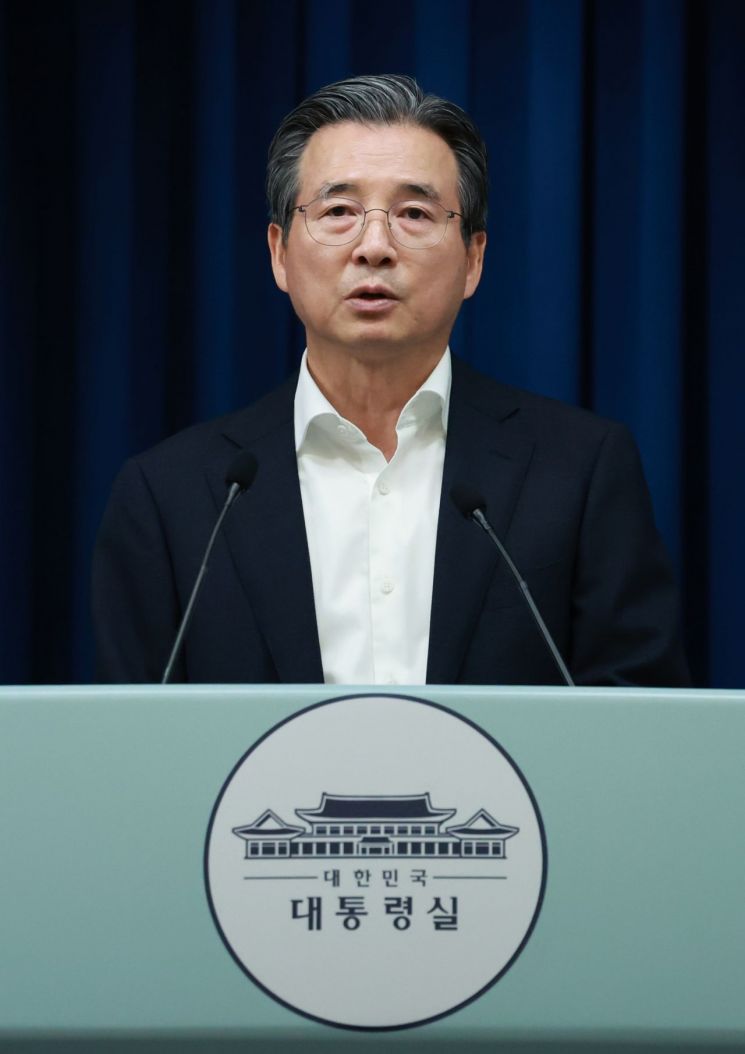
In response, Kim Yongbeom, Chief Presidential Secretary for Policy, drew a line regarding President Trump's claim of "completely open." During a briefing on the conclusion of the Korea-US tariff negotiations, Kim stated, "It is true that there was a strong demand from the US to open the agricultural and livestock markets during the negotiations. However, considering food security and sensitivities, we agreed not to further open rice and beef markets."
Kim added, "We understand that this is the expression of a political leader. What matters is the conversation between the ministers responsible for the negotiations. The US Trade Representative (USTR), which is in charge of rice and beef, persistently talks about complete opening, but in terms of trade, 99.7% is already open." He also noted, "It is difficult to specifically mention other agricultural products."
Kim's reference to "the expression of a political leader" is interpreted as suggesting that President Trump may be exaggerating the outcome of the negotiations. In previous tariff negotiations between the Trump administration and the European Union and Japan, there were also observations of discrepancies in explanations and feasibility of implementation, raising concerns that the details announced by the US may have been exaggerated compared to the actual agreements.
Kim also addressed the tariffs on South Korea's main export item to the US, automobiles, saying, "The rate was reduced to 15%. Our government insisted on 12.5% until the end. Both the EU and Japan have 15%, so this is a disappointing point."
There are also differences regarding the distribution of profits from Korea-US investment funds. On the US Department of Commerce's announcement that "the US will take 90% of the profits from Korea-US investment funds," Kim stated, "The US side has not provided a clear explanation of what this exactly means. Our side understands that these profits will be reinvested or retained within the US." He continued, "Since the structure of the fund, the investors, and the profit distribution method have not yet been specified, it is difficult to definitively interpret that the US will take 90%. In any normal, civilized country, a structure in which one side unilaterally takes 90% of the profits is hardly reasonable."
Previously, President Trump had warned that if the tariff negotiations failed, a 25% reciprocal tariff would be imposed starting August 1. On July 25, he specifically mentioned Australia's approval of US beef imports, stating, "We'll see about countries that refuse America's excellent beef," thereby pressuring for the opening of sensitive agricultural and livestock markets. As agricultural and livestock products were reportedly included in the negotiations between South Korea and the US, criticism spread among the agricultural industry and political circles.
Carsten Niket, Deputy Director of Research at the US think tank Teneo, commented on the trade agreements between the US and various countries, saying, "The focus has now shifted to interpretation and implementation risks," and predicted, "There is a high possibility that uncertainty will persist."
© The Asia Business Daily(www.asiae.co.kr). All rights reserved.
![Clutching a Stolen Dior Bag, Saying "I Hate Being Poor but Real"... The Grotesque Con of a "Human Knockoff" [Slate]](https://cwcontent.asiae.co.kr/asiaresize/183/2026021902243444107_1771435474.jpg)
















