Composed of 100 Key Policy Tasks in 10 Priority Areas
Including Advancement of the Innovation Ecosystem and Strengthening Economic Security
The Korea Federation of Mid-sized Enterprises announced on July 31 that it had delivered policy recommendations from the mid-sized business sector to the National Planning Committee. On July 30, Lee Hojun, Executive Vice Chairman of the Federation, met with Jin Sungjoon, Vice Chairman of the National Planning Committee, at the National Assembly and presented the "Policy Recommendations for Recovery and Growth for Mid-sized Enterprises," which consists of 100 key policy tasks in 10 priority areas that the government should pursue, including the advancement of the innovation ecosystem and the strengthening of economic security.
The Federation emphasized that in order for South Korea to achieve "genuine growth" rapidly, it is necessary to advance the corporate innovation ecosystem by establishing a foundation for activating startup mergers and acquisitions (M&A) and improving the corporate venture capital (CVC) system to stimulate venture investment. In particular, they stressed the urgent need to strengthen the foundation for nurturing mid-sized enterprises so that corporate innovation can be linked to continuous growth, and to restore a seamless corporate growth ladder from small businesses to mid-sized enterprises and then to large corporations.
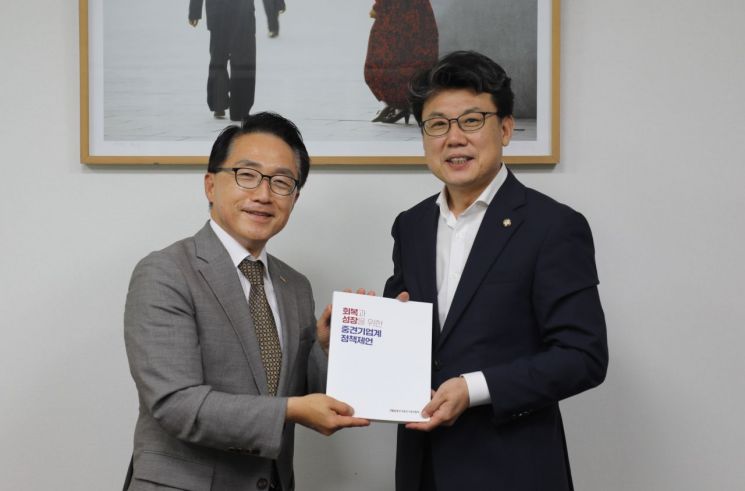 On the 30th, Hojoon Lee, Executive Vice President of the Korea Federation of Medium-sized Enterprises (left), met with Seongjun Jin, Vice Chairman of the National Assembly's National Policy Planning Committee, at the National Assembly to deliver 'Policy Proposals from the Medium-sized Enterprise Sector for Recovery and Growth.' Korea Federation of Medium-sized Enterprises
In addition, the Federation highlighted that to address trade and commerce uncertainties such as the spread of protectionism and continued supply chain instability, it is essential to strengthen existing trade networks centered on mid-sized enterprises, which account for 18.7% of exports in various sectors including materials, parts, and equipment. They also emphasized the need to pursue proactive economic security policies based on "practicality," such as diversifying export markets and export items.
The recommendations also included calls for bold measures to realize investment prospects for mid-sized enterprises, such as raising the integrated investment tax credit rate and extending the sunset period for temporary investment tax credits, so that positive signals such as stock market revitalization and domestic demand recovery since the launch of the government can be felt in the field by mid-sized businesses still facing difficulties.
To enhance the competitiveness of future advanced strategic industries led by AI, which the government is promoting, the Federation suggested that a wide range of policy support measures should be explored, including the innovation of AI regulations through a negative-list approach, expansion of tax and financial support, introduction of new tax incentives to promote digital transformation, and diversification of core mineral supply chains.
Jin Sungjoon, Vice Chairman of the National Planning Committee, stated, "Mid-sized enterprises are a core group that has driven our economy's growth for a long time through constant challenge, innovation, and global competitiveness." He added, "We will maximize the rationality of national planning by actively gathering concrete opinions from the field through close communication, so that the changes needed to open a new era will strengthen the global competitiveness of companies, including mid-sized enterprises, and lead to the harmonious development of all economic actors."
Lee Hojun, Executive Vice Chairman of the Federation, said, "In order to secure momentum for sustainable growth by effectively responding to rapid changes in internal and external environments, it is essential to have a clear understanding of the economic and industrial realities, balanced solutions, and decisive policy implementation." He continued, "To lay the foundation for South Korea's 'genuine growth' by overcoming the economic crisis, I hope that the government will do its utmost to revive the vitality of enterprises, which are both the foundation of people's livelihoods and the core of national competitiveness, by actively reflecting the real needs of the field."
© The Asia Business Daily(www.asiae.co.kr). All rights reserved.