50% Rule Suggested for E-Commerce and Taxi Sectors
PG Companies Face 100% Rule, Virtually Finalized
Industry Voices Concerns Over Fairness and Hasty Legislation
As the National Assembly is set to pass an amendment to the Electronic Financial Transactions Act requiring payment gateway (PG) companies to entrust 100% of their settlement funds to external institutions, the PG industry has raised concerns over fairness among different sectors. Last year, the large-scale unpaid settlement incident involving Tmon, Wemakeprice (Tmap), and Ballan provided the impetus for the legislative revision. However, e-commerce and taxi operators, including those involved in the incident, are only required to entrust 50% of their settlement funds to external institutions, while PG companies alone are being legally mandated to manage 100% of their funds externally. This has led to criticism that the so-called "Tmap exoneration law" was hastily processed.

According to political and financial industry sources on July 31, the National Assembly’s Political Affairs Committee passed the amendment to the Electronic Financial Transactions Act in a plenary session the previous day, with bipartisan agreement. The bill is expected to pass the National Assembly without difficulty. Remaining issues include whether to apply the principle of a single offense for delayed settlements (up to 10 years in prison and a fine of up to 100 million won), and whether to lower the administrative fine from 50 million won to 20 million won. However, the "100% rule" for settlement funds will be enforced as planned.
The PG industry has objected, arguing that it is unreasonable to enforce 100% external management only for PG companies, while maintaining the 50% rule for e-commerce and taxi sectors, which were involved in the incidents. Kang Minguk, a member of the People Power Party and opposition secretary of the Political Affairs Committee, introduced an amendment to the Large-Scale Distribution Business Act on October 28 of last year. This amendment would require e-commerce operators who manage customer sales proceeds to separately manage at least 50% of those proceeds in banks or through payment guarantee insurance, starting one year after the law’s enforcement. Although this amendment is still pending, the industry perceives that the committee effectively intends to regulate e-commerce with the "50% rule."
Furthermore, the committee has indicated that other industries with payment structures similar to PG companies, such as the taxi sector, will also be subject to the "50% rule." Taxi operators, like PG companies, claim the relevant amount from individual taxi drivers after customers make payments, before the funds are transferred from the linked account to the card company. This is essentially the same role that PG companies play in online transactions.
During the first subcommittee review of the bill by the Political Affairs Committee on November 15 last year, Choi Byungkwon, then chief policy advisor of the Planning and Finance Committee, stated that taxi operators (regulated by the Passenger Transport Service Act) should be considered settlement agents, just like e-commerce operators (regulated by the Large-Scale Distribution Business Act), and that "this law (PG regulations) should not be applied to them."
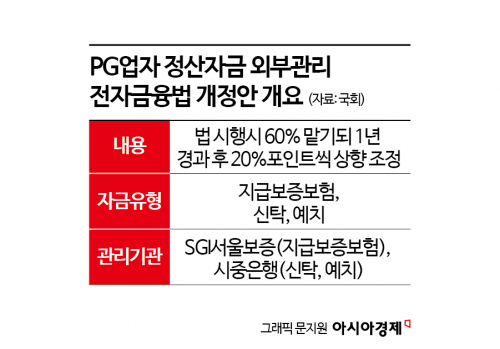
The PG industry had been preparing for the "60% rule" proposed by the Financial Supervisory Service at the end of last month, as the amendment introduced by Representative Kang in October last year had been pending for a long time. However, they were suddenly faced with the National Assembly’s adoption of the "100% rule." The industry now expresses dismay that the National Assembly is maintaining the principle of applying only "50%" to other sectors.
The industry has also criticized the legislative process itself. While they acknowledge the need for a prompt response since more than a year has passed since the Tmap incident, they argue that the process was too hasty, as it did not even go through the usual steps such as the preparation of a review report by the chief policy advisor.
An industry representative stated, "It is difficult to accept that only 50% is applied to e-commerce, which caused the incident, and to the transportation sector (taxis), where there is no guarantee that financial accidents like the Tmap incident will not occur, while 100% is applied to PG companies." The representative added, "There are complaints that the 'Tmap exoneration law' was processed in a slipshod manner."
© The Asia Business Daily(www.asiae.co.kr). All rights reserved.


















