Tsunami Warnings Expanded from Hokkaido to Kyushu
Tsunami Alerts Issued for Guam and Hawaii, with Possible Waves of 1 to 3 Meters
Tsunami of Less Than 0.3 Meters Predicted for South and North Korean Coasts
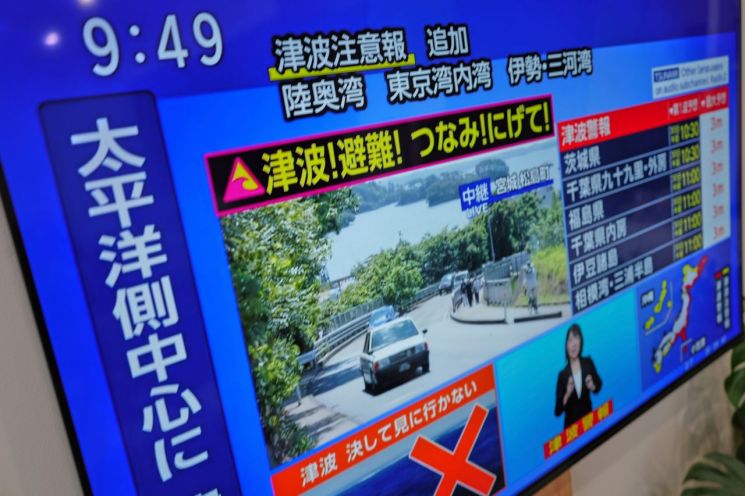
On July 30, a tsunami warning was issued for Japan's Pacific coastal regions, advising residents to prepare for waves up to 3 meters high following a massive earthquake that struck the Kamchatka Peninsula, which borders the Sea of Okhotsk in eastern Russia. The earthquake is expected to generate a tsunami of less than 0.3 meters along the Korean Peninsula's coast.
According to the European-Mediterranean Seismological Centre (EMSC), an earthquake with a magnitude of 8.0 occurred at approximately 9:24 a.m. local time in the sea east of the Kamchatka Peninsula. The Kamchatka Peninsula, which is part of the seismically active "Ring of Fire" in the Pacific Rim, frequently experiences both major and minor earthquakes.
The epicenter was located 136 kilometers southeast of Petropavlovsk-Kamchatsky, Russia, a city with a population of 187,000. The earthquake's focal depth was measured at 19 kilometers. Subsequently, an even stronger earthquake with a magnitude of 8.8 struck off the eastern coast of the Kamchatka Peninsula. The EMSC initially reported this quake as magnitude 8.7 but later revised it upward.
According to Reuters, Vladimir Solodov, Governor of Kamchatka, stated in a video posted on Telegram, "Today's earthquake was severe and the strongest in decades."
The United States Pacific Tsunami Warning Center (PTWC) issued a warning after the first earthquake, stating that a dangerous tsunami could reach Russia and Japan within three hours. The PTWC also predicted a tsunami of less than 0.3 meters could reach the Korean Peninsula. However, it was observed that, due to the time required for the high waves to reach the Korean Peninsula, significant damage was unlikely.
The PTWC also issued warnings for some coastal areas of Guam and Hawaii, stating that tsunamis between 1 and 3 meters in height could strike. It also warned that some coastal areas in the Philippines, the Marshall Islands, Palau, and the Chuuk and Kosrae islands of the Federated States of Micronesia could experience tsunamis between 0.3 and 1 meter high.
Japan, which experienced a major earthquake in 2011, issued a tsunami advisory for the entire Pacific coast of Hokkaido and is closely monitoring the situation. The Japan Meteorological Agency announced at approximately 8:25 a.m. that an earthquake with a magnitude of 8.7 had occurred off the eastern coast of Russia's Kamchatka Peninsula, and issued a tsunami advisory for the Pacific coast from northern Hokkaido to Kyushu. Later, at around 9:40 a.m., the agency raised the expected tsunami height for Japan to 3 meters.
Accordingly, in many regions, the advisory was upgraded to a "tsunami warning," which is a higher alert level. As of 9:40 a.m., tsunami warnings were in effect for 14 coastal areas. Nuclear power plants also entered emergency response mode. The Higashidori Nuclear Power Plant in Higashidori Village, Aomori Prefecture, which is currently shut down, suspended port area operations in preparation for the tsunami and is monitoring the situation.
Japanese authorities called on coastal residents to ensure their safety. NHK reported that the Japanese government had issued an emergency evacuation order, advising residents in areas under tsunami advisories to stay away from the coast and river mouths. Russian authorities also recommended that coastal residents evacuate.
With the occurrence of this powerful earthquake, speculation about a "July Great Earthquake" has resurfaced. The "July Great Earthquake" rumor, which spread through comic book predictions and YouTube-based urban legends, fueled social anxiety. Even after July 5 passed without incident, concerns persisted that a major earthquake could still occur within the month.
© The Asia Business Daily(www.asiae.co.kr). All rights reserved.
![User Who Sold Erroneously Deposited Bitcoins to Repay Debt and Fund Entertainment... What Did the Supreme Court Decide in 2021? [Legal Issue Check]](https://cwcontent.asiae.co.kr/asiaresize/183/2026020910431234020_1770601391.png)