Despite Party-Government Consultations, Opinions Remain Divided
Fierce Debate Over "Tax Cuts for the Wealthy" and Dividend Effect
The Democratic Party of Korea has held policy consultations with the government regarding the introduction of a separate taxation system for dividend income, but internal opinions within the party remain divided. Intense debate within the party is expected to be unavoidable until a final internal consensus is reached.
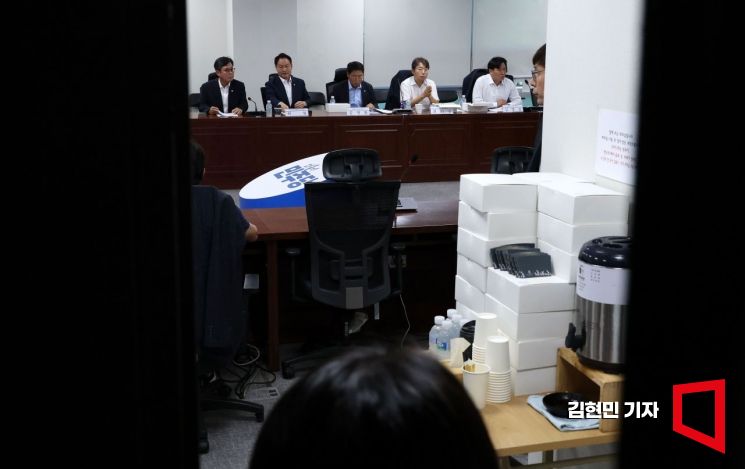 On the 29th, a closed-door meeting between the ruling party and the government regarding the tax reform plan is being held at the National Assembly Members' Office Building. 2025.7.29 Photo by Kim Hyunmin
On July 30 at the National Assembly in Yeouido, Moon Jinseok, Senior Deputy Floor Leader of the Democratic Party, was asked how the party would reconcile internal differences regarding the separate taxation of dividend income. He responded, "This will be addressed by the Special Committee on Tax System Reform," and added, "While discussions will also take place in the standing committee subcommittee, the party will present its views, and the special committee will play a role in reconciling internal differences." The special committee will be chaired by Kim Youngjin, a member of the Planning and Finance Committee, with Jung Taeho, the ruling party secretary of the committee, serving as secretary.
The Democratic Party and the Ministry of Economy and Finance held a closed-door party-government consultative meeting the previous day to discuss next year's tax reform plan. However, it was reported that many lawmakers expressed opposition to the government's proposal for separate taxation of dividend income. The government proposal is based on the bill submitted by Democratic Party lawmaker Lee Soyoung, with adjustments made to tax rates and taxation conditions. Lee's bill stipulates that dividend income received from listed companies with a dividend payout ratio of 35% or higher would be taxed separately from comprehensive income, with the following rates: 14.0% for amounts up to 20 million won, 20% for amounts between 20 million and 300 million won, and 25% for amounts exceeding 300 million won (as outlined in the proposed amendment to the Income Tax Act).
According to a lawmaker who attended the meeting, questions and criticisms were raised regarding whether this constituted a "tax cut for the wealthy," how much the increase in dividends would be compared to the decrease in tax revenue, and how effective the proposal would be in encouraging companies to pay dividends. The lawmaker said, "Lawmakers who supported the proposal did not express many opinions, perhaps because their support was implicit," and added, "It felt like there were slightly more lawmakers opposed than in favor."
Some lawmakers proposed alternative ways to increase corporate dividends, different from Lee's bill. Ahn Dogeol, a member of the Planning and Finance Committee, proposed an amendment to the Restriction of Special Taxation Act. Under this proposal, dividend income received from listed companies with a dividend payout ratio of 40% or higher, or from those with a dividend payout ratio of at least 20% and an average increase rate of at least 5% in total dividends over the past three years, would be subject to separate taxation. In such cases, the following rates would apply: 9% for amounts up to 20 million won, 20% for amounts between 20 million and 300 million won, and 30% for amounts exceeding 300 million won. Ahn explained, "Listed companies with inherently high dividend payout ratios and not much R&D investment would continue to benefit from separate taxation, while for manufacturing companies with high R&D and facility investment and consequently lower dividends, incentives would be given if they tried to increase dividends as much as possible within their circumstances." He added, "The main point is to offer benefits to both high-dividend and dividend-increasing listed companies."
As it was anticipated that the government proposal would set the highest tax rate for separate taxation of dividend income at 10 percentage points higher than the rate set by Lee's bill, Lee also raised concerns. The previous day, Lee posted on social media under the title "The reason I set the highest tax rate for dividend income at 27.5% (including 2.5% local tax)," stating, "I fundamentally believe that the tax rate for dividend income should be aligned with the capital gains tax on stocks (maximum 27.5%)." Lee added, "The Korea Institute of Public Finance also views, from a tax theory perspective, that dividend income and 'capital gains from stocks' have the same income source." Lee further commented, "If dividend income is disadvantaged compared to real estate rental income, it will be difficult to trigger a money move."
A member of the Planning and Finance Committee stated, "If the government proposal is finalized, there may be further discussions in the standing committee subcommittee," and added, "There is also a possibility that the government proposal may be revised through these discussions."
© The Asia Business Daily(www.asiae.co.kr). All rights reserved.

















