A next-generation wearable platform capable of monitoring health status 24 hours a day has been developed by optimizing power using light as an energy source.
KAIST announced on the 30th that the research team led by Professor Kwon Kyungha from the Department of Electrical and Electronic Engineering, together with Dr. Park Chanho's team from Northwestern University in the United States, has developed an "adaptive wireless wearable platform" that reduces battery power consumption by utilizing ambient light.
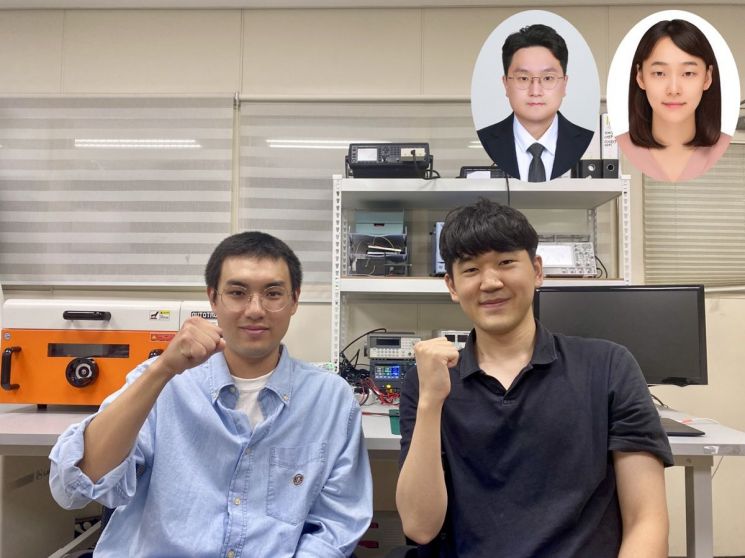 (From left) Youngmin Sim integrated master's and doctoral program, Doyun Park doctoral program, Chanho Park postdoctoral researcher, Kyungha Kwon professor. Provided by KAIST
The joint research team first developed a platform that uses ambient natural light as an energy source to address the battery issues of medical wearable devices.
This platform integrates three complementary light energy technologies: the photometric method, high-efficiency multi-junction photovoltaic cells (photovoltaic method), and photoluminescent technology (photoluminescent method).
The photometric method allows the brightness of LEDs to be adaptively adjusted according to the intensity of surrounding light sources. By combining ambient natural light and LED light to maintain a constant level of illumination, the system automatically dims the LEDs when natural light is strong and brightens them when natural light is weak.
While conventional sensors had to keep LEDs on at a constant level regardless of the environment, this technology offers the advantage of optimizing LED power in real time according to environmental conditions. Experimental results showed that using this function reduced power consumption by approximately 86.22% in specific lighting environments.
The high-efficiency multi-junction photovoltaic cell technology converts light from all indoor and outdoor environments into electricity. In particular, the adaptive power management system automatically switches between 11 different power configurations depending on the surrounding environment and battery status, achieving optimal energy efficiency.
The photoluminescent technology mixes strontium aluminate microparticles into the sensor's silicon encapsulation structure, allowing it to absorb and store ambient light during the day and gradually release it in dark environments. As a result, after 10 minutes of exposure to 500W/m² of sunlight, continuous measurement is possible for 2.5 minutes even in complete darkness.
Strontium aluminate microparticles are phosphorescent materials commonly used in glow-in-the-dark paints and safety signs. After absorbing light, they emit light for a long time in the dark as a persistent luminescent material.
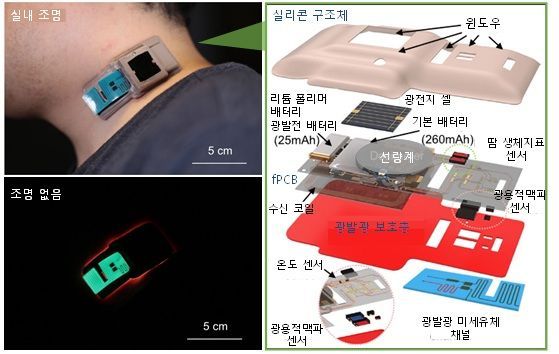 Multifunctional Device Configuration Method Applying Energy Harvesting and Power Management Platform. Provided by KAIST
These three technologies operate complementarily. In bright environments, the first and second methods are primarily used, while in dark environments, the third method provides additional support, enabling the device to operate continuously for 24 hours.
The joint research team verified the practicality of this platform by applying it to various medical sensors. Additionally, by introducing data processing technology within the sensor, they significantly reduced power consumption associated with wireless communication. Unlike previous methods that required transmitting all raw data externally, the new approach calculates only the necessary results within the sensor and transmits them, reducing data transmission from 400B/s to 4B/s?a 100-fold decrease.
When the platform developed by the joint research team was tested on healthy adult subjects under various conditions?including bright indoor lighting, dim lighting, infrared lighting, and complete darkness?it demonstrated measurement accuracy equivalent to that of commercial medical devices in all scenarios. Experiments using a mouse model in hypoxic conditions also confirmed accurate blood oxygen saturation measurements.
Professor Kwon Kyungha stated, "The technology developed by the joint research team enables continuous 24-hour health monitoring and could contribute to shifting the medical paradigm from treatment-centered to prevention-centered care. We also expect it to reduce medical costs through early diagnosis and to secure technological competitiveness in the next-generation wearable healthcare market."
Meanwhile, Park Doyoon, a doctoral student at the Graduate School of Artificial Intelligence Semiconductors, participated as co?first author in this research. The results (paper) were published on the 1st in the international journal Nature Communications.
© The Asia Business Daily(www.asiae.co.kr). All rights reserved.
![Clutching a Stolen Dior Bag, Saying "I Hate Being Poor but Real"... The Grotesque Con of a "Human Knockoff" [Slate]](https://cwcontent.asiae.co.kr/asiaresize/183/2026021902243444107_1771435474.jpg)












