Minister Kim Holds Briefing on the Yellow Envelope Act
"Time for Dialogue, Coordination, and Compromise Before Enforcement"
Expert Discussions and Collection of Field Opinions Underway
Urges Business Community to "Seize This as an Opportunity for Innovation"
Unification of Bargaining Channels Is the Most Urgent Task
"We Will Prepare While Keeping All Options Open"
As the ruling party accelerates the passage of the Yellow Envelope Act (amendments to Articles 2 and 3 of the Trade Union and Labor Relations Adjustment Act) in the National Assembly, the government has announced its intention to prepare concrete guidelines to ensure the bill is effectively implemented in the field.
On the afternoon of July 29, at a briefing on the Yellow Envelope Act held at the Government Complex Seoul, Minister of Employment and Labor Kim Younghoon stated, "The government will faithfully fulfill its responsibilities after the legislation to ensure that the application of the law in the field does not create uncertainty and does not undermine the predictability of the bargaining order between labor and management." At the event, Kim described the Yellow Envelope Act as a "dialogue promotion law," a "law for coexistence," and a "genuine growth law," explaining the necessity of introducing the bill and the government's plans for preparation.
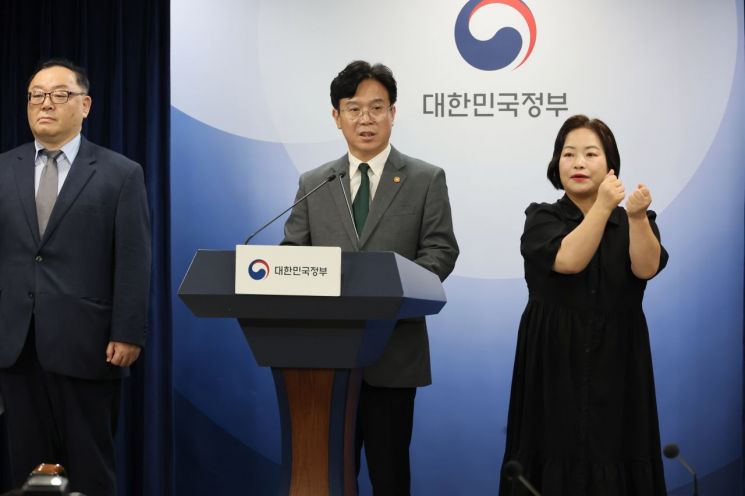 Kim Younghun, Minister of Employment and Labor, is speaking at a briefing on the Yellow Envelope Act held at the Government Seoul Office in Jongno-gu, Seoul on the 29th. Photo by Yonhap News
Minister Kim: "The Yellow Envelope Act, the cornerstone of sustainable genuine growth"
Minister Kim stated, "This amendment to the Trade Union Act began with the urgent demands of the industrial sector, and after the first bill was introduced in 2020, it has been achieved through extensive discussion and deliberation until its passage." He continued, "We will do our utmost to prepare so that the legislative intent of the National Assembly is fully realized, building a 'labor-management relationship based on participation and cooperation' and laying the cornerstone for 'sustainable genuine growth.'"
Minister Kim explained, "The core of this amendment is the alignment of authority and responsibility," adding, "It means that employers who have real authority in the field must also bear corresponding responsibility." He further stated, "By opening the door to legitimate discussions on decisions that have a significant impact on working conditions, we expect that autonomous dialogue between labor and management will be further promoted."
He also said, "While respecting the principle of labor-management autonomy, the government will support institutional trust and predictability as a guardian so that labor-management relations are not left in uncertainty." He continued, "Based on the factors considered by the Labor Relations Commission and the courts when recognizing the status of the principal employer, we will thoroughly prepare judgment criteria and bargaining procedures by considering specific cases in the field."
He stated, "During the preparation period, we will fully listen to the opinions of labor, management, and experts," and added, "Through expert discussions and collecting field opinions, we will prepare manuals and guidelines and promote necessary measures to support implementation in the field." He also explained, "The period between the legislation and its enforcement is a time for dialogue, coordination, and compromise."
Addressing the business community, which opposes the introduction of the bill, he urged, "We hope this amendment will serve as an opportunity for structural change and innovation." He also requested, "Please fulfill your responsibilities so this can be a turning point for establishing a new order in labor-management relations." To the labor community, he said, "As much of the legal uncertainty has been resolved, please establish a culture of dialogue and compromise based on autonomy and responsibility in line with the purpose of the law."
Earlier, the National Assembly's Environment and Labor Committee held a plenary meeting the previous day and passed the Yellow Envelope Act under the initiative of the ruling party. The Democratic Party of Korea has also expressed its intention to handle the Yellow Envelope Act at the July extraordinary session of the National Assembly (scheduled for the plenary session on August 4).
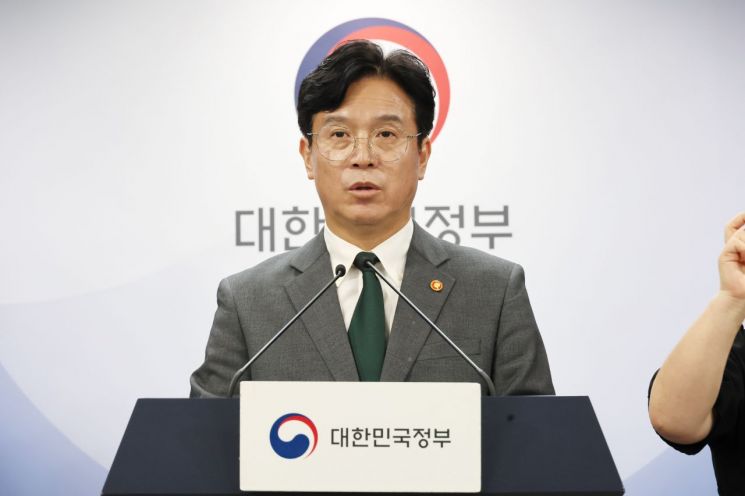 Kim Younghun, Minister of Employment and Labor, is speaking at a briefing related to the Yellow Envelope Act held at the Government Seoul Office in Jongno-gu, Seoul on the 29th. Photo by Yonhap News
"Unification of bargaining channels, the government must prepare quickly"
In a Q&A session following the briefing, Minister Kim responded to criticism that the passage of the Yellow Envelope Act is being rushed, saying, "The relevant law has passed the National Assembly twice and was rejected both times for unjustifiable reasons," and "I understand that the National Assembly is enacting the law promptly in line with the launch of the new government."
Regarding criticism from the labor community that the bill's content is insufficient, he said, "Even with the amendment of the Yellow Envelope Act, I do not believe the disparities in the labor market will fundamentally change overnight," and explained, "What is important is that it is meaningful to take even one step toward resolving delayed justice, where reality and constitutional values have been misaligned."
On the demand to enhance the predictability of the law, he said, "I agree," and added, "How to concretize the abstract legal language of so-called 'substantial control' is a very important issue." However, he also stated, "Given the accumulated precedents and court rulings so far, there should be no major difficulties in ensuring the law takes root in the field," mentioning, "Rulings related to Hanwha Ocean and CJ are being handed down one after another."
Regarding the unification of bargaining channels, he emphasized, "During the six-month grace period before enforcement, this is the task our government must prepare for most quickly." He stated, "As minister, I will personally oversee the field, seek expert advice, and keep all options open to determine what procedures can be established." However, he also explained, "Even without these procedures, bargaining order is already being autonomously established in the field."
Regarding concerns raised by the European Chamber of Commerce in Korea (ECCK), he replied, "If possible, I would like to meet as soon as possible to hear what concerns they have." Responding to criticism that the business community's position was not reflected, he explained, "By excluding the rights dispute section, which the labor community criticized as a step back in the previous original version of the Yellow Envelope Act, the current bill specifically addresses the business community's demand to remove uncertainty."
On the task of establishing a foundation for social consensus, he stated, "We are exploring various ways to promote the participation of labor and management parties in diverse forms of social dialogue governance, including the Economic, Social and Labor Council," and announced, "We will implement this soon."
Minister Kim also stated, "If the Yellow Envelope Act is intended to promote bargaining between principal and subcontractors, the first agenda item should be workplace safety," and added, "As last week's court ruling also recognized that safety issues always involve substantial control, we expect the amendment to the Trade Union Act will play a positive role in preventing the outsourcing of risks."
© The Asia Business Daily(www.asiae.co.kr). All rights reserved.













