Baik Nakchung Publishes "The Time for Transformative Centrism Has Come"
From the Yoon Suk-yeol Administration in 2021 to the Election of Lee Jaemyung in 2025
Capturing a Period of Political Upheaval
The Rise of the Yoon Suk-yeol Administration as an "Irregular Situation"
The End of the '87 System... Advocating the Need for 'Transformative Centrism'
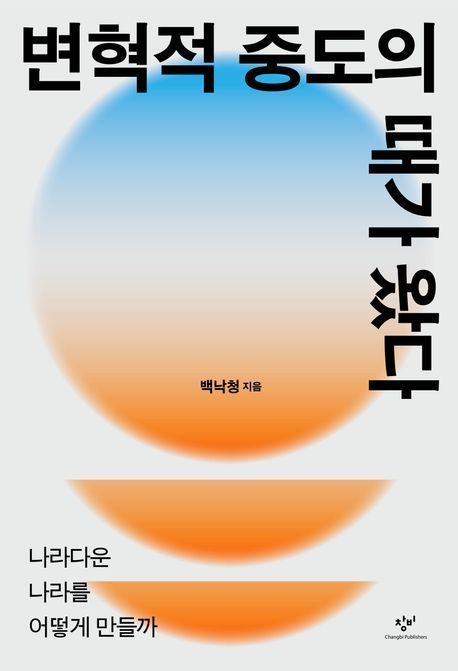
Baik Nakchung, Professor Emeritus at Seoul National University and author of the book "The Time for Transformative Centrism Has Come" (Changbi), emphasized the importance of 'transformative centrism' with these words. The concept of 'transformative centrism' coined by Professor Baik does not simply mean taking a neutral stance between the left and the right. Rather, it is closer to an attempt at systemic transformation that seeks to go beyond the political and social structures entrenched by the division system on the Korean Peninsula, while also fundamentally overturning the order of inequality and competition intensified by neoliberalism.
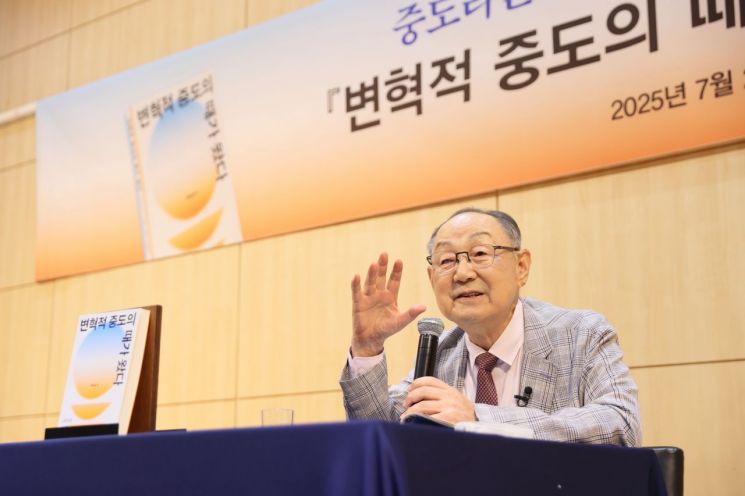 On the morning of the 29th, at the Changbi Publishing House building in Seogyo-dong, Seoul, Baek Nakcheong, professor emeritus at Seoul National University and author, is speaking at the book launch event for "The Time of Transformative Moderation in Books." Changbi
The book vividly captures the political upheaval from the establishment of the Yoon Suk-yeol administration in 2021 to the inauguration of the Lee Jaemyung administration in 2025. Defining the Yoon Suk-yeol administration as a kind of 'irregular situation,' the book presents 'transformative centrism' as the direction Korean democracy should pursue.
At a publication commemorative meeting held on July 29 at the Changbi Publishing headquarters in Seogyo-dong, Mapo-gu, Seoul, Professor Baik described 'transformative centrism' as "the creation of a new, sustainable structure of democracy that transcends existing ideological boundaries and overcomes confrontation and antagonism, based on a strategic alliance between progressives and conservatives."
This has many similarities with the centrist and pragmatic approach advocated by the Lee Jaemyung administration. Recently, Professor Baik, who attended a luncheon hosted by President Lee Jaemyung along with Father Ham Sewoong, said, "I did not ask the President whether the centrist party he is trying to establish is 'transformative centrism,' but the phrases he has repeatedly used?such as 'a world like a great transformation,' 'a grand society where everyone prospers together,' and 'eokgangbuyak' (restraining the strong and supporting the weak)?seem to contain such goals." He added, "Pragmatism is essential if we are to bring about transformation within the division system on the Korean Peninsula. If the President is considering transformative centrism, there is nothing more welcome." He pointed out that the division system acts as an obstacle to the development of the Korean Peninsula in every field.
Regarding the far-right forces that have emerged in the wake of the 12·3 martial law, he stressed the need to distinguish between reactionaries and the far-right. He said, "In Germany, far-right groups may carry Nazi flags, but they do not carry the Stars and Stripes. The far-right is defined by its extreme nationalism. In Korea, the phenomenon of people carrying the Stars and Stripes is a unique case stemming from the division system. It is not truly far-right, but rather a selective form of far-right behavior chosen to maintain vested interests, and it can change whenever necessary."
He argued that the clearing out of deep-rooted evils, which was promoted during the Moon Jae-in administration, is unnecessary for the current government. This is because there was significant confusion due to differing opinions on how to define and scope out these deep-rooted evils, and public fatigue was high in the past. Professor Baik emphasized, "This time, we simply need to punish, according to the law, those whose evidence of manipulating state affairs through insurrection is clear. There is no room for disagreement here. It is a national and historical opportunity."
He also argued for the necessity of constitutional amendment. He pointed out that the so-called '87 system,' referring to the constitutional amendment for direct presidential elections in 1987, made it difficult to amend the constitution and played a role in preventing a second dictatorship. However, he also noted that it had the side effect of making necessary amendments difficult. Professor Baik said, "I believe it is now difficult for a dictator to arbitrarily revise the constitution for their own convenience. This system is not suitable for a society as advanced and democratically aware as ours. Instead of only discussing the possibility of presidential re-election, I hope we can consider ways to increase public participation."
© The Asia Business Daily(www.asiae.co.kr). All rights reserved.













