Legislative Notice for National AI Committee Amendment Until the 28th
Aiming for Cabinet Submission Early Next Month
Lee Administration's AI Policy Expected to Gain Momentum
Potential for Intensified Conflicts of Interest as More Ministries Become Involved
As the authority of the National Artificial Intelligence Committee, which will serve as the control tower for national AI policy, rapidly rises, it is expected that the new government's AI policies will gain momentum. However, since the committee will oversee cross-ministerial strategies, there are also concerns that conflicts of interest and intensified competition among related ministries over AI policy may arise.
According to the government on July 29, the Ministry of Science and ICT announced a legislative notice for a partial amendment to the "Regulations on the Establishment and Operation of the National Artificial Intelligence Committee" from July 14 to July 28. The main point of the amendment is to restructure the National Artificial Intelligence Committee into an AI control tower that not only coordinates and mediates AI policies between ministries, but also holds substantive authority to deliberate and decide on policy. With this amendment, the committee will now discuss and decide on the national vision for artificial intelligence, mid- to long-term strategies, and individual ministries' AI projects at the national level. In addition, the committee will be responsible for evaluating and adjusting whether AI policies promoted by each ministry are being properly implemented in line with their goals. Although the committee was first launched in September of the previous year to foster the AI industry, its functions had been paralyzed due to martial law and impeachment crises. The current amendment normalizes its operations and significantly expands its authority and role.
With the reorganization of the presidential committee responsible for drafting and coordinating the "big picture" of national AI policy, there is growing anticipation that the new government's AI policies will be rapidly implemented. In particular, the previous issues of fragmented and inconsistent policy initiatives, which were pursued separately by the Ministry of Science and ICT, Ministry of Economy and Finance, and Ministry of Trade, Industry and Energy, are expected to be resolved. As a result, the processes of establishing, coordinating, and evaluating AI policy will be pursued more forcefully. Previously, the National Science and Technology Advisory Council played a role in coordinating AI policy among ministries, but its lack of legal binding power limited its effectiveness. An industry official said, "Previously, whenever a new AI policy was promoted, an ad hoc committee was convened to coordinate, only to disappear afterward. Now, with the establishment of a permanent committee that can provide stable support, there is growing expectation that policies will be implemented with greater speed."
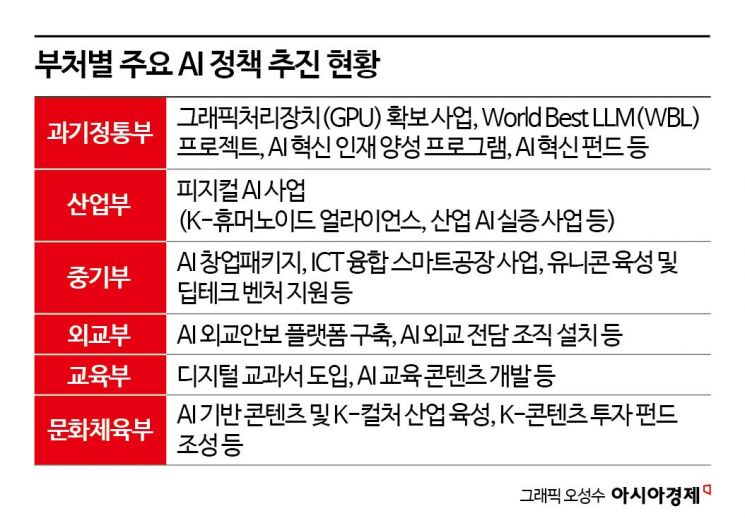
The key issue appears to be how to coordinate the "tug-of-war for leadership" among ministries. In this amendment, the ministries involved in AI policy coordination by the National Artificial Intelligence Committee have expanded from the existing seven?Ministry of Economy and Finance, Ministry of Education, Ministry of Science and ICT, Ministry of Foreign Affairs, and Ministry of Trade, Industry and Energy?to include five additional ministries: Ministry of SMEs and Startups, Ministry of National Defense, Ministry of Health and Welfare, Ministry of Environment, and Ministry of Employment and Labor. The Korea Communications Commission and the Digital Platform Government Committee, which were previously included, have been excluded. Currently, the Ministry of Science and ICT, as the main ministry in charge of AI, is leading a project to secure graphic processing units (GPUs) worth 1.46 trillion won, while the Ministry of Trade, Industry and Energy is leading physical AI projects such as developing smart factories and autonomous robots. In addition, the Ministry of SMEs and Startups is actively working on digital transformation (DX) for small and medium-sized enterprises and fostering AI startups, while the Ministry of Education is focusing on developing AI education content. Since AI technology is being discussed across all ministries, it is highly likely that conflicts of interest and leadership struggles among ministries will intensify.
A government official said, "For example, in the case of the Ministry of SMEs and Startups, it is expected to focus on the role of considering how to apply and utilize AI technology in specific industrial fields such as bio, beauty, and healthcare, rather than on data and technology development itself. In this case, there is a high possibility of some conflict and competition with the Ministry of Trade, Industry and Energy, which is considering the application of technology in industrial fields as part of its physical AI projects." Another official explained, "The Ministry of Science and ICT, as the main ministry in charge of AI, is exercising leadership in overall areas such as infrastructure development, AI foundation development, and training of professionals. As the flow of AI policy, which has so far been centered on the Ministry of Science and ICT, changes, conflicts among ministries may arise."
There are calls to ensure a substantial decision-making structure within the committee for clear "coordination." An industry official emphasized, "With a chief secretary for AI overseeing AI policy, there are concerns about whether the committee can exercise real coordinating functions when disagreements arise between ministries. To prevent the committee from becoming a mere formality, it is essential to appoint influential figures as standing vice-chair and heads of subcommittees, and to guarantee the committee's role as the final control tower so that its functions and roles do not become nominal."
© The Asia Business Daily(www.asiae.co.kr). All rights reserved.
![Clutching a Stolen Dior Bag, Saying "I Hate Being Poor but Real"... The Grotesque Con of a "Human Knockoff" [Slate]](https://cwcontent.asiae.co.kr/asiaresize/183/2026021902243444107_1771435474.jpg)
















