Mass Appearance of Blue Button Jellyfish in Jeju Waters
Caution Advised Due to Mild Toxicity
Recently, a large number of Blue Button Jellyfish have appeared at beaches in Jeju Island, prompting authorities to urge tourists to exercise extra caution.
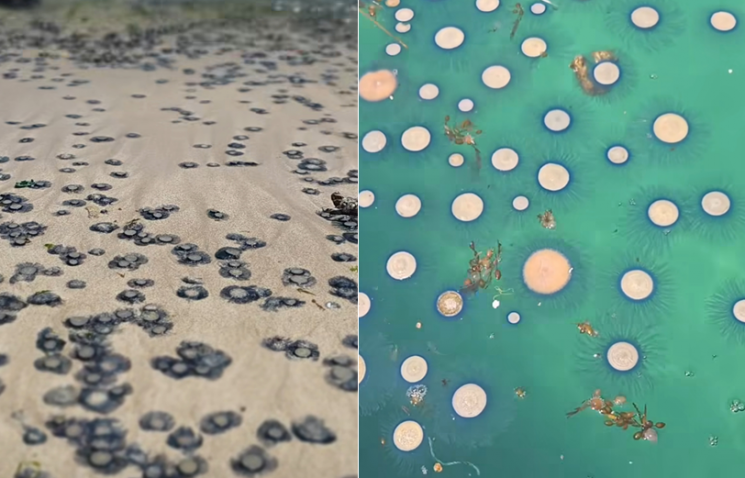 On the 28th, reports continued on social networking services (SNS) of sightings of blue umbrella jellyfish along the coast of Jeju. Instagram
On July 28, videos and photos showing swarms of blue, round jellyfish floating near the shores of Hamdeok and Gimnyeong in Jeju rapidly spread on social media platforms.
One user commented, "I saw these things washed up during high tide," adding, "They look like blue-rimmed circles with multiple tentacles. I was surprised to see one right next to me while swimming." Another user warned, "Be careful of the overflowing jellyfish in Gimnyeong," and continued, "I thought the coin-like things were Styrofoam debris, but they turned out to be Blue Button Jellyfish. Take caution when swimming in the northern part of Jeju."
The Blue Button Jellyfish is characterized by its blue color and coin-shaped, round appearance. It is small, measuring about 3 to 4 centimeters in diameter, and has numerous tentacles underneath its body. The Blue Button Jellyfish uses these tentacles to catch prey such as crustacean larvae.
This species mainly inhabits warm tropical waters such as the Pacific Ocean, the Mediterranean Sea, and the Indian Ocean. In Korea, it is known to occasionally drift in during high tide in the summer, influenced by wind and currents. It has been 2 to 3 years since such a large-scale appearance was last observed in the waters around Jeju.
Although the venom of the Blue Button Jellyfish is not strong, it is still advisable to avoid contact. This is because it can cause irritation, especially for those with sensitive skin. If stung by a jellyfish, the affected area should be rinsed immediately with clean seawater or saline solution. Tap water should be avoided, as it can spread the stingers.
© The Asia Business Daily(www.asiae.co.kr). All rights reserved.