Legislation and Judiciary Committee Holds Another Public Hearing on Prosecutorial Reform After July 9
Sharp Division of Opinions Between Ruling and Opposition Party Witnesses
As the Democratic Party of Korea has set the completion of prosecutorial reform?centered on the separation of investigation and indictment powers and the dismantling of the Prosecutors' Office?as its goal before Chuseok, witnesses from both the ruling and opposition parties have expressed diverging opinions. The ruling party asserts that dismantling the Prosecutors' Office is necessary to eradicate politically motivated investigations by prosecutors. In contrast, the opposition party argues that the criminal justice system cannot keep pace with the changing nature and speed of criminal organizations, and that negative assessments of investigative quality have emerged since the adjustment of investigative powers, so a cautious approach is required.
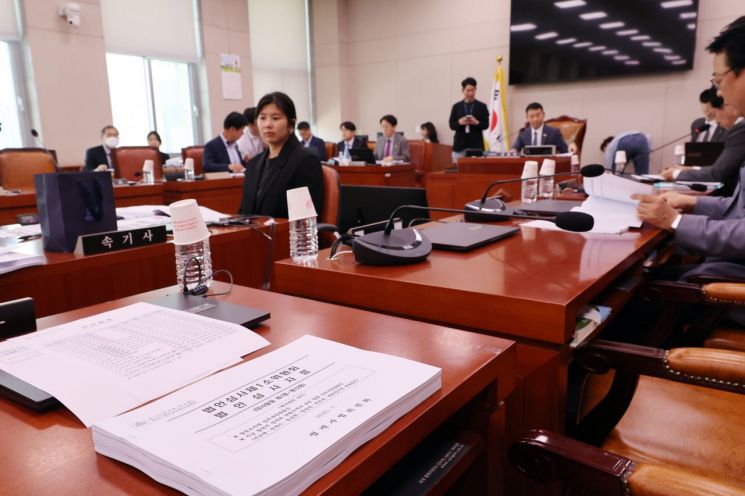
On the afternoon of July 28, the National Assembly’s Legislation and Judiciary Committee held a public hearing on prosecutorial reform bills, including the separation of investigation and indictment powers and the dismantling of the Prosecutors' Office. This was the second public hearing this month, following one held on July 9. The Legislation and Judiciary Committee had already convened its first subcommittee for bill review on July 25 and begun deliberating on the prosecutorial reform bills.
Moe Sungjun, a professor at the Judicial Research and Training Institute and a High Court judge representing the People Power Party, stated, "Criminal organizations in South Korea are thriving, and in terms of change, speed, adaptability, and execution, they have already overwhelmed the criminal justice system." He added, "The criminal justice system cannot keep up with their pace." He further commented, "If prosecutors are completely stripped of their investigative authority and are only left with the function of indictment, the capacity to respond to organized fraud crimes may disappear even more rapidly."
He also referenced the case of Kwon Dohyung, the key figure in the Terra-Luna cryptocurrency crash, whom the Korean government failed to indict, saying, "Unlike the United States, our criminal justice system has only revealed a significant lack of capacity for victim recovery, highlighting a clear gap in competence."
Yang Hongseok, an attorney at Law Firm Igong, also stated, "Since the adjustment of investigative powers in 2021, there have been a series of negative evaluations in all areas, including investigative quality, speed, and appropriateness." He expressed concern that "if the criminal justice system is changed to completely deprive prosecutors of investigative authority, operating the system will become even more difficult."
He continued, "There are opinions equating the separation of investigation and indictment powers with the deprivation of prosecutors’ investigative authority, but this approach is quite distant from the historical experience, theoretical framework, and practical operation of modern criminal justice systems." He pointed out, "Of course, it is not impossible, but even if prosecutorial reform is necessary, we need to review whether separating investigation and indictment powers is the only solution." Regarding the National Investigation Headquarters, he emphasized, "If prosecutors are actively incorporated into its organizational structure, the National Investigation Headquarters could become a second prosecutors' office with even greater powers."
On the other hand, Seo Bohak, a professor at Kyung Hee University representing the Democratic Party of Korea, argued, "The public has experienced the worst 'prosecutors' republic' during the three years of the Yoon Suk-yeol administration. Former President Yoon attempted a coup through emergency martial law not only because of the military but also because he had absolute faith in the prosecutors who had seized control of the law," adding, "Yoon Suk-yeol and the prosecution are an inseparable community of destiny."
After stressing the urgency of passing the prosecutorial reform bill, he criticized, "In dynamic Korean society, anything can happen within a year, and a year is more than enough time for prosecutors holding both investigative and indictment powers to attempt a reversal. A grace and preparation period of three to six months is sufficient." He added, "Over the past three years, 150 prosecutors were mobilized to investigate opposition leader Lee Jaemyung, and there were as many as 367 officially recorded search and seizures. If prosecutors with indictment powers continue to conduct investigations, excessive investigations, case fabrication, and forced indictments by the prosecution will persist."
Lee Gwangcheol, an attorney at the law office Gatensaenggak, also stated, "The runaway conduct of the Yoon Suk-yeol administration over the past two and a half years was, in other words, also the runaway conduct of the prosecution." He said, "Considering that he was a prosecutor, it is clear that the essence of this was prosecutorial dictatorship." However, regarding Lee, lawmaker Kwak Gyutaek of the People Power Party raised an issue with his eligibility to participate in the hearing, stating, "It is inappropriate for someone holding a key party position in the Cho Kuk Innovation Party to testify as a witness."
© The Asia Business Daily(www.asiae.co.kr). All rights reserved.












