Translator Anton Hur, Booker International Prize Nominee,
Publishes His First Full-Length Novel "Toward Eternity"
"My Dream Since Childhood Was to Be an English Novelist"
Plans to Continue Both Original Writing and Translation
"Strong Pride in Korean Poetry, Will Contribute Through Translation"
Anton Hur, a translator well known for translating works by authors such as Jeong Bora and Park Sang Young into English, has made his debut as a novelist with the publication of his full-length novel "Toward Eternity." Previously, he gained recognition as a translator for works like "Cursed Bunny" and "Love in the Big City," which were shortlisted for the Booker International Prize, one of the world's top three literary awards. This time, however, he stands before readers as the original author. The translation was done by author Jeong Bora.
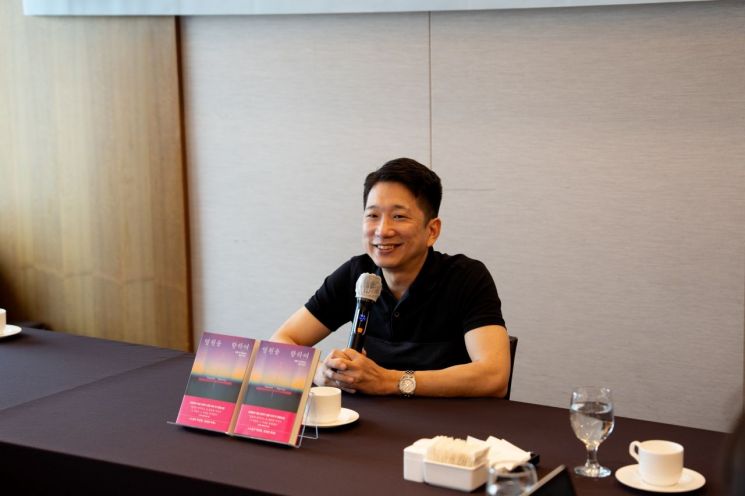 Anton Heo is speaking at the publication meeting of his book "Towards Eternity," held on the 28th at the Press Center in Jung-gu, Seoul. Photo by Openhouse
The novel is set in a future where infinite life extension is made possible through nanotherapy and artificial intelligence (AI) technology, and it explores the fundamental nature of human existence. In a world where machines can replace humans, it questions the meaning of "human"?the relationships between people. The idea of achieving immortality by replacing human cells with nanobots first came to him in 2014 while taking a shower, and he worked on the novel intermittently for ten years before its publication. The book was first published in English in the United States last year, and this year it was translated and published in Korean.
Anton Hur was born in 1981 in Stockholm, Sweden, and spent half of his school years abroad, following his father who worked at KOTRA. Although he later completed both his undergraduate and graduate studies in Korea, his somewhat awkward pronunciation often led people to mistake him for a Korean-American. At the publication commemorative meeting held at the Press Center in Jung-gu, Seoul, on the 28th, he said, "I am not a Korean-American, but 100% Korean," and added, "Writing in Korean feels natural to me."
Nevertheless, the reason he wrote the original manuscript of his first full-length novel in English was because he had dreamed of becoming an English-language writer when he was deeply immersed in English literature. He said, "Since I was young, I read a lot of English poetry and novels. Reading was truly my hobby," and added, "While Korean youth and children's literature has developed now, it wasn't like that back then. I felt a kind of obsession that I had to write novels in English."
The reason it took ten years to complete the novel was because he worked on it alongside his translation projects. He mainly fueled his creative energy while riding the subway, relying on the surrounding noise. He explained, "When I ride the rhythm of the subway sounds, words come out unconsciously. Rather than writing, I just transcribed them," and added, "After reading poet Lee Seongbok's 'Infinite Flowering,' I realized that 'a novel is not creation, but a language outside of me writing in my place.'" He focused less on deliberate creation and more on faithfully capturing the inspiration that came to him.
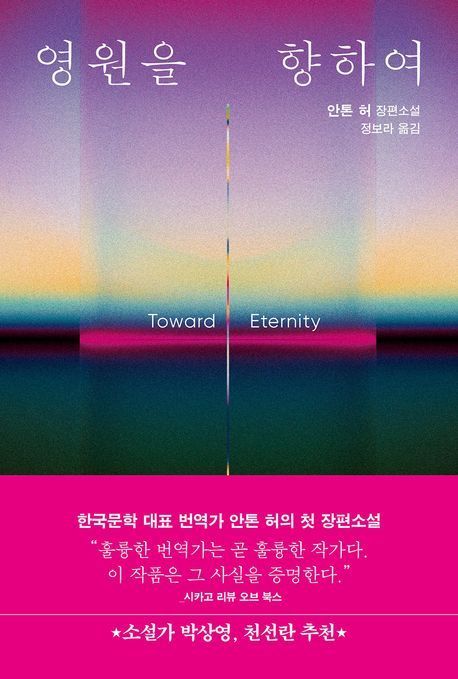
The translation was first proposed by author Jeong Bora. Despite not being fond of 19th-century British and American literature and poetry, which are major themes in the novel, she volunteered to translate it. Anton Hur said, "I am extremely grateful that she offered, saying, 'I want to translate this even if it kills me.' I knew how busy she was, so I felt sorry, but I accepted out of selfishness, and the result is more than satisfying. It was so good that it almost didn't feel like my own work." He added, "Personally, I believe that a translation is the work of the translator, not the author. If it doesn't feel like my own work and I can enjoy reading it, then it's a good translation. I think Korean readers are incredibly lucky to be able to read it through Jeong Bora's translation," he praised.
He explained that he entered the field of translation while pursuing his childhood dream of becoming a novelist, and plans to continue both translating and writing novels in the future. While he admitted that writing novels is much more attractive in terms of income, he said, "The world of Korean literature is incredibly rich. There are so many works to translate, especially excellent poetry," and added, "I don't know yet what the ratio between writing and translating will be, but I still think I can make detailed contributions to translation."
© The Asia Business Daily(www.asiae.co.kr). All rights reserved.