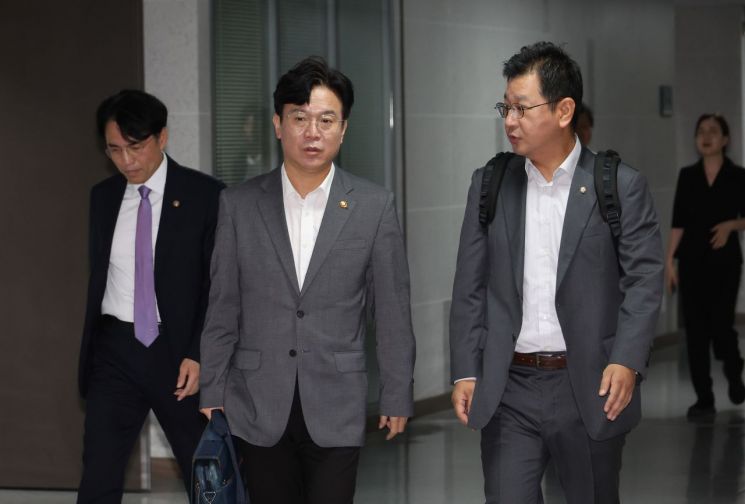
Minister of Employment and Labor Kim Younghoon now faces the significant task of mediating between the expectations of the labor sector and the policy realities of the government regarding the so-called "Yellow Envelope Act" amendment. This comes as the Yellow Envelope Act, a symbolic initiative of the Lee Jaemyung administration that has emphasized "respect for labor," is now facing the possibility of a postponed implementation and a reduction of its key provisions, contrary to initial expectations. As a result, opposition from the labor sector appears to be spreading.
According to relevant ministries and political circles on July 28, members of the ruling party's Environment and Labor Committee and government officials, including Minister Kim, held a party-government meeting at the National Assembly that morning. They unanimously called for the necessity of revising the Yellow Envelope Act. This meeting was held to coordinate opinions between the party and the government ahead of the review of the Yellow Envelope Act by the Employment and Labor Legislation Review Subcommittee of the National Assembly's Environment and Labor Committee.
The Yellow Envelope Act (amendment to Articles 2 and 3 of the Trade Union and Labor Relations Adjustment Act) originated from the issue of provisional seizure for damages claims raised after the 2009 Ssangyong Motor mass layoff incident. At that time, when the court ordered the union participating in the strike to pay 4.7 billion won in damages, civil society groups delivered donations in yellow envelopes to the union, establishing it as a symbol of solidarity. The labor sector asserts that the core elements of the Yellow Envelope Act include expanding the definition of "employer," broadening the scope of recognized industrial actions, and restricting indiscriminate damage claims against striking workers.
The bill was passed in August last year during the 22nd National Assembly, led by the Democratic Party of Korea, but was nullified when then-President Yoon Sukyeol exercised his right to request reconsideration (veto). The Lee Jaemyung administration expressed its intention to push for the bill again by appointing Kim Younghoon, who has a background in labor unions, as Minister of Employment and Labor. However, the situation changed rapidly after the contents of a revised proposal submitted by the Ministry of Employment and Labor to the National Assembly became public.
The government proposal presented by the Ministry of Employment and Labor reportedly includes a one-year grace period before implementation, and key elements such as "expanding the definition of employer" have been delegated to subordinate regulations. In addition, the provision for differentiating liability for damages based on fault was excluded, leading to criticism that the core structure of the bill has been significantly weakened.
The labor sector has strongly opposed these developments. The Korean Confederation of Trade Unions began an occupation protest at Democratic Party offices nationwide on July 23, and from July 25, launched a full-scale protest in front of the National Assembly. Its affiliated Metal Workers' Union also visited the office of the chairperson of the Environment and Labor Committee to increase pressure, while the Federation of Korean Trade Unions is preparing a press conference in front of the main building of the National Assembly this morning to demand the prevention of the bill's rollback and its swift passage.
Minister Kim responded immediately. Last week, he met with Kim Dongmyung, head of the Federation of Korean Trade Unions, and stated, "Once the party-government consultation is officially held, the government will finalize its position based on the various opinions gathered so far." An official from the Ministry of Employment and Labor told Asia Economy, "There seems to be some misunderstanding. Discussions are currently centered on the seven bills submitted by lawmakers, and the government has not submitted its own proposal," adding, "Since the ruling party also recognizes the need for a compromise, it appears that sufficient coordination of the bill is possible."
However, distrust from the labor sector remains strong. In particular, as the minimum wage increase rate for next year was set at 2.9%, the lowest for the first year of any administration since the foreign exchange crisis, skepticism about the government's "respect for labor" stance has grown. The labor sector has also criticized the government for its passive attitude during the process of accepting the deliberation promotion range proposed by public interest members of the Minimum Wage Commission.
Convincing the opposition People Power Party is another challenge. The opposition party has consistently opposed the Yellow Envelope Act, arguing that it could impose a serious burden on corporate activities and the national economy. There are also predictions that, without a political agreement between the ruling and opposition parties, the bill is unlikely to pass smoothly through a plenary session of the National Assembly. On this day, Minister Kim stated, "All citizens have the right to work, and working conditions should be determined socially by labor and management based on human dignity, but the gap between this constitutional value and reality has led to astronomical damages lawsuits and extreme struggles at workplaces. I understand that the amendment of Articles 2 and 3 of the Trade Union Act, currently under discussion in the National Assembly, is a process to quickly resolve this gap and create a new paradigm of participation and cooperation at industrial sites."
© The Asia Business Daily(www.asiae.co.kr). All rights reserved.











