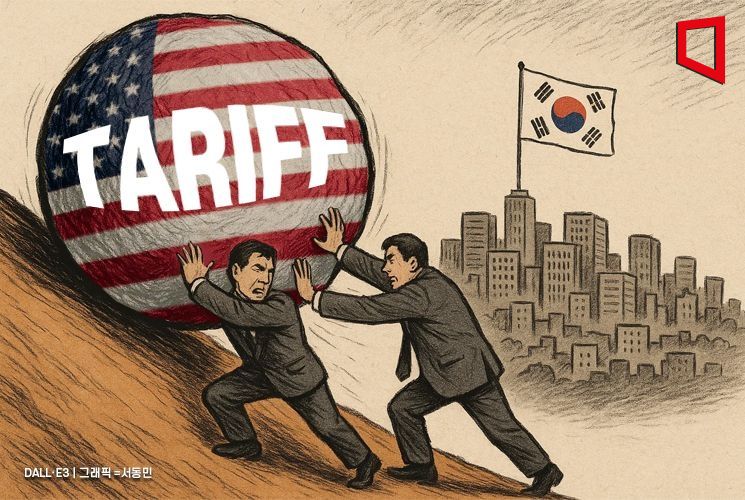
There are growing concerns that it is becoming increasingly difficult for South Korea to secure favorable terms in tariff negotiations with the United States. This is because both Japan and the European Union (EU) have recently concluded negotiations with the US based on a “large-scale investment commitment plus tariff reduction” model. Japan pledged $550 billion in financial support, while the EU agreed to $600 billion in investments and the purchase of $75 billion worth of energy and military equipment. Although both parties managed to reduce the US’s previously announced tariff rate of 25-30% to 15%, the actual concessions made went far beyond a simple reduction in tariffs.
According to a White House fact sheet and summary documents released by the Japanese government on July 28, Japan agreed to lower the US’s additional tariff from 25% to 15% in exchange for providing up to $550 billion in equity investments, loans, and loan guarantees through government-affiliated financial institutions. The summary document explicitly states that the profit-sharing ratio for equity investments between the US and Japan will be 9 to 1, confirming in Japanese documentation President Donald Trump’s demand that “90% of the profits return to the US.”
This structure means that Japan is not making direct cash investments, but is essentially supporting US-led projects with public financing. The decision-making authority and operational control are concentrated on the US side, while Japan bears the risk and is likely to be disadvantaged in profit distribution, effectively relegating Japan to the role of a “financial provider.”
Notably, the agreement includes a Most-Favored-Nation (MFN) clause, stipulating that products with an MFN tariff rate above 15% will not face additional tariffs, while those below 15% will be subject to a 15% tariff. This suggests that the US has effectively set 15% as the minimum tariff rate.
Japan’s concessions are particularly pronounced in the automotive sector. Currently, the MFN tariff rate on automobiles is only 2.5%, but by halving the additional tariff, a final rate of 15% was applied. The summary document also specifies that the US and Japan will cooperate in nine economically and strategically important areas through Japanese investment in the US.
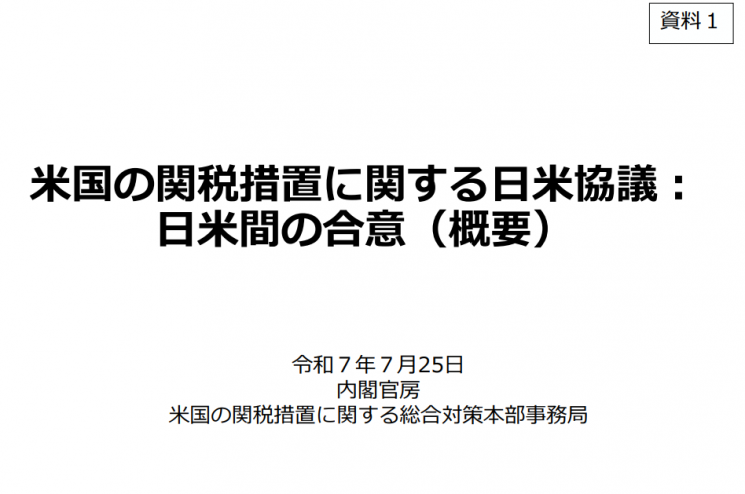
The nine sectors include semiconductors, pharmaceuticals, steel, shipbuilding, critical minerals, aerospace, energy, automobiles, and artificial intelligence (AI) and quantum technologies. Japan will participate in building supply chains within the US in these sectors. The agreement also includes expanded purchases of agricultural products and energy. Purchases of US bioethanol, soybeans, corn, fertilizer, semiconductors, and aircraft will be increased, and rice will be procured as needed using the Minimum Access (MA) system. Energy products such as liquefied natural gas (LNG) will be purchased on a stable, long-term basis, with a commitment to review the Alaska LNG project. Easing of non-tariff barriers was also agreed upon. Japan will allow US-made passenger cars that meet Japanese safety standards to be imported without additional testing and will review the operation of its clean energy vehicle (CEV) subsidy system.
This structure of the Japan-US agreement was directly reflected in the subsequent US-EU negotiations. The EU pledged $600 billion in investments and expanded purchases of $75 billion worth of energy and military equipment, while the US agreed to apply a 15% tariff on most EU products. Although zero tariffs will apply to some strategic items, it remains unclear whether this is legally binding. Many foreign media outlets have reported that “the US applied the negotiation framework developed with Japan to the EU as well,” and that “a comprehensive package model including investment and regulatory easing has effectively become the standard.”
This negotiation pattern exerts direct pressure on South Korea. The US has reportedly already proposed the establishment of a $400 billion “manufacturing cooperation fund” to South Korea. While the Korean government is internally reviewing a $100 billion counterproposal, most observers believe it will be difficult for Korea to secure more favorable terms, given that both Japan and the EU settled at the 15% tariff level. A trade expert, speaking on condition of anonymity, stated, “Due to the MFN clause, 15% has effectively become the minimum threshold. It will be structurally difficult for Korea to secure a lower tariff rate. It is essential to negotiate conditional agreements that jointly design the investment structure and secure operational and profit rights.”
There are also concerns that if South Korea adopts the Japanese model as is, it risks providing massive funds while being excluded from operational control and profit sharing. This is especially likely in strategic industries such as semiconductors, batteries, and automobiles, where Korea could become subordinate to a US-centric investment structure. As a result, there is a growing call for the Korean government to avoid simple monetary competition and to make it a principle to negotiate conditional agreements that jointly design the investment structure and secure operational and profit rights. An industry insider emphasized, “Only by creating a joint fund structure with Korean company participation can we secure real benefits. Negotiations should not come at the expense of the national interest.”
© The Asia Business Daily(www.asiae.co.kr). All rights reserved.













