Pusan National University and POSTECH Joint Research Team
Precisely Recreates Pathological Blood Flow and Inflammatory Responses
A 3D bioprinted artificial blood vessel model that precisely replicates the actual structure of narrowed cerebral blood vessels and the internal blood flow has been developed by a Korean research team.
This innovation is expected to provide a groundbreaking turning point for research into the mechanisms of major cerebrovascular diseases such as stroke, dementia, and vasculitis, as well as for new drug evaluation.
Pusan National University (President Choi Jaewon) announced on July 23 that a research team led by Professor Kim Byungsoo from the Department of Biomedical Convergence Engineering, in collaboration with a team led by Professor Cho Dongwoo of Pohang University of Science and Technology, has developed a 3D artificial cerebral blood vessel model that precisely recreates pathological blood flow conditions outside the body.
This study involved the precise printing of stenotic blood vessel regions and the cultivation of endothelial cells inside them, thereby establishing a blood flow and cellular response environment similar to that found in the human body. In particular, the team used a hybrid bioink composed of collagen and alginate mixed with decellularized extracellular matrix (dECM) derived from pig blood vessels, which significantly improved structural stability and biocompatibility.
The developed model features a finely detailed stenotic vessel structure with an inner diameter of 250 to 500 micrometers. Using computational fluid dynamics (CFD) simulations and fluorescent microbead experiments, the researchers quantitatively analyzed pathological blood flow characteristics such as turbulence and recirculation phenomena.
Additionally, when human brain microvascular endothelial cells (HBMEC) and human umbilical vein endothelial cells (HUVEC) were cultured, endothelial cell junction proteins (such as CD31 and VE-cadherin) were evenly expressed, and permeability varied depending on molecular weight, thereby demonstrating physiological validity.
Notably, the model is also capable of reproducing inflammatory responses. In the stenotic regions, the inflammatory adhesion molecules ICAM-1 and VCAM-1 increased by approximately 2.2 times and 1.5 times, respectively, showing results similar to pathological reactions observed in conditions such as atherosclerosis.
Professor Kim Byungsoo explained, "This research has established an ex vivo platform capable of quantitatively reproducing inflammatory responses under pathological blood flow," adding, "It can be widely used not only for vascular disease research, but also for drug response evaluation and the development of personalized treatment strategies."
This achievement was supported by the Ministry of Science and ICT and the Ministry of Trade, Industry and Energy, and was published in the international journal 'Advanced Functional Materials' in the field of biomaterials and tissue engineering on June 30.
Professor Kim Byungsoo of Pusan National University and Professor Cho Dongwoo of Pohang University of Science and Technology served as co-corresponding authors, while Minjoo Choi (Master’s graduate, Pusan National University, currently at Korea Institute of Materials Science) and Wonbin Park (PhD, Pohang University of Science and Technology, currently at Tissen Biopharm) participated as co-first authors.
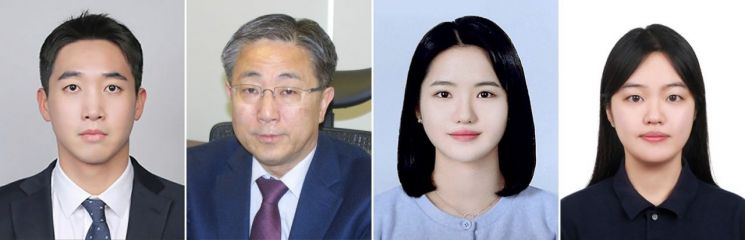 From the left, Professor Byungsoo Kim of Pusan National University, Professor Dongwoo Cho of Pohang University of Science and Technology, Master’s graduate Minjoo Choi of Pusan National University, and PhD candidate Wonbin Park of Pohang University of Science and Technology. Provided by Pusan National University
© The Asia Business Daily(www.asiae.co.kr). All rights reserved.

















