A team of Korean researchers has developed a technology that enables the retrieval of specific proteins and genetic information (mRNA) from inside cells at desired times using light, opening up new possibilities for gene regulation and drug development.
On July 23, KAIST announced that the research team led by Distinguished Professor Wondo Hur from the Department of Biological Sciences, in collaboration with the team of Distinguished Professor Yongkeun Park from the Department of Physics, has developed the 'Releaser Technology (REversible Light-Induced Store and Release·RELISR)', which allows for the storage and release of proteins and mRNA inside cells at desired times using light.
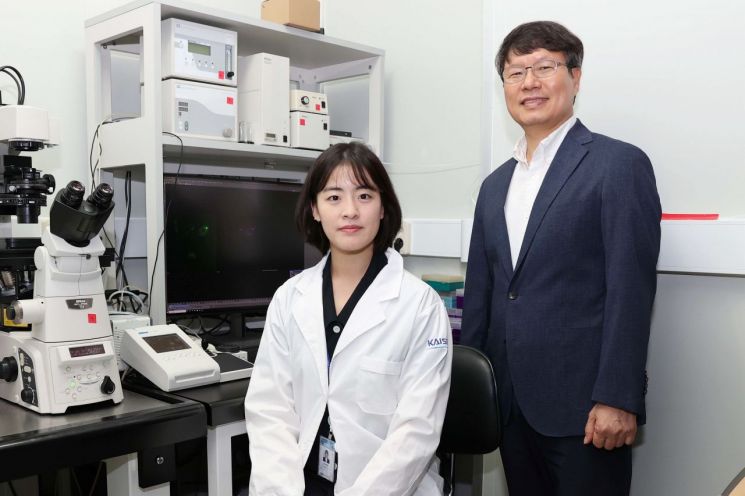 (From left) Chaeyeon Lee, PhD, Department of Biological Sciences, KAIST; Wondo Hur, Professor. Provided by KAIST
This research is regarded as a technology that implements, using light, the latest principle of cellular function regulation, in which various biomolecules are stored in membraneless condensates inside cells to regulate their function.
The joint research team designed the Releaser technology, a light-responsive molecular storage and release system, by amplifying an optogenetic protein complex with a target site that selectively binds to specific molecules.
Through this, they demonstrated that specific proteins or mRNA could be stably stored in the Releaser inside cells and organisms, and then released at desired times by exposure to light.
The joint team validated the effectiveness of this system in various cell lines, neurons, and even in the liver tissue of mice.
Furthermore, with the protein release system 'Protein-RELISR', which stores and releases proteins, they succeeded in real-time control of biochemical reactions in microenvironments, such as changes in cell morphology and localized protein activity within neurons.
When utilizing the mRNA release system 'mRNA-RELISR', which targets mRNA, they successfully controlled the timing of mRNA translation in the cytoplasm using light. This also confirmed that mRNA translation could be regulated in actual mouse models.
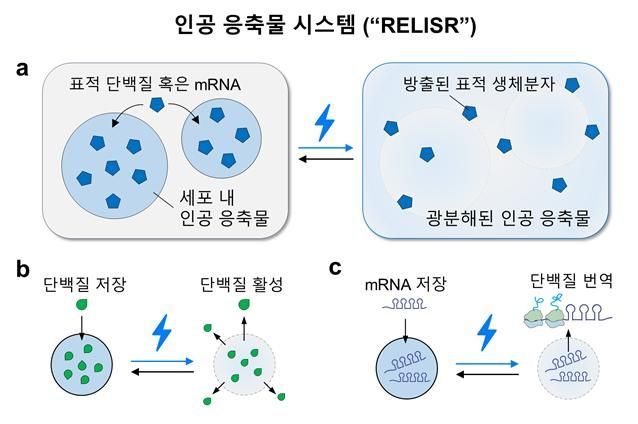 Overview of Artificial Condensate System (RELISR). The artificial condensate system RELISR consists of 'Protein-RELISR' for storing proteins and 'mRNA-RELISR' for storing mRNA. These artificial condensates can be decomposed by blue light irradiation and reassembled in the dark. Provided by KAIST
This research goes beyond previous studies such as LARIAT (protein lariat, 2014) and mRNA-LARIAT (mRNA lariat, 2019), which temporarily 'trap' target molecules with light. It is significant in that it presents a new platform capable of immediately 'releasing' proteins and mRNA stored in membraneless condensates inside cells with the same light stimulus, thereby restoring protein function and activating mRNA translation.
Distinguished Professor Wondo Hur stated, "The Releaser platform is a universal tool based on optogenetic principles that allows for the storage and release of proteins and mRNA at desired times and locations. This platform can be widely applied in future research on brain neurons, cell therapies, and next-generation drug development."
This research was supported by the Samsung Science & Technology Foundation and the National Research Foundation of Korea's Gene Editing, Control, and Restoration Technology Development Program. The research team included Chaeyeon Lee, PhD (first author, Department of Biological Sciences), Daseul Yu, PhD, and Distinguished Professor Yongkeun Park (co-corresponding authors, Department of Physics). The results were published in the international journal 'Nature Communications' on July 7.
© The Asia Business Daily(www.asiae.co.kr). All rights reserved.


















