Increase in Foreign Residents Across Gyeongsang, Jeolla, and Other Regions
It has been revealed that the number of 'areas with a high concentration of foreign residents' has surged, particularly outside the Seoul metropolitan area. These areas are defined as those with more than 10,000 foreign residents or where foreign residents make up more than 5% of the population.
On July 22, Yonhap News Agency reported that the Migration Policy Institute highlighted this trend in its report titled 'Current Status and Policy Implications of Areas with a High Concentration of Foreign Residents Based on Statistical Analysis.'
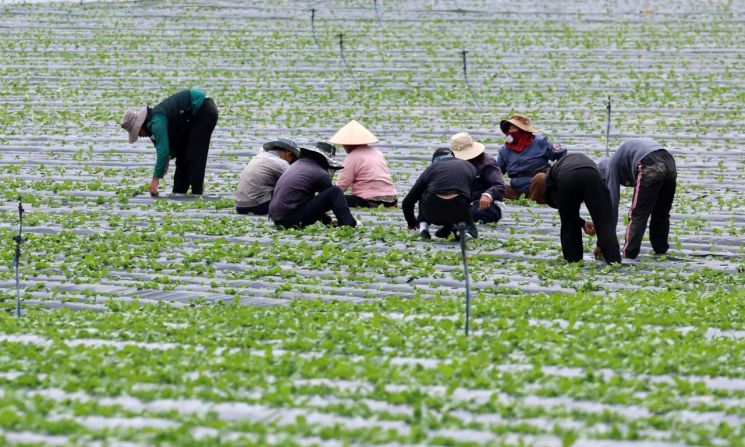 On the 16th, after the rain that relieved the drought stopped, foreign workers were busy with supplementary planting and thinning work in the highland vegetable fields in Daegiri, Wangsangmyeon, Gangneung City, Gangwon Province. Photo by Yonhap News
According to the Ministry of the Interior and Safety's statistics on 'Status of Foreign Residents in Local Governments,' as of November 2023, there were 2.46 million foreign residents who had lived in Korea for at least three months. This is the highest number ever recorded since such statistics were first released in 2006.
The number of 'areas with a high concentration of foreign residents' also reached 127 in 2023, a 31% increase from the previous year (97 areas). This means that more than half of the 229 cities, counties, and districts nationwide now fall into this category.
Back in 2016, 63% (41 areas) of the 65 areas with a high concentration of foreign residents were located in the Seoul metropolitan area, while only 37% (24 areas) were outside the metropolitan area. Since then, the number of such areas outside the metropolitan region has surged. In 2023, the number of these areas in the metropolitan region increased slightly to 48, whereas the number outside the metropolitan area jumped to 79, more than tripling.
By region, Jeonbuk increased from 1 to 10 areas, Jeonnam from 2 to 11, Chungnam from 3 to 13, and Gyeongbuk from 4 to 12. Gangwon and Daejeon, which previously had no areas with a high concentration of foreign residents, saw increases to 3 and 1 area(s), respectively.
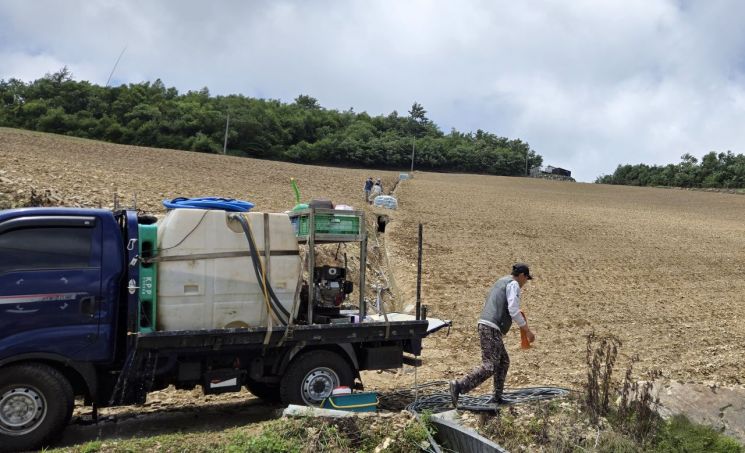 On the 11th, water trucks were deployed to water the cabbage fields in Anbandegi, Wangsanmyeon, Gangneung City, Gangwon Province, the largest highland vegetable farming area in Korea. Photo by Yonhap News
The research team interpreted this as a result of an increase in foreign residents not only in the Chungcheong and Gyeongsang regions, where foreign residents were already concentrated, but also in various non-metropolitan areas such as the Jeolla region.
However, the scale of foreign residents in these concentrated areas still remains higher in the metropolitan region. The average number of foreign residents in each such area in the metropolitan region was 27,538, about three times higher than the average of 9,391 in non-metropolitan areas.
The increase in the number and diversity of regions with foreign residents has affected their influence. The research team explained, "Many local governments are calling on the central government to expand the inclusion of foreign resident numbers when calculating local allocation tax, indicating their growing influence," and added, "It is important to design research and build basic data to analyze how policies on the inflow of foreign residents affect the local economy and society as a whole."
© The Asia Business Daily(www.asiae.co.kr). All rights reserved.


















