79.0% “No Special Response”
A recent survey found that 9 out of 10 small and medium-sized enterprises (SMEs) in South Korea have experienced damage due to the entry of Chinese e-commerce platforms into the domestic market. Nevertheless, the majority of these companies are not responding adequately to the damage, mainly due to budget constraints and other issues, raising concerns.
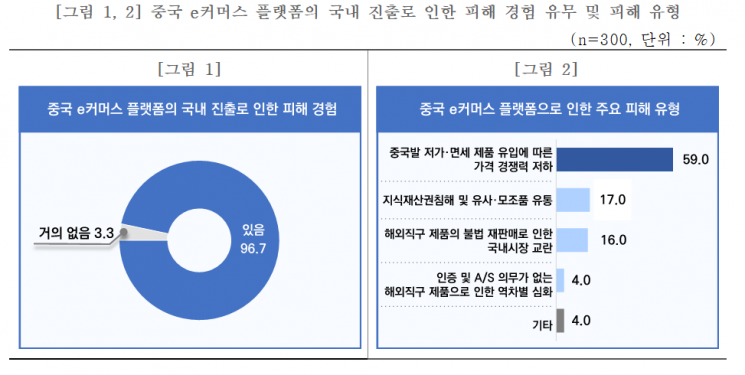
On July 22, the Korea Federation of SMEs announced that, according to a survey of 300 manufacturing and distribution SMEs, 96.7% reported experiencing damage as Chinese e-commerce platforms such as Al, Te, and Sui have made full-scale entries into the Korean market. Only 3.3% of respondents said they had experienced little to no damage.
The most common type of damage was "loss of price competitiveness due to the influx of low-priced and duty-free products from China," cited by 59.0% of respondents. This was followed by ▲intellectual property infringement (17.0%), ▲illegal resale of overseas direct purchase products (16.0%), and ▲worsening reverse discrimination due to overseas direct purchase products that are not subject to certification or after-sales service obligations (4.0%). For example, Company A, which sells cosmetics in Seoul, exhibited a new product at a trade fair in China, only to later find counterfeit products with similar designs being sold on a Chinese commerce platform. However, since there was no infringement of function or patent, the company faced difficulties in pursuing legal action.
On the other hand, among the companies that experienced damage from the entry of Chinese e-commerce platforms, a very high proportion?79.0%?responded that they "did not take any special action." The reasons for not taking action were, in order: ▲the cost and effort required to respond was considered greater than the amount of damage (35.4%), ▲difficulty in proving the damage or collecting relevant evidence (27.4%), and ▲lack of information about relevant agencies or responsible departments (15.6%).
Regarding the "abolition of the duty-free system for low-value goods," which is being discussed as a countermeasure against Chinese commerce, 71.7% were in favor, far exceeding the 28.3% opposed. Therefore, it was analyzed that urgent revision of the system allowing duty-free treatment for goods valued at up to $150 per transaction is needed. As for the most necessary government support, "mandatory certification and regulation for overseas direct purchase goods" was cited by 48.7% of respondents.
Chu Moonkap, head of the Economic Policy Division at the Korea Federation of SMEs, stated, "While Chinese commerce platforms can provide some SMEs with opportunities for overseas market expansion and reverse direct export, for many small businesses, the reality is that the risks outweigh the opportunities due to platform entry barriers and lack of marketing capabilities." He emphasized, "The government must quickly implement effective measures such as revising the duty-free system for low-value goods, strengthening product certification, and blocking illegal distribution, so that domestic SMEs can compete in a fair environment."
© The Asia Business Daily(www.asiae.co.kr). All rights reserved.

















