Passed 500,000 Folding Test
Testing Standard Raised from 200,000 Folds
Enhanced Using Bulletproof Glass Principles
Samsung Display's new foldable OLED (organic light-emitting diode) has proven its durability by passing a 500,000-fold test. This panel is installed in Samsung Electronics' recently unveiled 'Galaxy Z Fold7.'
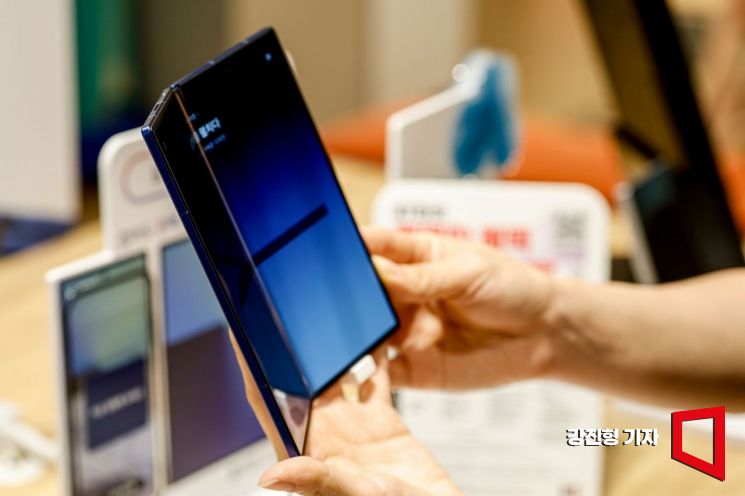 On the 15th, a customer visiting the KT Plaza Gwanghwamun Central Branch in Jongno-gu, Seoul, is experiencing Samsung Electronics' 'Galaxy Z Fold7.' KT announced that from the 15th to the 21st, advance reservations for the 'Galaxy Z Fold7' and 'Galaxy Z Flip7' will be available at KT stores nationwide and on KT.com. July 15, 2025. Photo by Kang Jinhyung
ㅐ구
On July 22, Samsung Display announced that its new foldable panel had passed the 500,000-fold test conducted by the global certification company Bureau Veritas. Samsung Display raised the testing standard from the previous 200,000 folds to 500,000 folds, which is 2.5 times higher than before.
Bureau Veritas explained, "This test was conducted over 13 days at room temperature (25 degrees Celsius), and all panels functioned normally even after 500,000 repeated folds." A total of 500,000 folds means that an average user who folds and unfolds the device about 100 times a day could use it for more than 10 years, while even a 'heavy user' who folds it more than 200 times a day could use it for over 6 years. Samsung Display stated, "These results show that the durability of foldable panels is no longer an issue for the lifespan of foldable smartphones."
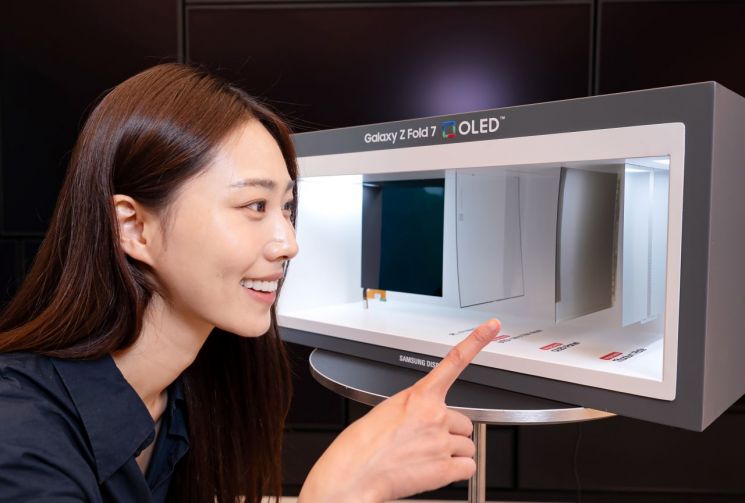
Samsung Display was able to enhance the durability of its panels by applying an 'impact-resistant reinforced structure' to its latest foldable OLED, utilizing the principles of bulletproof glass. Typical bulletproof glass is a multi-layered structure consisting of reinforced glass and special plastic films; when a bullet strikes, the elasticity of the glass surface absorbs the impact, preventing penetration. Inspired by this, Samsung Display increased the thickness of the UTG (ultra-thin glass component that protects the outermost part of the panel) by 50% compared to previous versions, and replaced the special adhesive that bonds each internal layer of the panel with a high-elasticity material whose resilience is more than four times greater, thereby improving the panel's shock absorption rate.
In addition, Samsung Display introduced a flattening structure to the panel to more effectively disperse external shocks, and applied titanium to the 'plate.' The plate is a component that supports the foldable panel, and this is the second time a titanium plate has been used in a Samsung Electronics Galaxy series device, following the 'Galaxy Z Fold SE.' Although titanium is difficult to process, it is thinner and stronger than other materials, allowing the panel to be made thinner while offering greater protection.
Lee Hojung, Vice President and Head of Product Planning at the Small and Medium Business Division, stated, "Now in its seventh year of commercialization, foldable OLED has made another significant leap forward in durability and design this year. This new product not only gives consumers confidence in the durability of foldable panels, but also once again demonstrates Samsung Display's foldable technology, which stands out from competitors."
© The Asia Business Daily(www.asiae.co.kr). All rights reserved.
![User Who Sold Erroneously Deposited Bitcoins to Repay Debt and Fund Entertainment... What Did the Supreme Court Decide in 2021? [Legal Issue Check]](https://cwcontent.asiae.co.kr/asiaresize/183/2026020910431234020_1770601391.png)

















