'Time Barcodes' Only for Ready-to-Eat Foods
Milk, Bread, and Snacks Remain in a Blind Spot
Store Owners Held Responsible and Headquarters Inspections Continue... But Gaps Persist

"I bought Makgeolli at a convenience store, but is this expiration date correct? If I drink it, will I die?"
Last month, a post like this along with a photo was uploaded to the social networking service X (formerly Twitter). It showed a bottle of Makgeolli from Company A with an expiration date marked as September 12, 2021. The poster wrote, "It's not even soju, it's Makgeolli, so I'm really shocked," and added, "I usually don't check expiration dates, but for some reason I noticed it today," expressing relief. Fortunately, the Makgeolli was refunded.
With the risk of food poisoning increasing during the summer, it has been revealed that the management of expiration dates for products sold at domestic convenience stores is lax. While ready-to-eat foods such as triangle kimbap, hamburgers, and sandwiches are equipped with "time barcodes" that prevent checkout at the register once the expiration date has passed, processed foods such as milk, yogurt, and snacks do not use time barcodes, creating a blind spot in expiration date management.
According to data titled "Status of Violations of the Food Sanitation Act by Convenience Store Brands Over the Past Five Years," submitted by the Ministry of Food and Drug Safety to the office of Kim Mi-ae, a member of the National Assembly's Health and Welfare Committee, on August 17, the number of Food Sanitation Act violations by major convenience store companies has been increasing every year.
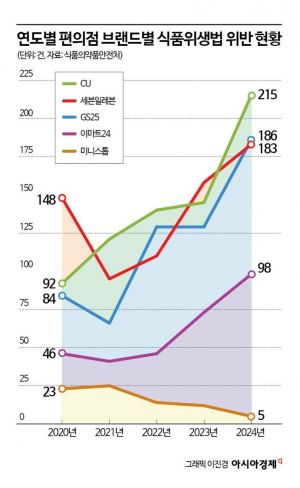
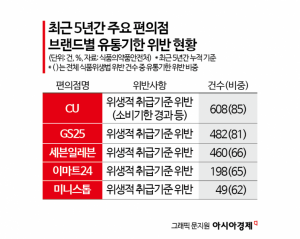
The majority of these violations were related to "expiration dates." CU, operated by BGF Retail, had the highest number of Food Sanitation Act violations, with 85% (608 cases) related to breaches of hygienic handling standards, such as selling products past their expiration date. This was followed by GS25 of GS Retail at 81% (482 cases), Seven-Eleven at 66% (460 cases), and Emart24, part of the Emart group, at 65% (198 cases), all for expiration date violations.
Over the past five years, 75% of the 2,384 Food Sanitation Act violations by these convenience stores were due to handling products past their expiration dates.
The convenience store industry introduced the "time barcode" system for ready-to-eat foods in the early 2000s. This system attaches a barcode indicating the manufacturing date and expiration date to convenience store ready-to-eat foods such as lunch boxes, kimbap, and sandwiches, and prevents checkout at the register for products past their expiration date.
However, products other than ready-to-eat foods are not subject to time barcodes. If a store sells an expired product, the store owner is held responsible. Under the "store owner compensation principle," if damage occurs, store owners are required to handle exchanges or refunds, or they may be fined. If the issue is not resolved through refunds or other means, the convenience store headquarters sends a certified letter as a warning. However, as the convenience store market grows, the number of expiration date violations is also rapidly increasing every year.
An industry official explained, "Since these are franchise businesses, store owners are fundamentally responsible for issues arising from poor store management, and store managers regularly visit stores to check operations," but added, "Since humans are involved, there are inevitably gaps in the process."
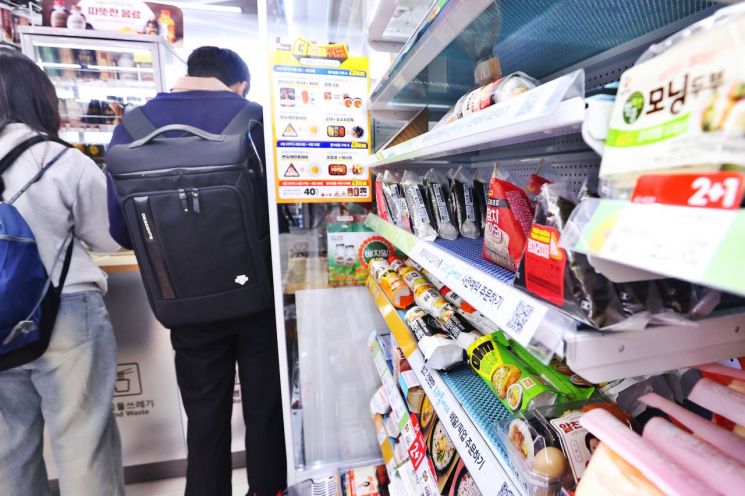
Processed foods such as ramen and beverages have long shelf lives and are manufactured in large quantities at once, so the cost-effectiveness of introducing time barcodes is low. An industry official stated, "Convenience meals are produced in small quantities and have short shelf lives of just a day or two, with production occurring twice a day, so it is essential to manage them strictly with time barcodes. However, ramen and beverages are manufactured in large batches and have long shelf lives, so the need to manage each item with a time barcode is relatively low."
Processed food manufacturers have also expressed reluctance. A food manufacturer representative said, "For processed foods, we bring in packaging with printed barcodes in bulk to the factory and use it in production, but if we have to attach time barcodes, we would need to install equipment to attach a time barcode to each individual product." He continued, "Currently, we deliver products to distributors with sufficient shelf life remaining, but if time barcodes are introduced, both parties would have to check the manufacturing date, which would be cumbersome." He added, "It is practically impossible for logistics centers, which handle thousands of products daily, to count every product individually."
© The Asia Business Daily(www.asiae.co.kr). All rights reserved.
![Clutching a Stolen Dior Bag, Saying "I Hate Being Poor but Real"... The Grotesque Con of a "Human Knockoff" [Slate]](https://cwcontent.asiae.co.kr/asiaresize/183/2026021902243444107_1771435474.jpg)


















