Cancer Risk Increases with Larger Waist Circumference in Men
Severe Obesity Raises Risk for Liver and Bile Duct Cancer,
While Low Body Weight Raises Risk for Lung Cancer
A study has found that the impact of obesity indicators such as body mass index (BMI) and waist circumference on cancer risk varies not only by cancer type but also by gender and menopausal status in women. On July 21, a joint research team led by professors Shin Dongwook and Kim Sunghye from the Department of Family Medicine at Samsung Seoul Hospital, and professor Han Kyungdo from the Department of Information Statistics and Actuarial Science at Soongsil University, published these findings in the international journal Cancer Communications.
 A study has found that the impact of obesity indicators such as body mass index (BMI) and waist circumference on cancer risk varies not only by cancer type but also by gender and menopausal status in women. Asia Economy
The research team tracked approximately 3.98 million individuals (about 2.2 million men and about 1.78 million women) who had undergone health checkups between 2009 and 2020, using data from the National Health Insurance Service, with an average follow-up period of nine years. The average age of all participants was 46.7 years. Among them, 6.1% (242,243 individuals) were diagnosed with cancer during the study period. The largest group was men, with about 135,000 cases, followed by about 40,000 premenopausal women and about 66,000 postmenopausal women.
The analysis showed that in men, the risk of developing cancer increased as waist circumference increased, and decreased as waist circumference decreased, indicating a linear relationship. The risk of cancer associated with obesity also varied by cancer type. In liver cancer, a nonlinear relationship between obesity indicators and cancer incidence was observed in men. The risk of liver cancer increased when BMI was 25 kg/m² or higher or waist circumference was 90 cm or more, and bile duct cancer showed a similar pattern. In the case of lung cancer, among men with a BMI of 23 kg/m² or lower (considered a normal weight), the lower the BMI, the higher the risk of developing cancer. This trend was not clearly observed in those above the normal weight range.
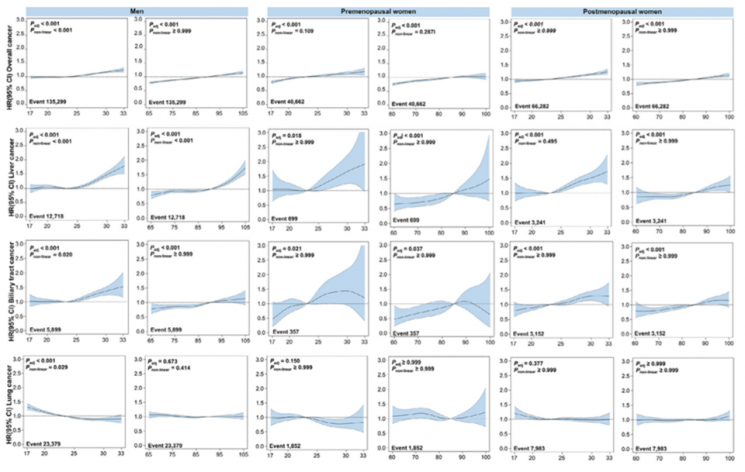 In overall cancer, liver cancer, bile duct cancer, and lung cancer, a nonlinear relationship was observed in men, unlike in women, where the risk of cancer occurrence increased or decreased within specific ranges of obesity indicators. Samsung Seoul Hospital
This study is significant in that it precisely analyzed the effects of BMI and waist circumference on cancer incidence using spline curves, taking into account gender and menopausal status. The research confirmed associations between obesity or abdominal obesity and a variety of cancers, including not only the 13 cancers previously known to be related to obesity, but also myeloid leukemia and non-Hodgkin lymphoma.
Professor Kim stated, "This study demonstrates that while various cancers are associated with obesity and abdominal obesity, the nature of these associations differs depending on gender and menopausal status, highlighting the need for tailored cancer prevention strategies." Professor Shin added, "Along with active surveillance for high-risk groups for cancer, these findings can serve as important data for developing future individualized cancer prevention and management policies."
© The Asia Business Daily(www.asiae.co.kr). All rights reserved.


















