As of the morning of the 20th, a total of 8 cases of damage reported
Including 1 National Treasure, 2 Treasures, and 3 Historic Sites
Since July 16, heavy rainfall has caused damage to national heritage sites across the country.
According to the "Status of Damage and Response to National Heritage Sites Due to Heavy Rain from July 16 to 20," announced by the Cultural Heritage Administration on July 20, a total of eight cases of damage to national heritage sites have been reported due to the recent rains. This is three more cases than two days earlier. By region, there were four cases in Chungnam, two in Jeonnam, and one each in Gyeongbuk and Gyeongnam. By type, the damaged national heritage sites include three Historic Sites, two Treasures, and one each of National Treasure, Scenic Site, and National Registered Cultural Heritage.
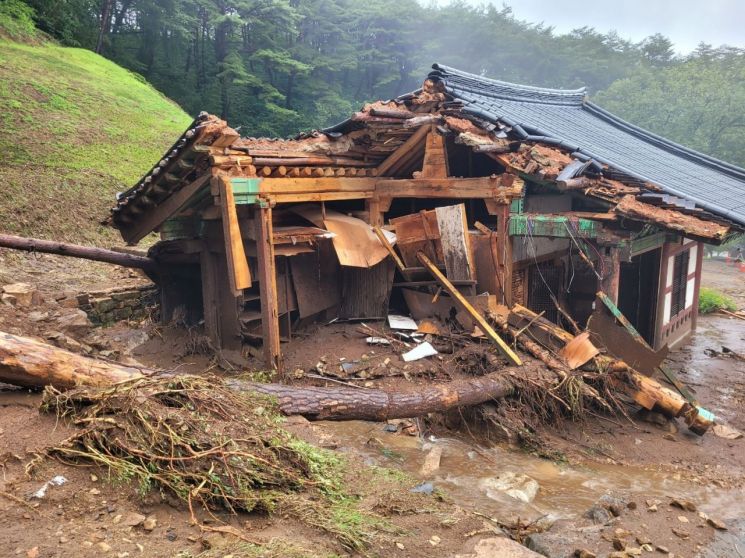 The Daeungjeon Hall of Yulgoksa Temple in Sancheong, Gyeongnam, damaged by a landslide caused by heavy rain. Photo by Yonhap News
In Sancheong, Gyeongnam, where 300 mm of torrential rain fell in a single day on July 19, the Treasure "Daeungjeon Hall of Yulgoksa Temple" was damaged. According to the National Heritage Portal of the Cultural Heritage Administration, Yulgoksa Temple is said to have been founded in 930 during the reign of King Gyeongsun, the last king of Silla (reigned 927?935). Records show that the Daeungjeon Hall of this temple was extensively renovated in 1679, the fourth year of King Sukjong of Joseon (reigned 1674?1720). This building was designated as a Treasure in 1963.
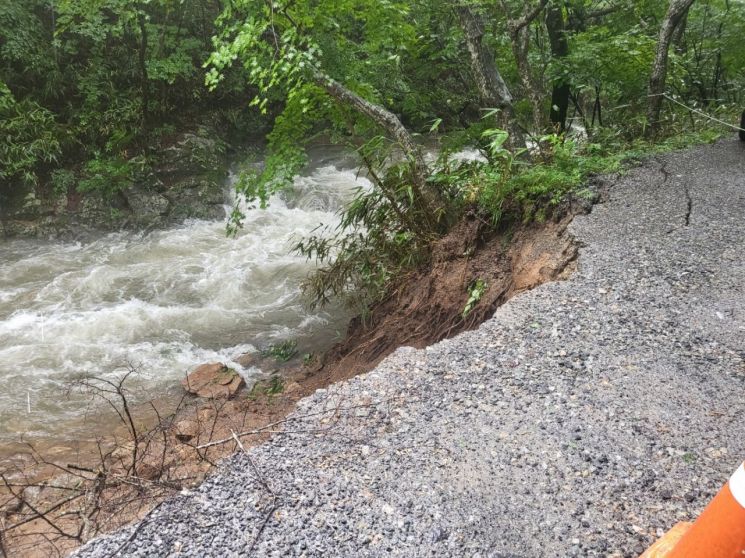 Damage at the scenic site "Jogyesan Songgwangsa and Seonamsa Area" in Suncheon, Jeollanam-do. Photo by Yonhap News
However, due to a landslide caused by the recent heavy rain, a mass of earth swept into the Daeungjeon Hall, damaging part of its walls and part of a nearby building. All temple personnel evacuated.
Damage from heavy rain also continued in Boseong and Suncheon, Jeonnam. At the scenic site "Jogyesan Songgwangsa and Seonamsa Area" on the slopes of Jogyesan Mountain in Suncheon, Jeonnam, a section of about 10 meters of the access road was partially covered by a landslide, and a safety barrier was installed at the affected area. At the "Boseong Angyuhong and Park Jehyeon House," a National Registered Cultural Heritage site, earth from the stone embankment behind the main building collapsed, restricting access. The area where the earth was lost has been temporarily restored.
 Before (left) and after flooding of the Bangudae Petroglyphs in Daegokri, Ulju, Ulsan. Photo by Yonhap News
Although not included in the official tally by the Cultural Heritage Administration, the "Bangudae Petroglyphs of Bangudae Stream" in Ulju-gun, Ulsan, which was inscribed as a UNESCO World Heritage site only a week ago, was once again submerged. Of the two petroglyph sites inscribed as World Heritage, the National Treasure "Bangudae Petroglyphs in Daegokri, Ulju" becomes submerged when the water level of the nearby Sayeon Dam exceeds 53 meters. At 5 a.m. the previous day, the water level surpassed 53 meters, and by 1 p.m., it had reached 57 meters, leaving the petroglyphs almost completely underwater. This is the first time the Bangudae Petroglyphs in Daegokri have been submerged since August 2023, nearly two years ago.
Currently, the Cultural Heritage Administration is restricting access around the affected national heritage sites and is working with local governments to implement emergency measures to prevent secondary damage and ensure safety.
© The Asia Business Daily(www.asiae.co.kr). All rights reserved.



















