Prime Minister Kim: "We will mobilize all available means"
Proposal for reconstruction of Sinan Railway Bridge and river widening
Gwangju hit by 536mm of rainfall... 1,311 cases of damage reported
Administrative efforts focused on relief and disease control for disaster victims
On July 20, Gwangju Mayor Kang Gijeong officially requested Prime Minister Kim Minseok, who visited the sites affected by heavy rainfall, to designate the Gwangju area as a special disaster zone. Mayor Kang accompanied Prime Minister Kim as they inspected areas including Sinan Bridge in Buk-gu and Hasin Village in Yonggang-dong, emphasizing the need for permanent measures against repeated flooding and calling for active financial support from the central government.
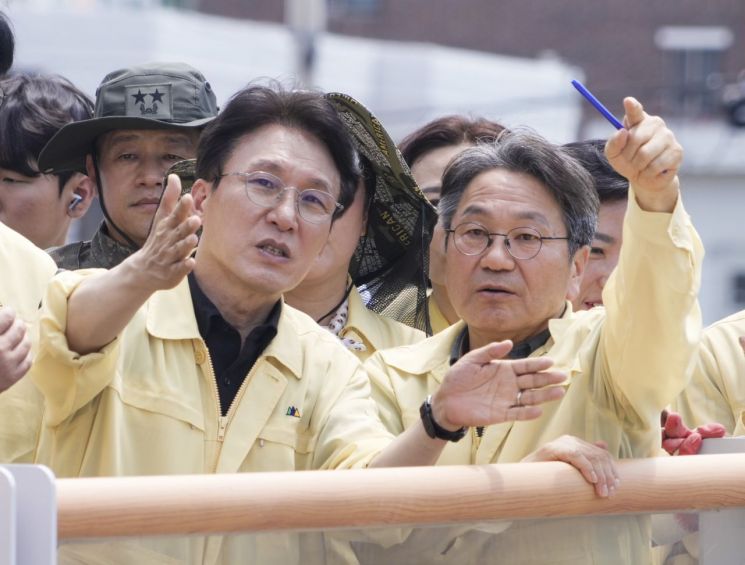 Gwangju Mayor Kang Gijeong is inspecting the damage site around Sinan Bridge in Buk-gu, a flood-affected area, with Prime Minister Kim Minseok on the morning of the 20th. Photo by Gwangju City
Mayor Kang stated, "Record-breaking heavy rain has caused extensive damage throughout Gwangju," and stressed, "Considering the poor financial condition of local governments, state-level financial support is urgently needed." In particular, regarding the Sinan Bridge area, which is prone to frequent flooding, he said, "This area suffered significant damage five years ago as well, and unfortunately, there are missing persons again this time." He proposed the reconstruction of Sinan Railway Bridge and the widening of the river to improve low-lying areas.
During the site visit, Mayor Kang explained the critical situation during the heavy rainfall and shared details about emergency response and rescue operations. Prime Minister Kim stated, "The government is mobilizing all available means and resources to resolve the current crisis as quickly as possible and help restore daily life. We will seek solutions on site and prepare tailored measures that fit the local circumstances."
The two officials visited not only the area around Sinan Bridge, where the damage was concentrated, but also moved to Hasin Village in Yonggang-dong, Buk-gu, to inspect flooded homes and farmland. During this process, they met with local strawberry farmers and listened to their accounts of the damage.
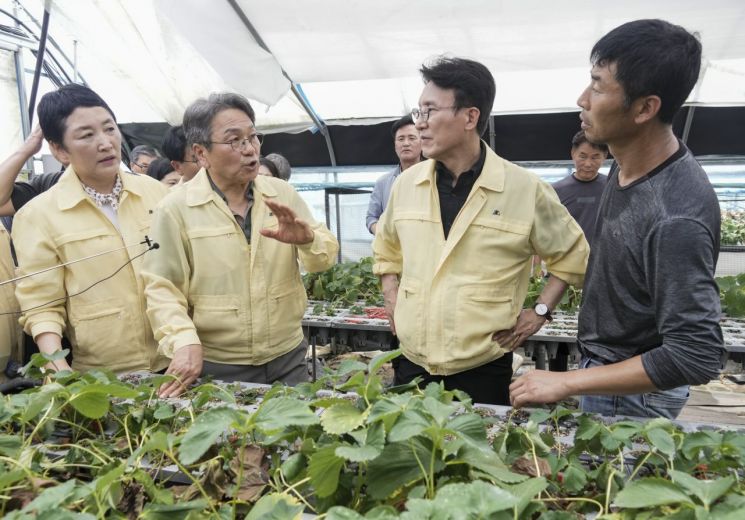 Gwangju Mayor Kang Gijeong is inspecting the strawberry cultivation facility greenhouse in Hasin Village, Yonggang-dong, Buk-gu, a flood damage area caused by heavy rain, with Prime Minister Kim Minseok on the morning of the 20th. Provided by Gwangju City
On July 17 alone, the Gwangju area recorded 426mm of rainfall, marking the highest daily precipitation since weather observations began. By July 19, the cumulative rainfall reached 536mm. As of 10 p.m. on July 19, Gwangju City reported a total of 1,311 cases of damage, including 447 cases of road flooding, 260 cases of road damage, 263 cases of building flooding, 124 cases of vehicle flooding, and 54 cases of fallen trees. The scale of the damage is expected to increase as further investigations are conducted.
Gwangju City is focusing its administrative resources on recovery efforts and support for disaster victims. Relief supplies are being provided to evacuees staying in temporary shelters, and emergency restoration work is being expedited. At the same time, disinfection activities are being carried out to manage hygiene and prevent the spread of infectious diseases in flooded areas.
© The Asia Business Daily(www.asiae.co.kr). All rights reserved.
![Clutching a Stolen Dior Bag, Saying "I Hate Being Poor but Real"... The Grotesque Con of a "Human Knockoff" [Slate]](https://cwcontent.asiae.co.kr/asiaresize/183/2026021902243444107_1771435474.jpg)












