On July 20, the Daegu City and District Council Chairpersons Association issued a statement, saying, "There are reports that the government is discussing expanding rice imports and easing beef import standards in trade negotiations with the United States." The association emphasized that the government must not make any concessions that would undermine public health or food security.
The Daegu City and District Council Chairpersons Association stated, "The agricultural sector is experiencing an extreme sense of crisis due to reports that the government is considering expanding agricultural and livestock product imports and easing non-tariff barriers as negotiation cards in trade talks with the United States. In particular, the U.S. side is reportedly demanding the allowance of beef imports from cattle over 30 months old, expansion of the rice tariff rate quota (TRQ), relaxation of regulations on the import of living modified organisms (LMOs), and easing of quarantine measures for fruits such as apples. Some remarks by government officials are being interpreted as indicating a willingness to positively consider these demands." The association added, "These discussions are not simply trade issues, but critical matters directly related to public health, food security, and the survival of agriculture."
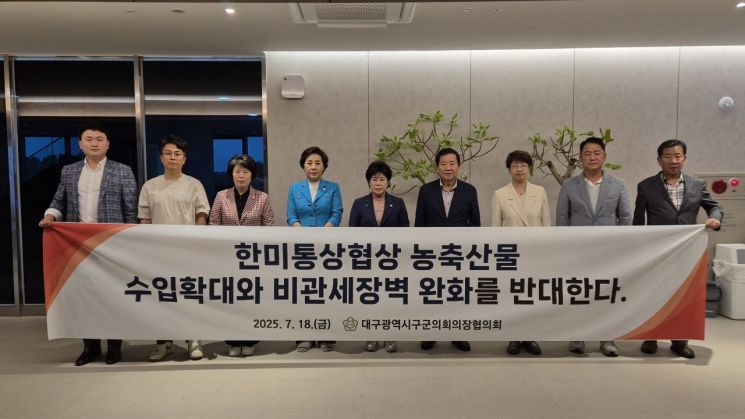 The Daegu City and District Council Chairpersons Association is holding placards opposing the expansion of agricultural and livestock product imports in the Korea-US trade negotiations.
The association also argued, "Easing beef import standards is a measure that threatens public health and food safety. Due to concerns about mad cow disease, Korea currently imports only U.S. beef from cattle under 30 months old, which is an essential measure to protect public health. In 2008, the government's attempt to allow imports of beef from cattle over 30 months old led to nationwide candlelight protests. If the standards are relaxed again, public distrust, consumer backlash, and the contraction of the domestic livestock industry, including Korean native cattle and beef cattle, will be inevitable."
The association continued, "Expanding rice imports threatens the livelihood of farmers and undermines food security. Rice is a key crop for maintaining domestic self-sufficiency and is the main source of income for many farming households. The current 513% tariff and the tariff rate quota (TRQ) are the minimum protective measures in place. If these are relaxed or expanded, it could lead to a sharp drop in domestic rice prices and the collapse of farming households. This would ultimately weaken the nation's food sovereignty."
The Daegu City and District Council Chairpersons Association stated, "Relaxing regulations on the import of living modified organisms (LMOs) threatens the safety of the nation's food supply. The debate over the safety of LMOs is not yet settled, and the current regulations are based on legitimate scientific and ethical standards to protect the public's right to choose their food and their right to life. If these regulations are relaxed in response to U.S. demands, it is inevitable that food safety will be compromised and public distrust will spread." The association added, "Easing quarantine measures for U.S. fruits threatens the survival of domestic fruit farmers. Easing quarantine for U.S. fruits such as apples, blueberries, cherries, and strawberries could increase the risk of pest and disease introduction and lead to the collapse of the domestic distribution order due to an influx of low-priced imports. In particular, apples are a key crop in major regions such as North Gyeongsang and South Gyeongsang, and large-scale imports would threaten the entire domestic production base. This is not just an issue for farmers, but a matter of food sovereignty and consumer safety."
The association stated, "The government must prioritize the public interest of agriculture and public health above all else. Long-term public safety and the maintenance of the agricultural base should take precedence over short-term negotiation outcomes, and the further opening or deregulation of agricultural and livestock products must never become a sacrifice in trade negotiations under any circumstances." The association added, "Trade policies pursued without public consensus will lead to social confusion and a loss of trust. We urge the government to make a responsible decision in these negotiations that preserves public trust, national food sovereignty, and the agricultural base."
The association further called on the government to "completely reject demands to ease non-tariff barriers on agricultural and livestock products, firmly exclude any trade concessions that would undermine public health and food security, and establish negotiation strategies that prioritize the public value and survival base of agriculture above all else."
© The Asia Business Daily(www.asiae.co.kr). All rights reserved.

















