"The Next Stage of AI Development is Physical AI"
"Physics, Chemistry, Earth Science... Understanding Physical Laws is Essential"
"If I were 20 years old, I would focus more on the physical sciences than on software science."
This was the answer given by Nvidia CEO Jensen Huang when asked, "If you had just graduated from college this year and were a young person with the same ambitions as you have now, which field would you focus on?"

According to a report by Yonhap News on July 17 (local time), citing U.S. broadcaster CNBC, CEO Huang gave this response when asked by a reporter during his visit to Beijing, China. Huang studied electrical engineering at Oregon State University in 1984 and received his master's degree in electrical engineering from Stanford University in 1992. About a year later, in April 1993, he co-founded Nvidia in California with colleagues. As of last week, Nvidia surpassed a market capitalization of $4 trillion, becoming the most valuable company in the world.
CNBC explained that the physical sciences, which CEO Huang said he would study if he were a young graduate this year, is a broad field that studies non-biological systems, as opposed to life sciences. It includes physics, chemistry, astronomy, and earth sciences.
Although he did not specify why he would study physical sciences, it is presumed that this is due to his optimistic outlook on "physical AI," which is considered the next stage of artificial intelligence (AI).
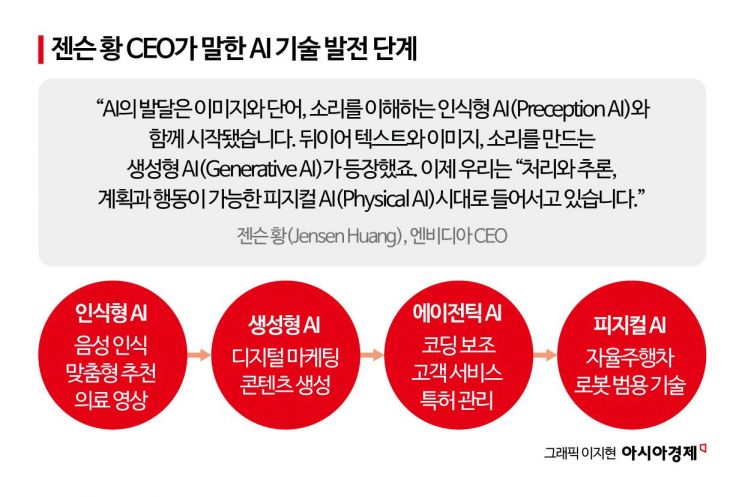
Physical AI refers to the concept of AI expanding beyond the digital realm into the real world, where artificial intelligence can perceive and understand physical environments, make its own judgments, and act accordingly. Humanoids?robots that behave like humans?and autonomous vehicles are cited as representative industries in this field.
Previously, at a forum held in Washington, D.C. in April, CEO Huang explained the stages of AI development and predicted that after the current stage of "inference AI," the era of "physical AI" would arrive. He added, "Next-generation AI must understand the principles of the physical world, such as physical laws, friction, inertia, and causality."
As examples of the application of physical reasoning, he said, "This includes predicting where a ball will roll, understanding the amount of force needed to grasp an object without damaging it, and inferring whether there is a pedestrian behind a vehicle." He added, "When physical AI is applied to robots, it becomes robotics, which is extremely important to us because we are building factories across the United States."
© The Asia Business Daily(www.asiae.co.kr). All rights reserved.


















