The Korean Institute of Certified Public Accountants announced on the 18th that it held the 19th Sustainability Certification Forum on the 9th.
This forum was held under the theme of "Global Sustainability Reporting and Assurance, and the Current Status of Domestic Greenhouse Gas Emissions Measurement and Verification," and was attended by over 400 stakeholders from various sectors. Based on the "The State of Play: Sustainability Disclosure and Assurance" report published by IFAC in May, participants examined global trends in sustainability reporting and assurance, and shared the results of the Korean Institute of Certified Public Accountants' survey on the current state of domestic greenhouse gas emissions measurement and verification with stakeholders.
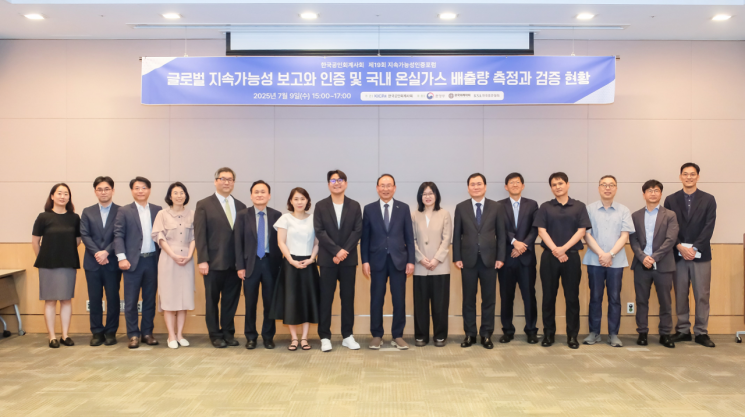 At the 19th Sustainability Certification Forum held on the 9th, the executives of the Korean Institute of Certified Public Accountants, forum presenters, and discussants are taking a commemorative photo. Korean Institute of Certified Public Accountants
Choi Woonyeol, President of the Korean Institute of Certified Public Accountants, emphasized, "More than half of sustainability assurance worldwide is conducted by accounting firms, and in the European Union, over 90% of assurance performed by accounting firms is carried out by financial statement auditors. This demonstrates that certified public accountants play a key role in enhancing the reliability of sustainability information." He added, "In Korea, the proportion of assurance conducted by accounting firms is only 6%, so it is necessary to expand the participation and role of accounting firms in assurance."
Park Sungwon, Senior Researcher at the Korean Institute of Certified Public Accountants, who delivered the first keynote presentation, stated, "Globally, the disclosure and assurance of sustainability information are increasingly being linked to financial information." He continued, "In Korea, sustainability reports are published independently and separately from financial information, and the proportion of sustainability assurance by accounting firms is low." He also pointed out, "There is a significant time gap between the audit date of financial statements and the date of sustainability assurance, which differs from global trends in terms of connectivity with financial information. It is necessary to closely analyze the reasons for these differences and seek appropriate response measures going forward."
Kim Imhyun, Professor at Daegu University, who delivered the second keynote presentation, emphasized, "It is necessary to harmonize international standards such as the GHG Protocol and ISO with domestic guidelines." He also stressed, "We must ensure international alignment of measurement and assurance standards and secure the credibility of greenhouse gas verification statements." In addition, he noted, "In major overseas countries, accounting firms are actively participating in the greenhouse gas assurance market," and suggested, "Korea should also establish cooperative relationships with accounting firms in the field of greenhouse gas assurance."
During the general discussion, Lee Hyoseop, Head of the Capital Market Research Institute, suggested, "Since international sustainability disclosure standards are based on financial materiality, financial statement auditors should be encouraged to actively participate in sustainability assurance." He also pointed out, "Currently, the disclosure rate of greenhouse gas verification statements in sustainability reports is only 50%," and emphasized, "It is necessary to design a system that mandates the disclosure of greenhouse gas verification statements."
Lee Woonghee, Standing Member of the Korea Accounting Standards Board, commented, "In Japan, the Financial Services Agency is leading the operation of a sustainability disclosure and assurance working group. There are ongoing discussions regarding the scope of assurance, the qualifications of assurers, supervisory authorities, and self-regulatory organizations." He suggested, "Korea should benchmark Japan's example and establish an expert working group to systematically discuss sustainability assurance."
Yoon Jinsu, Head of the Korea ESG Standards Institute, urged, "It is hoped that the direction and institutionalization of domestic sustainability disclosure standards will be finalized as soon as possible," adding, "Once the direction is set, it will greatly help in establishing disclosure strategies, including Scope 3." He also suggested, "Since it is difficult to obtain direct data for Scope 3, estimates are used, so it would be helpful if the government could guide companies on the use of public data." Furthermore, he predicted, "As the new government's ESG disclosure pledges include measures to prevent greenwashing, assurance of sustainability information will become increasingly important in the future."
Park Sungyong, Senior Expert at the Korea Standards Association, pointed out, "There are frequent cases of selecting low-cost, low-quality assurers for sustainability and greenhouse gas assurance." He added, "The fees for greenhouse gas assurance have remained stagnant for the past 15 years, and as a result, many greenhouse gas assurance organizations have withdrawn from the market." He also suggested, "For assurance to be effective, active monitoring and participation by external stakeholders are necessary."
Kim Beomjun, Professor at Catholic University, stated, "It takes a significant amount of time to aggregate and assure greenhouse gas emissions, resulting in a time gap of about three months compared to the timing of financial information disclosure." He suggested, "Investment in emissions measurement systems is needed to ensure that carbon information is disclosed in a timely manner." He further explained, "Domestic greenhouse gas assurance and disclosure, which began as a regulation by the Ministry of Environment, are focused more on achieving emission reduction targets than on high-quality assurance." He added, "International sustainability disclosure standards require that important sustainability information for investors, such as carbon emissions, be disclosed as part of general-purpose financial reports." He also noted, "If such information is disclosed in business reports, the Capital Markets Act will apply, and a higher level of assurance system than currently exists will be necessary to ensure the reliability of disclosed information." He concluded, "Going forward, accounting firms will need to take a leading role."
Meanwhile, since 2022, the Korean Institute of Certified Public Accountants has been operating the Sustainability Certification Forum to enhance the transparency and reliability of sustainability information. In addition, it is carrying out various sustainability-related initiatives, including the introduction of international assurance standards, operation of an ESG academy, and publication of related materials.
© The Asia Business Daily(www.asiae.co.kr). All rights reserved.

![Clutching a Stolen Dior Bag, Saying "I Hate Being Poor but Real"... The Grotesque Con of a "Human Knockoff" [Slate]](https://cwcontent.asiae.co.kr/asiaresize/183/2026021902243444107_1771435474.jpg)















