Chronic Deficits Caused by Failed Demand Forecasts
Attention is focused on whether the Supreme Court's final decision to hold the head of the local government responsible for the Yongin Light Rail Transit project, which was embroiled in controversy over 'waste of taxpayers' money,' will affect other light rail projects. There are projections that projects such as Uijeongbu Light Rail Transit, Busan-Gimhae Light Rail Transit, and Incheon Wolmi Sea Train, which have also suffered chronic deficits due to failed demand forecasts like the Yongin project, could become targets of future resident lawsuits.
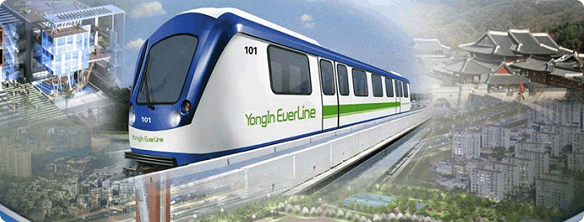
In 2004, Yongin Light Rail Transit signed a project agreement with Canadian company Bombardier, including a Minimum Revenue Guarantee (MRG) clause that required Yongin City to cover the shortfall if fare revenues fell below 90% of the forecasted demand. The Korea Transport Institute, which conducted the demand forecast for Yongin Light Rail Transit, projected an average daily ridership of 139,000 passengers. However, in 2013, the first year of operation, the actual number of passengers was only 9,000 per day. During this process, Yongin City engaged in legal disputes with Bombardier over the MRG and other issues but ultimately lost in international arbitration and was ordered to pay 850 billion won, including interest.
Even after opening, passenger numbers remained far below the forecasted demand, resulting in mounting deficits. As the massive deficits were covered by taxes, Yongin City residents filed a resident lawsuit in October 2013, seeking damages from three former mayors, including former mayor Lee Jeongmun, as well as former and current public officials, city council members, and researchers from the Korea Transport Institute who were responsible for the demand forecast. The residents lost in both the first and second trials, but in 2020, the Supreme Court overturned the ruling and remanded the case. In February last year, the remand trial court ruled that the current mayor of Yongin must seek damages of over 21.4 billion won from former mayor Lee Jeongmun, the Korea Transport Institute, and the responsible researchers. In the retrial held on the 16th, the Supreme Court upheld its previous decision, siding with the residents.
The Yongin Light Rail Transit lawsuit is significant as it is the first case since the introduction of the resident lawsuit system in 2005 to target a private investment project carried out by a local government, and it could have implications for other large-scale private investment projects that are running deficits.
A representative example is the Busan-Gimhae Light Rail Transit, which opened in 2011 at a cost of 1.3124 trillion won. Like Yongin Light Rail Transit, it has failed to meet demand forecasts and continues to operate at a loss. Last year alone, the compensation amount reportedly reached 84.1 billion won. At the time of the project, the average daily ridership was projected to exceed 300,000, but actual ridership has remained at around 40,000. Civic groups in Gimhae and Busan filed a lawsuit against the government in 2014, claiming damages due to the inaccurate demand forecasts for Busan-Gimhae Light Rail Transit.
Uijeongbu Light Rail Transit is another case where failed demand forecasts led to persistent deficits. Opened in 2012, Uijeongbu City signed an agreement with the operator under the MRG system, guaranteeing to cover deficits if passenger numbers reached 50-80% of the forecasted demand. However, actual ridership fell far below 50%, and the operator was unable to recover losses, resulting in a cumulative deficit of 370 billion won and eventual bankruptcy in 2017. At the end of 2018, Uijeongbu City signed a new agreement with a different operator under a Minimum Cost Compensation (MCC) system, covering deficits based on passenger numbers at the time of the previous operator's bankruptcy rather than the original projections. Uijeongbu Light Rail Transit currently operates at a deficit of 10 billion won.
Other light rail lines in Seoul are also experiencing ongoing deficits due to failed demand forecasts.
The Ui-Sinseol Line, which opened in 2017, recorded a deficit of 10.2 billion won in its first year, and has continued to post annual losses exceeding 10 billion won. Its cumulative deficit reportedly exceeds 200 billion won. The Ui-Sinseol Line project was initially pursued as a Build-Transfer-Operate (BTO) private investment project, but due to poor profitability, it switched to a Minimum Cost Compensation (BTO-MCC) model this year, with Seoul City covering about 8 billion won in operating costs annually. During this process, the previous operator suffered capital erosion and a new operator had to be found. The main cause of the deficit was, again, the initial failure in demand forecasting. The Ui-Sinseol Line was expected to carry 130,000 passengers per day at opening, but as of last year, average daily ridership was only 75,000, about 58% of the projection. Furthermore, the free ridership rate reached 36.2%, more than triple the forecasted 11.6%. The Sillim Line has faced similar issues. Although it was expected to carry 130,000 passengers per day, actual ridership after opening was only 50,000 to 60,000. Currently, the average daily ridership is 82,000. Namseoul Light Rail Transit, the operator of the Sillim Line, posted a net loss of 16 billion won in its first year of operation.
© The Asia Business Daily(www.asiae.co.kr). All rights reserved.
![User Who Sold Erroneously Deposited Bitcoins to Repay Debt and Fund Entertainment... What Did the Supreme Court Decide in 2021? [Legal Issue Check]](https://cwcontent.asiae.co.kr/asiaresize/183/2026020910431234020_1770601391.png)
















