Liquefied Carbon Dioxide Emissions from Vessels Used as Resources During Operation
Emerging Need for Regulatory Improvements to Process Captured CO2
"OCCS Expected to Become a Core Technology for Achieving Net Zero in Ships"
Samsung Heavy Industries has successfully captured carbon dioxide in real time from a vessel in actual operation and utilized it as a raw material for the production of eco-friendly fuel. This achievement is considered the first step in establishing a decarbonization value chain across the shipbuilding, shipping, and energy industries.
Samsung Heavy Industries announced on the 18th that it has achieved meaningful results in the demonstration of the 'Onboard Carbon Capture & Storage (OCCS)' system, which was carried out in collaboration with HMM, Panasia, and the Korean Register (KR). In July last year, they installed an amine absorption-based OCCS on HMM's 2,200 TEU-class container vessel for the first time in Korea and have been verifying its performance every month under real navigation conditions. The amine absorption method refers to a technology in which an amine solution, a chemical substance, reacts with carbon dioxide to selectively absorb and store it.
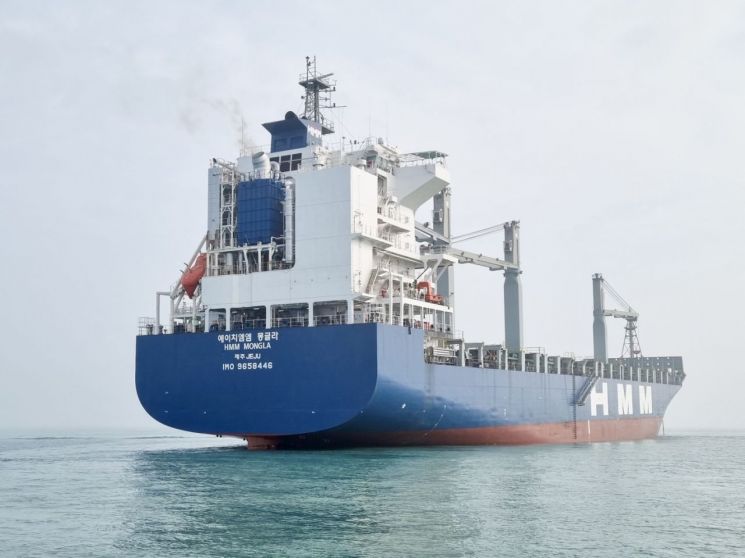 Samsung Heavy Industries announced on the 18th that it has achieved meaningful results in the demonstration of the 'Onboard Carbon Capture & Storage (OCCS)' system, participated in together with HMM, Panasia, and the Korean Register (KR). The photo shows the OCCS system installed on the upper part of the ship. Photo by Samsung Heavy Industries
In particular, this demonstration succeeded in capturing carbon dioxide while minimizing energy consumption by utilizing waste heat generated during vessel operation. The liquefied carbon dioxide collected in January and May, each with a purity of over 99.9%, was used as a feedstock in the production process of eco-friendly methanol. This case is drawing attention as an example of 'carbon resource utilization,' as it goes beyond simply storing carbon dioxide and converts it back into a resource.
Lee Dongyeon, Vice President and Director of the Shipbuilding & Offshore Research Institute at Samsung Heavy Industries, stated, "OCCS can be used as an energy source by capturing carbon and converting it into eco-friendly fuel, making it a core technology for achieving net zero in ships," and added, "We will lead the relevant market through collaboration among the shipbuilding, shipping, and equipment industries."
Meanwhile, the industry is pointing out that, in order to commercialize the technology, it is urgent to establish onshore infrastructure capable of processing the captured carbon dioxide, as well as to revise related laws and systems.
© The Asia Business Daily(www.asiae.co.kr). All rights reserved.

















