Recent Economic Trends: July Green Book
"Downward Pressure" Mentioned for Seven Consecutive Months
Positive Signs from Improved Consumer Sentiment
"31.8 Trillion Won Supplementary Budget Expected to Boost Domestic Demand"
The government has assessed that "downward pressure on the Korean economy remains persistent." Although exports increased in June due to improvements in the semiconductor sector, the government judged that domestic indicators such as construction and facility investment continue to be sluggish. However, it also noted that there are some positive signs, such as improved consumer sentiment.
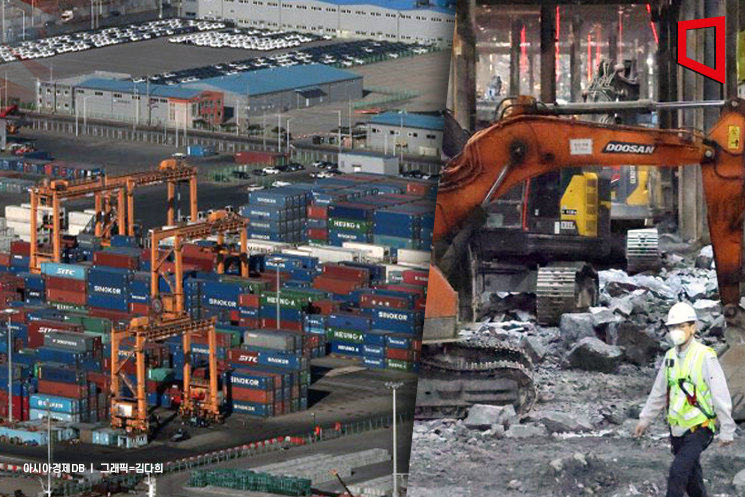
In the July edition of the "Recent Economic Trends (Green Book)" released on July 18, the Ministry of Economy and Finance stated, "While the recovery of domestic demand, including consumption and construction investment, is delayed and employment difficulties persist, especially in vulnerable sectors, downward pressure on the economy remains due to concerns over a slowdown in exports amid deteriorating external conditions caused by U.S. tariffs." The term "downward pressure" has been included for seven consecutive months this year.
However, exports in June rebounded for the first time in a while, mainly due to improvements in the semiconductor market. Total exports in June increased by 4.3% year-on-year, and average daily exports reached $2.85 billion, up 6.8% from the same month last year. Cho Sungjoong, Director of Economic Analysis at the Ministry of Economy and Finance, said, "While downside risks and uncertainties remain significant for exports, positive sentiment is emerging on the domestic front, reducing internal uncertainty."
On the other hand, domestic indicators remained weak. Retail sales in May were flat at 0.0% compared to the previous month and decreased by 0.2% year-on-year. Facility investment fell by 4.7% from the previous month but increased by 7.5% year-on-year, indicating a somewhat stable situation. Construction investment plunged by 3.9% from the previous month and by a substantial 20.8% year-on-year, signaling a continued slump in the construction sector.
Production also continued to contract. Total industrial production in May decreased by 1.1% from the previous month, with declines across all major sectors: manufacturing (-2.9%), services (-0.1%), and construction (-3.9%). The Korea Development Institute (KDI) also stated in its recent "July Economic Trends" report that "while the construction sector remains sluggish, external conditions are also worsening, causing the economy to remain at a similarly low level as the previous month."
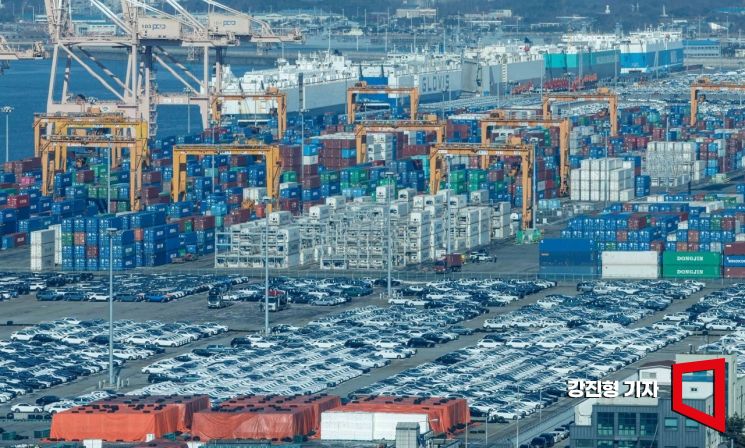 President Donald Trump signed a proclamation imposing a 25% tariff without exceptions on steel and aluminum products imported into the United States, and announced that tariffs on automobiles and semiconductors are also under consideration. On February 13, 2025, export vehicles were waiting to be loaded at Pyeongtaek Port in Gyeonggi Province. Photo by Kang Jinhyung
The Consumer Sentiment Index (CSI) rose by 6.9 points from the previous month to 108.7 in June, reflecting a more optimistic outlook. However, the Corporate Business Survey Index (CBSI) remained below the benchmark level of 100. The CBSI performance index for June was 90.2, down 0.5 points from the previous month, and the outlook index also fell by 0.1 points to 89.4, indicating that business sentiment remains subdued.
Employment indicators continued to improve. The number of employed people in June increased by 183,000 year-on-year, a smaller increase than the 245,000 recorded in the previous month, but the trend of employment growth persisted. The unemployment rate was 2.8%, down 0.1 percentage points from the same month last year. However, inflation accelerated again. The consumer price index in June rose by 2.2% year-on-year, up 0.3 percentage points from 1.9% in the previous month, and core inflation, excluding food and energy, also rose by 2.0%. The government attributed this to larger increases in petroleum and processed food prices.
Regarding the global economy, the Ministry of Economy and Finance stated, "Deteriorating trade conditions due to tariffs imposed by major countries are causing continued volatility in international financial markets and ongoing concerns about a slowdown in trade and growth." The U.S. economy continues to show solid employment, but household consumption is slowing, and risks remain due to uncertainties in government trade policy. The Chinese economy saw its gross domestic product (GDP) increase by 5.2% year-on-year in the second quarter, while the consumer price index (CPI) in June turned positive for the first time in five months, and export growth expanded by 1.0 percentage point from the previous month.
The government emphasized, "We will swiftly execute the supplementary budget of 31.8 trillion won and focus all government resources to ensure that the livelihood recovery consumption coupons, scheduled to be distributed on July 21, serve as a catalyst for boosting consumption and revitalizing the local economy. We will also make every effort to support domestic companies affected by U.S. tariffs and to respond to trade risks."
© The Asia Business Daily(www.asiae.co.kr). All rights reserved.


















