Proposals for Grand Social Reform in the New Democratic Republic
Politics, Unelected Powers, Diplomacy, Economy, Education, and More
The National Professors and Researchers Solidarity Alliance, which includes the Korean Professors and Lecturers Union and other associations of professors and researchers, presented reform proposals on July 17 in nine key areas: politics, unelected powers, diplomacy, media, economy, society, labor, climate crisis and energy, and education. The proposals included reforming the winner-takes-all representative system.
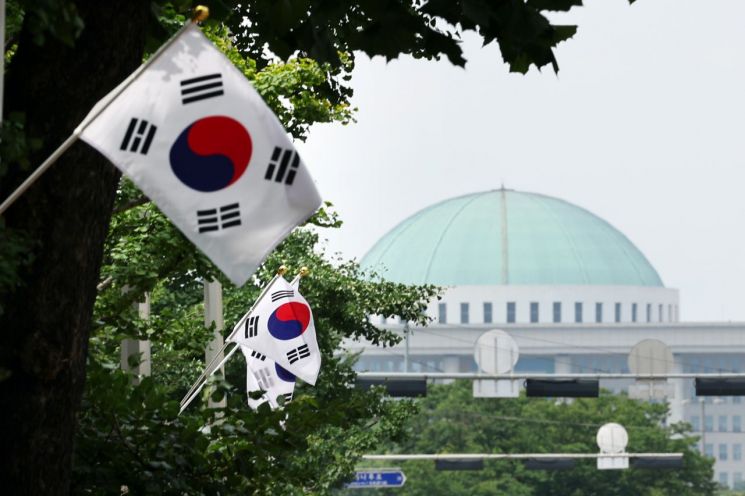 On the 74th Constitution Day, July 17, the National Assembly building is visible behind the Taegeukgi flag displayed on the street in Yeouido-dong, Yeongdeungpo-gu, Seoul. Photo by Yonhap News
Nam Joongwoong, the standing representative of the National Professors and Researchers Solidarity Alliance, stated during his opening remarks at the "What We Expect from the New Government and National Assembly: 2025 Grand Social Reform Proposals for a New Democratic Republic Aiming for Democracy, Equality, and Public Interest" conference held at the National Assembly Library on the morning of July 17, "During the Yoon Suk Yeol administration, Korean society earned the disgraceful reputation of being a country leading the global retreat of democracy." He emphasized, "With the power of citizens who prevented insurrection, we must not stop at restoring democracy, but must move toward a more equal and public-oriented society."
Specifically, regarding political reform, the alliance proposed reforming the winner-takes-all representative system, strengthening local autonomy and decentralization for balanced regional development, and expanding public participation.
Kang Woojin, a professor in the Department of Political Science and Diplomacy at Kyungpook National University, stated during the policy proposal presentation, "Democracy after democratization, which has focused on institutionalizing the electoral system, must now move toward democratizing the representative system." He emphasized, "To achieve this, institutional reforms are needed to strengthen the recruitment and representative functions of political parties."
He then proposed the following: a significant expansion of proportional representation, the introduction of a runoff voting system, strengthening the National Assembly's budgetary, legislative, and oversight functions, allowing regional parties, and constitutional amendments for a presidential two-term system and its combination with the parliamentary election system.
The alliance also proposed democratic control over unelected powers such as the judiciary and prosecution, as well as legal and institutional reforms to prevent abuse of power and protect civil rights.
Maeng Sooseok, professor emeritus at the Law School of Chungnam National University, who was in charge of the policy proposals, said, "We all witnessed how important the roles of the courts, prosecution, and Constitutional Court are during the impeachment process of former President Yoon Suk Yeol." He stressed, "Because the courts have the authority to judge the people, everyone must pay attention to preventing the abuse of that power."
Professor Maeng further stated, "The so-called 'legal cartel' attempted an unprecedentedly unfair political intervention, akin to a military operation, in election law trials involving leading opposition presidential candidates." He asserted, "They cannot be free from criticism that they tried to obstruct the sacred exercise of citizens' voting rights."
He went on to point out, "The prosecution, too, has frequently manipulated the media, which is driven by the rush for breaking news and often neglects the facts in political cases. This has led to situations where individuals are perceived as criminals even before trials begin, obscuring the truth through media play."
He emphasized, "The new government, launched through the 6·3 presidential election that resulted from anti-democratic and unconstitutional martial law, must complete revolutionary-level reforms of the judiciary and prosecution systems." He warned, "If the reforms are not implemented intensively and irreversibly at the beginning of the administration, the judicial and prosecutorial reforms that were presidential campaign pledges could once again come to nothing."
The alliance also stated that in terms of diplomacy and peace policy, it aims to establish a peace regime on the Korean Peninsula and pursue pragmatic diplomacy centered on national interests, with the goal of promoting peace in Northeast Asia and the world.
The alliance also emphasized the need for media reform, aiming to guarantee freedom of expression, establish an independent media regulatory system, and create a participatory media environment. It further stressed the necessity of expanding social rights and strengthening public interest, including the guarantee of the right to health, care, housing, and mobility, as well as gender equality and the establishment of a social solidarity system.
Regarding economic reform, the alliance proposed shifting from a growth-centered economy to a people- and region-centered economy, and aiming for a solidarity-based state that integrates welfare and environmental justice. In terms of labor reform, it suggested introducing a four-day workweek, guaranteeing basic labor rights, ensuring non-discriminatory jobs, and creating safe workplaces.
To move toward an ecologically equal society, the alliance also proposed large-scale public investment and the expansion of public renewable energy.
The alliance further highlighted the need to guarantee the right to education through balanced development of the humanities and basic sciences, balanced university development, free higher education, and the expansion of public funding for higher education.
Song Joomyung, chairperson of the Korean Professors and Lecturers Union, stated, "Citizens who have been reborn as sovereigns in the public square are now demanding a complete restructuring of the established order created by the June 1987 Uprising, in other words, the '1987 system.'" He added, "Only when everyone can equally enjoy their rights as citizens will democracy in our country become more stable and robust. The realm of social public interest must also be further expanded."
© The Asia Business Daily(www.asiae.co.kr). All rights reserved.

















