Lecture at the Korea Chamber of Commerce and Industry Summer Forum
"Quantum computers can solve problems impossible for conventional computers"
"With 300 quantum bits, can calculate more possibilities than the number of particles in the universe"
"Potential to render current encryption systems ineffective"
"Education, automobile, and computer industries will also converge"
Professor Jeongsang Kim of Duke University in the United States stated at the Korea Chamber of Commerce and Industry Summer Forum held in Gyeongju, North Gyeongsang Province on the 17th, "Quantum computers are a new technology that calculates in a completely different way from conventional computers," adding, "They will become an important tool that will change the structure of industry in the future."
In his lecture titled "Quantum Computers and the Future of Advanced Technology," Professor Kim highlighted the impact of quantum technology on industry. He noted, "Until the 1990s, the telephone, television, photography, and music industries all existed separately, but now they are all integrated into a single smartphone," and predicted, "In the future, the education, automobile, and computer industries will also converge in this way." He explained that the convergence of technology is breaking down the boundaries between industries and creating a new order.
Regarding the commercialization timeline of quantum technology, he said, "It is impossible to know exactly when it will become a reality, but technology that has already emerged from the laboratory is making its way into industry." He emphasized, "Rather than fearing change, those who ride the wave of transformation first will seize the opportunities."
He also explained the operating principles of quantum computers using simple analogies. Introducing the core concepts of quantum mechanics, "superposition" and "entanglement," Professor Kim explained that superposition is "like a coin spinning in the air, being neither heads nor tails, so a quantum bit (qubit) can be both 0 and 1 at the same time." He added that entanglement is "the concept that if you toss two coins and one lands on heads, the other must also land on the same side, meaning that two particles are connected even when they are far apart."
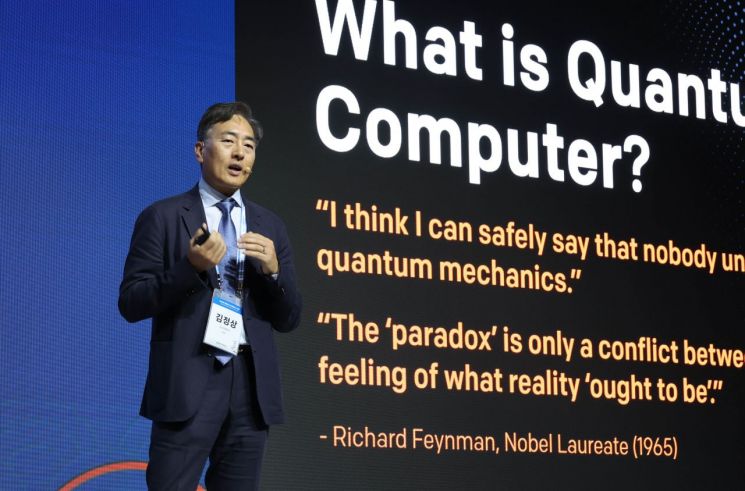 Professor Jeongsang Kim of Duke University is giving a lecture titled "Quantum Computers and the Future of Advanced Technology" at the Korea Chamber of Commerce and Industry Summer Forum held in Gyeongju on the 17th. Korea Chamber of Commerce and Industry
By utilizing these quantum properties, it is possible to simultaneously calculate far more possibilities than the number of particles in the universe with just 300 quantum bits. Professor Kim said, "Quantum computers have the potential to solve problems in a much shorter time that would take billions of years for classical computers to solve."
As an example of practical application, he mentioned "integer factorization," which involves finding what numbers can divide a very large number?a calculation that forms the basis of current online finance and cryptography. Professor Kim warned, "If quantum computers become commercialized, most of the security systems we use today could be rendered ineffective," and added, "There is even a possibility that the entire global financial system may need to be redesigned."
The lecture also introduced the "ion trap" type of quantum computer that Professor Kim is currently researching. This method involves capturing and aligning individual atoms, then performing calculations by firing lasers at each one. He explained, "We arrange 23 atoms in a row and precisely control lasers over them to perform quantum operations," adding, "The architecture is fundamentally different from that of conventional computers." He described this as an example of technology moving beyond the laboratory and toward commercial application.
Concluding his lecture, Professor Kim said, "The world is changing faster and faster." He emphasized, "Understanding the essence of technology and preparing now is the way to shape the future," stressing the need to anticipate the direction of change and act accordingly.
© The Asia Business Daily(www.asiae.co.kr). All rights reserved.
![User Who Sold Erroneously Deposited Bitcoins to Repay Debt and Fund Entertainment... What Did the Supreme Court Decide in 2021? [Legal Issue Check]](https://cwcontent.asiae.co.kr/asiaresize/183/2026020910431234020_1770601391.png)















