Travel Balance Deficit Persists for 25 Years in South Korea
A Major Factor Holding Back Economic Growth
KB Research Institute: "Resolving Travel Balance Deficit Alone Would Boost Growth Rate by 0.75 Percentage Points"
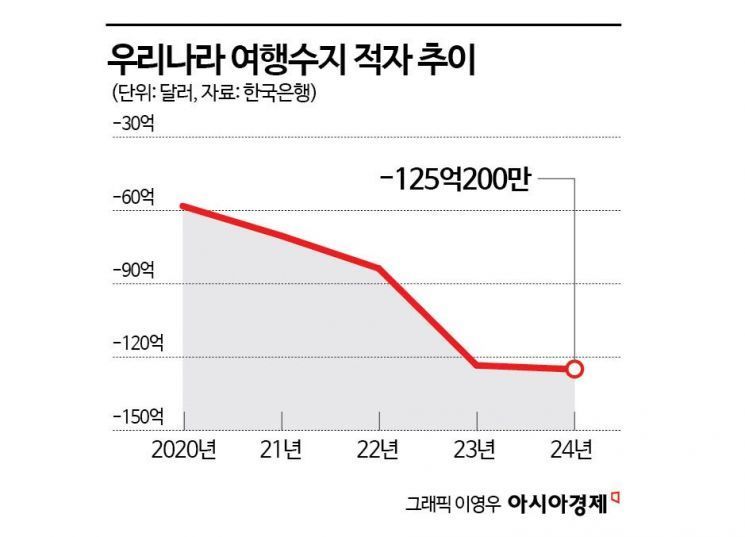
An analysis has found that if the persistent deficit in South Korea’s travel balance were to be resolved, the country’s economic growth rate could surge by more than 0.7 percentage points. If the travel balance were to turn positive, it is projected that more than 170,000 jobs would be created. Experts point out the need to expand various regional tourism programs and develop differentiated content and products to attract more foreign visitors to South Korea.
Travel Balance Deficit Continues for 25 Years, Burdening the Economy
According to KB Management Research Institute and the Bank of Korea on July 17, South Korea’s travel balance deficit reached $12.5 billion (17.3 trillion won) last year, marking the largest deficit in six years since 2018. South Korea’s travel balance has recorded a deficit for 25 consecutive years since 2000. During the COVID-19 pandemic in 2020, the deficit shrank to $5.8 billion as overseas travel by South Koreans decreased, but the deficit worsened again as outbound travel increased afterward.
The annual travel balance deficit, which exceeds 10 trillion won each year, has become a burden on the South Korean economy. This is because domestic travelers spend more money overseas than foreign visitors spend in South Korea, which negatively affects GDP growth.
KB Management Research Institute believes that simply resolving the travel balance deficit would have a significant economic impact. The institute analyzed that if last year’s travel balance had broken even instead of posting a deficit, South Korea’s economic growth rate would have increased by 0.75 percentage points.
Bae Jaehyun, a researcher at KB Management Research Institute, explained, “The figure was calculated by assuming that nominal GDP would have increased by $12.5 billion if last year’s travel balance deficit had improved from a $12.5 billion deficit to zero.” Last year, South Korea’s economic growth rate was 2.0%, and it is estimated that the growth rate would have reached 2.75% if not for the travel balance deficit.
If the travel balance deficit had been resolved, employment would also have increased by an estimated 175,000 jobs. Researcher Bae stated, “The employment increase was estimated based on the 2020 input-output table, considering that the employment inducement coefficient in the consumer services sector, a subcategory of the service industry, is 10.3 jobs per 1 billion won.”
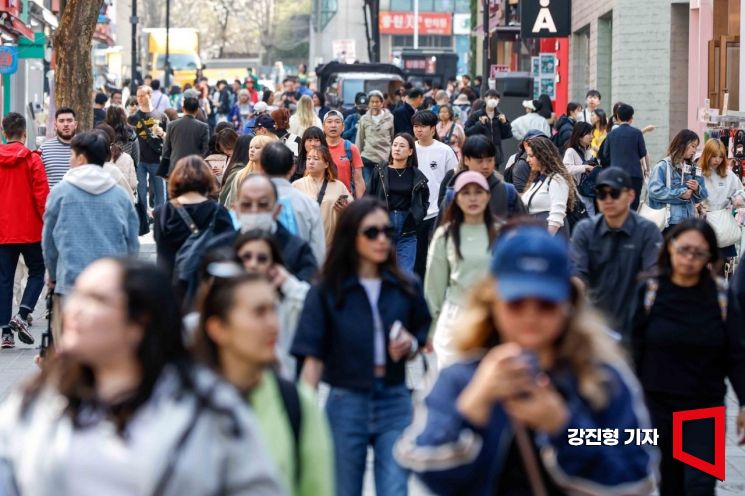 Foreign tourists visiting Myeongdong, Jung-gu, Seoul, in early April are enjoying sightseeing. Photo by Jin-Hyung Kang aymsdream@
Need to Develop Regions Outside the Seoul Metropolitan Area to Attract More Foreign Visitors
The institute suggested that South Korea should look to neighboring Japan as a reference for resolving its travel balance deficit. In Japan, regional tourism promotion in the 2000s, deregulation of the tourism industry and the effect of a weak yen in the 2010s, and a shift in policy focus from quantity to quality (increasing travel spending) in the 2020s have all contributed to positive results. As a result, Japan’s travel balance has been in surplus since 2014 and now contributes more than 1% to the country’s total GDP.
Japan has branded travel themes by region, built 22 international airports in non-metropolitan areas during the 2000s, and improved transportation infrastructure by allowing flexible purchase of the Japan Rail Pass. The institute noted that these examples are worth considering. The United Kingdom also designates a “City of Culture” every four years to develop regional tourism.
The institute argued that since foreign visitors are likely to perceive travel to South Korea as limited to the Seoul metropolitan area, it is necessary to develop “regional tourism” programs that leverage cultural heritage, natural landscapes, and unique local characteristics outside the metropolitan area. Researcher Bae emphasized, “More than 80% of foreign travelers visiting South Korea go to the metropolitan area, but if regions outside the metropolitan area build up tourism infrastructure, the number of foreign visitors could increase.”
Additionally, he added, “It is necessary to prepare differentiated content and products so that interest in K-culture?including music, dramas, food, and culture?can lead not only to travel to Korea but also to increased consumption.”
© The Asia Business Daily(www.asiae.co.kr). All rights reserved.













