Trump Administration Decides on 50% Tariff for Brazilian Products
Brazil: "No Request to Postpone Tariff Start Date"
Signs of "Retaliatory Tariffs"... Beef Export Market Undergoing Restructuring
As the Trump administration announced plans to impose an ultra-high tariff of 50% on Brazilian products, tensions are rising after the Brazilian government stated that it would not request a delay in the tariff implementation date. Yonhap News reported on the 15th (local time) that "Brazilian Vice President and Minister of Industry and Trade Geraldo Alckmin held a meeting with representatives from the Brazilian Business Association and other industry leaders on the same day."
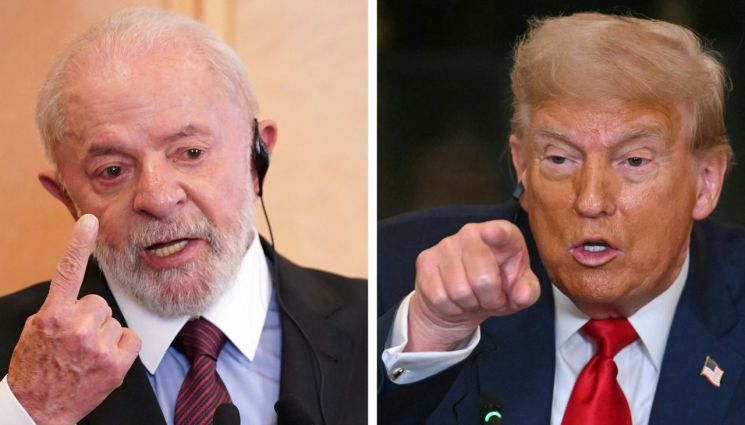 Brazilian President Luis Inacio Lula da Silva and U.S. President Donald Trump. Photo by AFP News Agency
After the meeting, Vice President Alckmin told reporters, "Companies have asked us to negotiate with the United States to postpone the tariff implementation date by up to 90 days," adding, "The industry says this is to allow time to prepare for the tariff increase."
Vice President Alckmin said, "Negotiating the withdrawal of the tariff increase is our top priority, but the industry also wants us to express concerns about how soon the United States plans to implement the tariffs." However, he added, "Our government does not plan to request a delay in the tariff implementation date from the United States, and we will resolve the issue by the 31st."
Previously, President Luis Inacio Lula da Silva had declared that Brazil would respond to the U.S. plan to impose a 50% tariff with a "retaliatory tariff" under the Economic Reciprocity Act. It was reported that on the 14th, President Lula signed a presidential decree stating that if the United States imposes a 50% "tariff bomb," Brazil could respond by imposing tariffs at the same rate.
The Brazilian industry has expressed "concern" about the possibility of retaliatory tariffs by the government, but has also indicated its intention to cooperate with the government in general terms. Local media outlet G1 reported, "Brazilian beef exporters have already begun adjusting their production volumes," adding, "They mainly supply quantities requested by U.S. food processing companies, and having already stockpiled production through the first half of August, they have stopped additional slaughtering."
The Mato Grosso do Sul State Meat Processing Industry Association told G1, "This is a strategic decision to prevent an oversupply of products destined for the U.S. market," and added, "If reaching an agreement with the United States becomes difficult, we are preparing to redirect shipments to other export destinations, including China."
Brazil is the world's largest beef exporter, raising about 200 million cattle annually. According to the Brazilian Meat Exporters Association, last year Brazil produced 11.81 million tons of beef and exported 3.75 million tons. Of these exports, 48.8% went to China, followed by the United States (12.1%) and Chile (4.76%). The Brazilian Meat Exporters Association stated, "We are working to reorganize global export destinations by collaborating with new partners," and explained, "If the United States is unable to import meat, China, Southeast Asia, and the Middle East will be the most likely destinations."
© The Asia Business Daily(www.asiae.co.kr). All rights reserved.
![Clutching a Stolen Dior Bag, Saying "I Hate Being Poor but Real"... The Grotesque Con of a "Human Knockoff" [Slate]](https://cwcontent.asiae.co.kr/asiaresize/183/2026021902243444107_1771435474.jpg)
















