Ministry of Science and ICT Holds 6G Satellite Communication Conference
Starlink and OneWeb Expected to Launch Satellite Internet Services in Korea This Year
"Developing Indigenous Satellite Communication Technology... Aiming for Self-Reliance"
The government is launching full-scale efforts to develop technology in line with the domestic introduction of low Earth orbit (LEO) satellite communication. As LEO satellite communication is considered a core technology for sixth-generation (6G) mobile networks, the government aims to strengthen the competitiveness of the domestic industry and achieve technological self-reliance.
The Ministry of Science and ICT announced on the 15th that it held the '6G Satellite Communication 2025 Conference' at EL Tower in Yangjae, Seocho-gu, Seoul. Marking its fourth year, this year's conference was held under the theme, "Korea's Leap Toward Space! The First Year of 6G LEO Satellite Communication Technology Development."
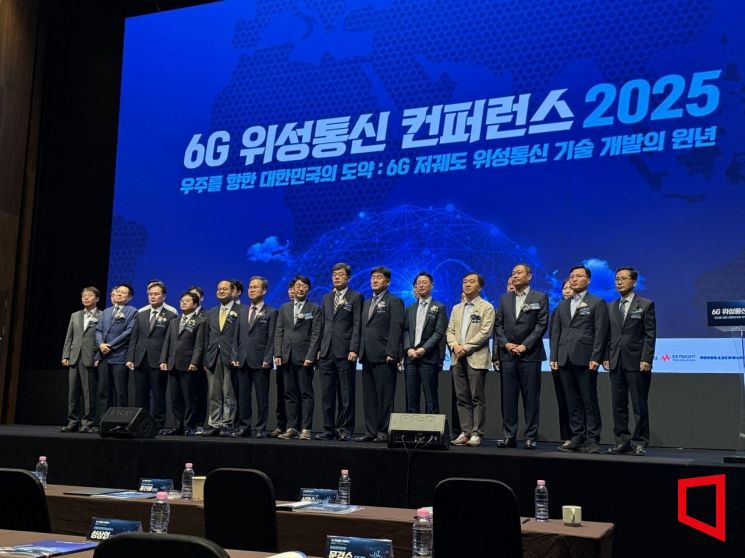 Participants are taking a commemorative photo at the '6G Satellite Communication 2025 Conference' held on the morning of the 15th at EL Tower in Yangjae, Seocho-gu, Seoul. Photo by Lee Myunghwan
The conference consisted of four sessions: ▲Next-generation satellite communication development strategies and global trends ▲Satellite communication standardization and technology trends ▲Domestic service and technology trends in LEO satellite communication ▲Innovative 6G standard-based LEO satellite communication technologies.
The Ministry of Science and ICT emphasized that this year's event is particularly significant, as it marks the beginning of the full-scale introduction of domestic LEO satellite communication services and the development of 6G standard technologies. According to industry sources, Starlink and OneWeb, both LEO satellite-based internet services, are expected to launch domestic services within the year.
Previously, the Ministry of Science and ICT approved in May the cross-border supply agreement between Starlink Korea and SpaceX, as well as the agreement between Hanwha Systems, KT SAT, and Eutelsat OneWeb. As a result, both Starlink and OneWeb now only need to complete the device conformity assessment for user antennas. Currently, a separate antenna terminal is required to communicate with the satellites for these services, and once the device conformity review is completed, both companies will be able to launch their services domestically.
Under the Telecommunications Business Act, foreign operators such as SpaceX and OneWeb cannot directly provide communication services in Korea. For these companies to offer services domestically, a domestic key telecommunications operator must sign a cross-border supply agreement with the foreign operator and obtain approval from the Minister of Science and ICT.
The Korean government is also pursuing measures to promote satellite communication in order to become a leading nation in this field. Specifically, the measures include ▲strengthening the competitiveness of the satellite communication industry ▲securing satellite networks and managing them throughout their life cycle ▲establishing a foundation for the introduction of new services ▲improving the efficiency of satellite spectrum utilization ▲establishing order in the use of satellite spectrum. Ji Eunkyung, Director of the Radio and Broadcasting Management Division at the Ministry of Science and ICT, who presented the current status of satellite communication promotion policies, explained, "As global companies like SpaceX and OneWeb compete fiercely in the LEO satellite communication market, countries around the world are also pursuing the construction of their own state-led LEO satellite communication networks."
Director Ji stated, "By 2030, we will develop LEO satellite communication technologies and support their standardization so they can be reflected in international standards. We will also support overseas expansion and advance the radio monitoring system to foster the LEO satellite ecosystem."
Ryu Jemyoung, Second Vice Minister of Science and ICT, said, "We will strategically link 6G and LEO satellite communication as key infrastructure for an AI-based society, and actively support Korea's leap to become one of the world's top three AI powerhouses."
Yoon Youngbin, Administrator of the Korea Aerospace Administration, stated, "To prepare for the era of ultra-connected 6G communication, we are promoting LEO satellite communication technology development projects, and through technological self-reliance, we will lay the foundation for the commercialization of satellite communication and securing market competitiveness."
Meanwhile, the conference was hosted by the Ministry of Science and ICT and organized by the Satellite Communication Forum. Approximately 350 domestic and international satellite communication experts and industry representatives from academia, research institutes, and the private sector attended the event.
© The Asia Business Daily(www.asiae.co.kr). All rights reserved.












