Investing 16 Billion KRW to Develop an AI-Based 'Small-Scale Smart City'
Building Innovative Administrative Services for Youth, Small Business Owners, and Foreign Residents
Ansan City in Gyeonggi Province will establish an 'ICT Landmark' in Sadong, Sangnok-gu, where citizens can experience a variety of artificial intelligence (AI) technologies.
On July 15, Ansan City held a policy briefing in the main conference room at City Hall and announced its plan to promote the creation of an AI-based smart city.
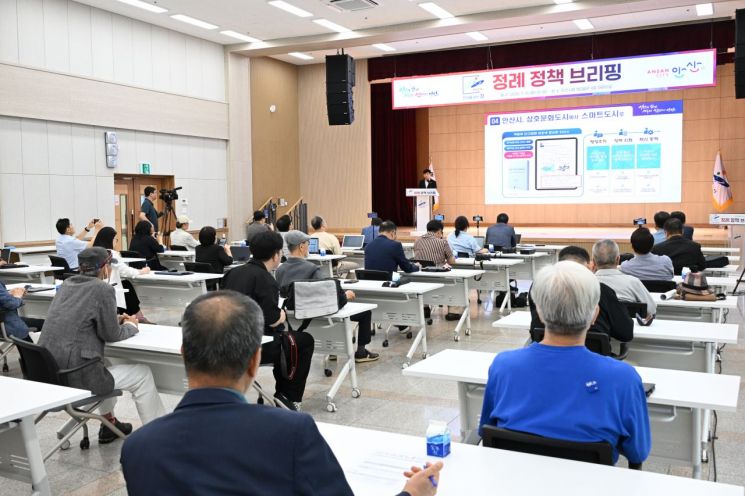 Jeon Deokju, Director of Administrative Safety Education Bureau of Ansan City, is explaining the city's smart city construction plan at the policy briefing on the 15th. Provided by Ansan City
This initiative follows Ansan City's selection last month for the '2025 Small-Scale Smart City Development Project' hosted by the Ministry of Land, Infrastructure and Transport. To this end, the city will invest a total budget of 16 billion KRW, including 8 billion KRW from the national government and 8 billion KRW from the local government, by the end of 2027.
The city will especially utilize unused space within the Urban Information Center to create the 'Smart Nest Center,' an 'ICT Landmark.' The center will feature a smart city experience and exhibition hall, a citizen-participatory data utilization living lab, and a training center for cultivating professional talent equipped with AI digital devices for educational purposes.
Jeon Deokju, Director of the Administrative Safety Education Bureau of Ansan City, stated, "With the establishment of the ICT Landmark as a starting point, we will realize inclusive digital urban innovation that all citizens can enjoy together."
The city plans to integrate dispersed urban and industrial data through this project to build a platform that connects the city, industry, and citizens as one. Through this, the city aims to ensure that all citizens can equally benefit from public services.
Specifically, the city will provide multilingual transportation, tourism, and administrative services through an integrated platform based on MaaS (Mobility as a Service). By utilizing behavioral data-based commercial district analysis, the city will attract and retain young people, as well as revitalize commercial districts and the local economy. The city also presented plans to promote research and industrial exchange by connecting technology transfer and talent supply chains between the National Industrial Complex and the Campus Innovation Park.
The city also plans to develop a smart city model that can proactively respond to demographic changes such as population decline and the transition to a multicultural society. To achieve this, the city will provide AI-tailored educational support at foreign language education sites and establish a health management and telemedicine support system in cooperation with medical institutions at healthcare sites.
Lee Mingeun, Mayor of Ansan City, said, "With our selection for the smart city development project, the city has reached an important turning point to leap forward as an AI-based future city," adding, "We will create a smart city ecosystem where citizens, businesses, experts, and the administration all participate together throughout the project implementation process."
© The Asia Business Daily(www.asiae.co.kr). All rights reserved.

















