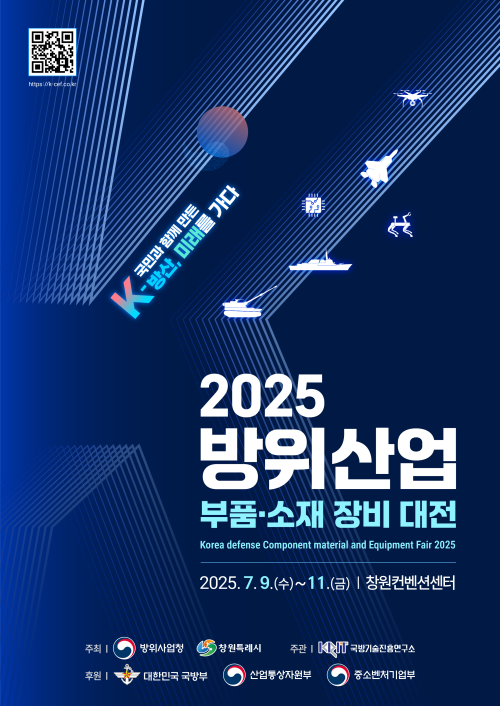
Specialized in pearl luster pigments, C-Cube announced on July 15 that it unveiled next-generation stress detection sensor technology at the '2025 Defense Industry Component·Material Equipment Exhibition.'
This technology enables intuitive assessment of structural damage through color changes. It is part of a dual-use technology development project jointly overseen by the Ministry of Trade, Industry and Energy and the Defense Acquisition Program Administration. The project is led by the Korea Electronics Technology Institute, with C-Cube participating as a joint research institution. The research theme is 'Development of color-changing materials and film-type visual sensors for detecting stress deformation and fatigue fracture.'
Traditionally, structural safety diagnostics have relied on expensive equipment and specialized personnel. Microcracks or fatigue damage are difficult to detect visually, which has limited accident prevention. According to the company, this technological development has enabled the creation of a film-type sensor that changes color even with minor deformation, making it possible for anyone to easily identify abnormalities through a 'visual diagnostic method.'
This film exhibits a distinct color change when a specific stress threshold is exceeded. It can also be mass-produced in meter-long units, allowing it to be attached to various structures. The technology was developed with the goal of detecting structural anomalies, such as microcracks or minor deformations, in military applications including fighter jets, helicopter fuselages, naval vessels, and military vehicles by observing color changes. Additionally, the potential for expansion into civilian sectors such as bridges, tunnels, wind towers, aircraft, trains, and ships has been confirmed.
If this technology is commercialized, it could save hundreds of billions of won in costs associated with regular safety inspections of bridges, tunnels, and power facilities. The company also expects that accident prevention will minimize social losses and human casualties.
A company representative stated, "As an integrated civil-military technology, this innovation is a strategic asset that can not only secure the safety of national infrastructure, but also improve the efficiency of military equipment maintenance and enhance the technological competitiveness of civilian industries." The representative added, "We plan to work with our partner institutions to systematically review specific applications and commercialization possibilities so that the related technology can be applied across various fields in the future."
© The Asia Business Daily(www.asiae.co.kr). All rights reserved.

















