Only CLV in Korea Proves Its Performance in Challenging West Sea Conditions
Hybrid Vessel with Selectable Operation Modes
Preparing to Join the 'West Coast Energy Expressway' Project
On July 15, Daehan Cable announced that its submarine cable laying vessel, Pharos, had successfully completed the installation of the entire external network section for the Yeonggwang Nakwol offshore wind power project in South Jeolla Province.
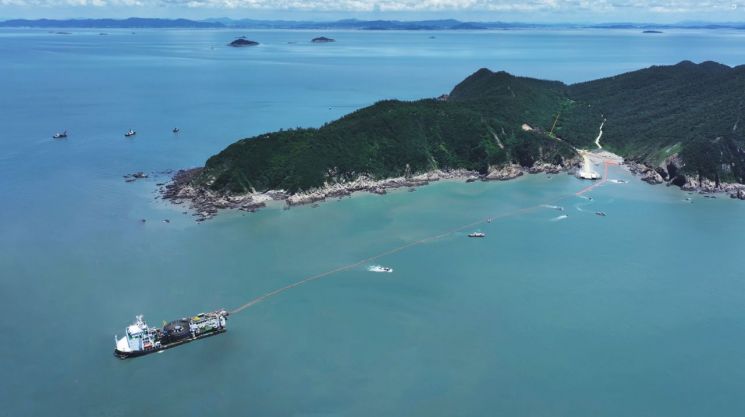 Pharosho is carrying out the external network installation for the Yeonggwang Nakwol project. Photo by Daehan Cable
The Yeonggwang Nakwol offshore wind power project is a large-scale initiative to build a power generation complex with a capacity of approximately 364.8 megawatts (MW) in the waters near Songido, Nakwol-myeon, Yeonggwang-gun, South Jeolla Province. The total project cost is 2.3 trillion won, and upon completion, it will generate enough electricity to supply about 250,000 households throughout the year. The overall construction progress has now surpassed 50%.
This project marks the first deployment of the Pharos vessel since Daehan Cable acquired it, and the external network installation was carried out in two phases. The first phase took place over about two weeks in mid-May, while the second phase began at the end of last month and was completed last week. The installation of the internal network, which is manufactured by Daehan Cable, is scheduled to proceed later this month.
Pharos is a submarine cable laying vessel introduced by Daehan Cable in November 2023 to secure “turnkey competitiveness” by handling everything from cable production and transportation to installation and maintenance. It is the only CLV (Cable Laying Vessel) in Korea and was specially constructed for submarine cable installation from the design stage. The vessel can operate at speeds of up to 9 knots under its own power, making its installation speed more than five to six times faster than a CLB (Cable Laying Barge), which relies on tugboats for propulsion, and it remains stable even under changing weather and tidal conditions.
Additionally, Pharos is a hybrid vessel that can be operated in either DP2 mode, which automatically and precisely controls the vessel’s position, or in anchoring mode, which uses anchors to fix the vessel in place, depending on the situation. In deep waters requiring high-precision installation, DP2 mode is used, while in shallow waters with less current, the anchoring mode is chosen for greater fuel efficiency and cost-effectiveness.
Unlike ordinary vessels, Pharos features a flat-bottom design, allowing it to independently access very shallow shorelines, which enables all-weather deployment in a variety of marine environments. In particular, it is evaluated as delivering optimal performance in the West Sea, where shallow depths and strong currents make cable installation especially challenging.
Meanwhile, in June, Daehan Cable completed the comprehensive construction of its Dangjin Submarine Cable Plant 1, which is capable of producing both internal and external cables for offshore wind projects. In the second half of the year, the company plans to begin construction of Submarine Cable Plant 2, which will produce 640kV-class high-voltage direct current (HVDC) submarine cables and external networks for Jangjojang, thereby strengthening its production capacity to participate in the West Coast Energy Expressway Project.
© The Asia Business Daily(www.asiae.co.kr). All rights reserved.
![Clutching a Stolen Dior Bag, Saying "I Hate Being Poor but Real"... The Grotesque Con of a "Human Knockoff" [Slate]](https://cwcontent.asiae.co.kr/asiaresize/183/2026021902243444107_1771435474.jpg)
















