An artificial sensory nervous system that mimics the sensory nervous system of living organisms has been developed in South Korea. This technology is expected to be used in medical and specialized environments, such as robotic prosthetic hands and micro-robots, as it can intelligently respond to external stimuli.
On July 15, KAIST announced that the research team led by Sunghyun Choi, distinguished professor in the Department of Electrical and Electronic Engineering at KAIST, and the team led by Jongwon Lee, professor in the Department of Semiconductor Convergence at Chungnam National University, have collaborated to develop a next-generation neuromorphic semiconductor-based artificial sensory nervous system that mimics the functions of the sensory nervous system in living organisms. They have successfully implemented a new concept robot system that responds efficiently to external stimuli.
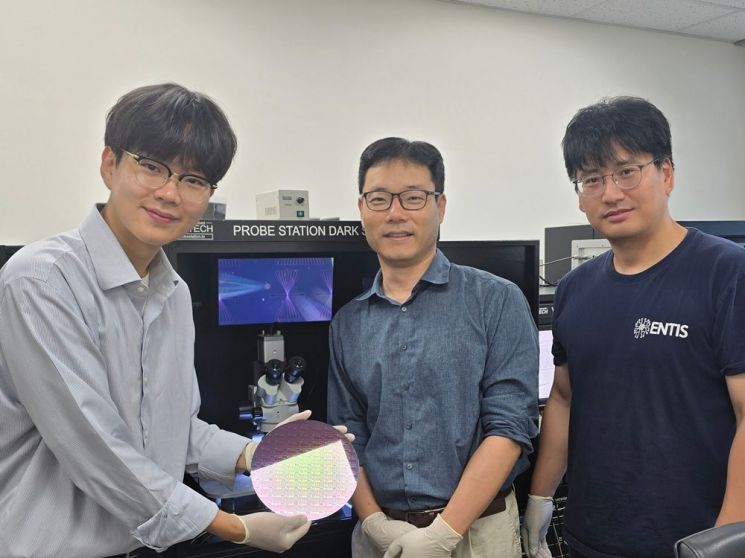 (From left) Sion Park, integrated master's and doctoral program, Jongwon Lee, professor, Sunghyun Choi, professor. Provided by KAIST
Animals, including humans, ignore safe or familiar stimuli and selectively respond sensitively to important stimuli. This allows them to avoid unnecessary energy expenditure, focus on crucial signals, and respond quickly to changes in their environment.
For example, the sound of an air conditioner in the summer or the sensation of clothing touching the skin soon becomes familiar and is largely ignored. However, in unexpected situations, such as when someone calls your name or a sharp object touches your skin, you quickly focus and respond (or withdraw).
This is regulated by the 'habituation' or 'sensitization' functions of the sensory nervous system. Recently, as artificial intelligence and robotics technologies have advanced, there have been ongoing efforts to apply the functions of the sensory nervous system in living organisms to robots in order to enable them to respond to external environments as efficiently as humans do.
However, in the past, implementing complex neural characteristics such as habituation or sensitization in robots required separate software or complicated circuits, making miniaturization difficult and limiting energy efficiency.
Attempts have been made to address these issues by using memristor devices, a type of neuromorphic semiconductor. However, even memristors have only been able to achieve simple changes in conductivity, making it difficult to mimic the complex properties of the nervous system.
A memristor is a next-generation electronic device whose name is a combination of 'memory' and 'resistor.' Its resistance value is determined by the amount and direction of electric charge that has previously flowed between its two terminals.
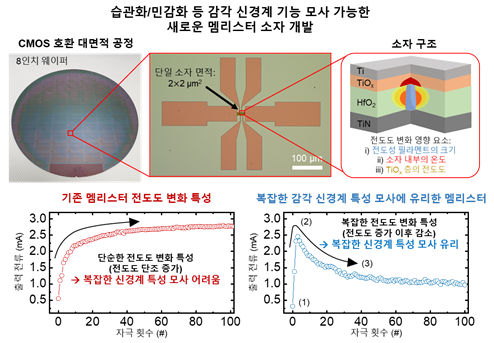 Physical appearance and description of a new memristor device capable of mimicking habituation and sensitization functions of the sensory nervous system. Provided by KAIST
To overcome the limitations identified so far, the joint research team developed a new memristor that forms layers within a single device that change conductivity in opposite directions, enabling it to realistically mimic functions such as habituation and sensitization, just like an actual sensory nervous system.
This device has the advantage of realistically reproducing the complex synaptic response patterns of the actual nervous system, such as gradually reducing its response to repeated stimuli but becoming sensitive again when a danger signal is detected.
The joint research team used this memristor to create a memristor-based artificial sensory nervous system capable of recognizing touch and pain, and applied it to an actual robotic hand to demonstrate its effectiveness.
In experiments, when repeated safe tactile stimuli were applied, the robotic hand initially responded sensitively to the unfamiliar stimuli but gradually began to ignore them, demonstrating the characteristic of habituation. Later, when the stimuli were accompanied by an electric shock, the robotic hand recognized this as a danger signal and responded sensitively again, confirming the sensitization characteristic as well.
Through this, the joint research team succeeded in proving that a robot can efficiently respond to stimuli like a human without the need for separate complex software or processors, suggesting the possibility of developing an energy-efficient, nervous system-mimicking robot.
Sion Park, a KAIST researcher in the integrated master's and doctoral program, said, "This study is significant in that it opens the possibility of realizing a new concept robot that can respond more intelligently to the external environment by mimicking the human sensory nervous system with next-generation semiconductors. This technology is expected to be applied in various convergence fields of next-generation semiconductors and robotics, such as micro-robots, military robots, and robotic prosthetic hands."
Meanwhile, Sion Park participated as the first author in this research. The results were published online on July 1 in the international journal Nature Communications.
© The Asia Business Daily(www.asiae.co.kr). All rights reserved.
![A Woman Who Jumps Holding a Stolen Dior Bag... The Mind-Shaking, Bizarre Con of a "Human Knockoff" [Slate]](https://cwcontent.asiae.co.kr/asiaresize/183/2026021902243444107_1771435474.jpg)

















