Continuous Complaints Over Odors, Noise, Illegal Dumping, and Landscape Damage
"City's Inaction Harms Residents... Decisive Measures Like Demolition Needed"
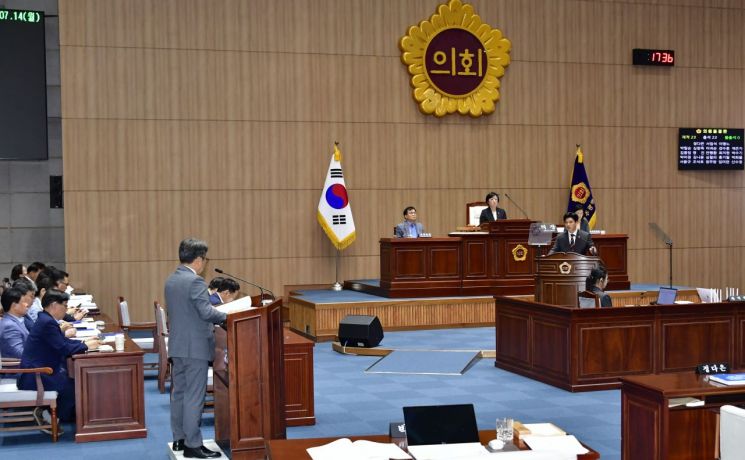 Lee Myungno, a member of the Gwangju City Council, is urging Gwangju City to take measures regarding the Seojin Hospital building, which has been left as an eyesore in the downtown area, through a city administration question session held in the plenary hall on the 14th. Provided by Gwangju City Council
Lee Myungno, a member of the Gwangju City Council (Democratic Party of Korea, Seo-gu District 3), pointed out during a city administration question session at the 334th extraordinary meeting held on the 14th, "The issue of Seojin Hospital, which has been neglected for over 30 years, is a pressing livelihood matter that can no longer be postponed, yet Gwangju City has effectively done nothing."
Seojin Hospital is a representative eyesore in the downtown area, left abandoned for more than 30 years after construction began in 1982 by Seonam University to attract a medical school, but was halted in 1989 due to financial difficulties.
In particular, as the hospital is adjacent to educational facilities such as Seojin Girls' High School and Daekwang Girls' High School, as well as residential areas, nearby residents and students have continuously suffered from foul odors, noise, illegal dumping, and damage to the landscape.
Lee stated, "This building is located directly in front of the route students use to commute to Seojin Girls' High School and Daekwang Girls' High School. Complaints from parents and local residents about foul odors, noise, and illegal dumping have been constant," and criticized, "Nevertheless, the city has claimed it bears no legal responsibility and has failed for years to attempt mediation, propose a purchase, or present any utilization plan, leaving the matter neglected."
He continued, "According to the 'Special Act on the Maintenance of Long-Term Abandoned Buildings with Suspended Construction' (Abandoned Building Maintenance Act), the mayor or provincial governor may order the demolition of buildings harmful to the public interest. If the owner fails to comply without just cause, the law stipulates that the authorities may directly demolish the building or acquire rights to it." He then asked whether the city is willing to proceed with demolition if no solution is established by the end of this year.
In response, Mayor Kang Gijung stated, "Demolition of private property is only possible if it is practically beneficial," and added, "At present, the city has no intention whatsoever to demolish the building or acquire rights to it."
Regarding this response, Lee criticized, "For years, Gwangju City has only repeated surveys of the situation, but has failed to present the maintenance and execution plan that citizens expect. If the city continues to postpone its decision, it is irresponsible administration that disregards citizen safety and livelihood."
He further emphasized, "If litigation is ongoing, the city should directly step in to mediate or seek solutions through the Building Dispute Mediation Committee. It is also necessary to take proactive measures, such as preparing utilization plans in consultation with the private sector."
Meanwhile, Lee added, "Now is the time for Gwangju City to make judgments and decisions from multiple perspectives, including urban aesthetics, student safety, and resident inconvenience. The Seojin Hospital issue will serve as a test of the city's urban space policy direction and sense of responsibility."
© The Asia Business Daily(www.asiae.co.kr). All rights reserved.
![Clutching a Stolen Dior Bag, Saying "I Hate Being Poor but Real"... The Grotesque Con of a "Human Knockoff" [Slate]](https://cwcontent.asiae.co.kr/asiaresize/183/2026021902243444107_1771435474.jpg)
















