'Hallasan Mosewat Rhyolitic Breccia Area'
A key stratum revealing the sequence of volcanic sedimentary layers
"First discovery of rhyolitic rock... highly significant"
The traces of volcanic activity that occurred 28,000 years ago in the Hallasan area of Jeju are now being managed as a natural heritage site.
 Panoramic view of the Hallasan Mosewat Yu Moonamjil Gakryeokam area
Photo by National Heritage Administration
On July 15, the National Heritage Administration announced that it had designated the "Hallasan Mosewat Rhyolitic Breccia Area," located within the Hallasan Natural Reserve, as a Natural Monument. The agency evaluated the site as having high geological value, as it serves as a key stratum that reveals the order in which volcanic sedimentary layers accumulated in the highlands of Hallasan.
"Mosewat" is a Jeju dialect word combining "sand" and "field." The name was given because the sight of rhyolitic breccia scattered across the area resembles a sandy field, reflecting its geological characteristics.
The Mosewat Rhyolitic Breccia Area stretches for approximately 2.3 kilometers along the outer rim of Baengnokdam on Hallasan. Fragments of rhyolitic rock of various sizes are interlocked and widely distributed throughout the area. Rhyolite is a volcanic rock with a high silica content, primarily composed of alkali feldspar and quartz. Breccia refers to a rock made up of angular gravel.
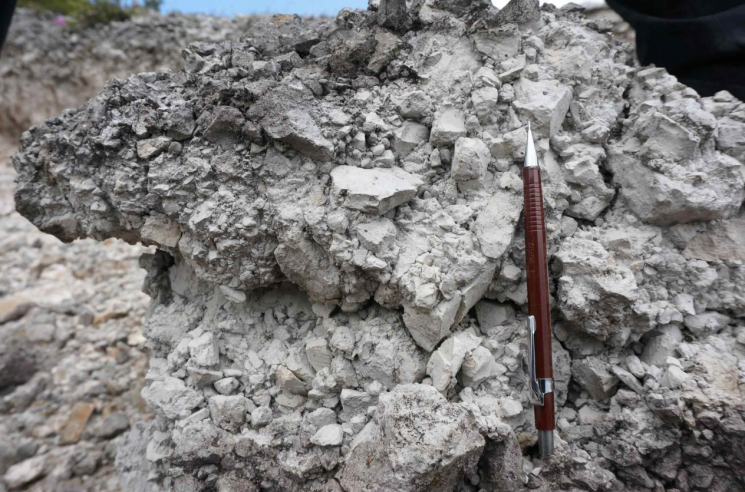
The maximum width of this area reaches 500 to 600 meters. It is estimated to have formed when a small lava dome?a volcanic hill formed by erupted lava?collapsed 28,000 years ago.
Academics believe that the site can greatly contribute to the prediction of volcanic disasters and the study of magma differentiation processes. This is because rhyolitic breccia is a type of rock formed during the final stage of differentiation, a process in which the composition of magma changes as it gradually cools. Unlike the dark basaltic rocks commonly found in Jeju, the rhyolitic breccia discovered in this area contains a high amount of silica, giving it a lighter color.
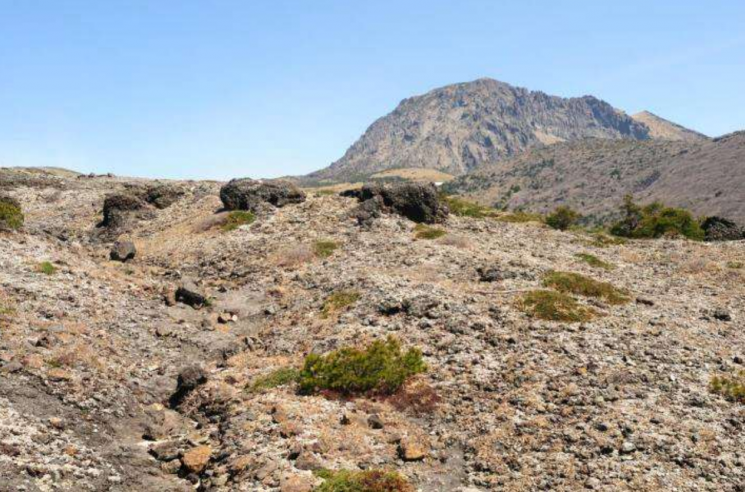 Panoramic view of the Hallasan Mosewat Yu Moonamjil Gakryeokam area
Photo by National Heritage Administration
The National Heritage Administration stated, "Among the volcanic rocks identified in Jeju so far, this is the most differentiated form," and added, "It is especially significant as this is the first time the presence of rhyolitic rock has been confirmed in Jeju."
© The Asia Business Daily(www.asiae.co.kr). All rights reserved.

![Clutching a Stolen Dior Bag, Saying "I Hate Being Poor but Real"... The Grotesque Con of a "Human Knockoff" [Slate]](https://cwcontent.asiae.co.kr/asiaresize/183/2026021902243444107_1771435474.jpg)

















