Korea Dispatches Special Envoys to Australia and Germany
Indonesia and EU Accelerate FTA Agreement
India and Brazil Aim to Triple Trade Volume
Asian countries that have received tariff letters from U.S. President Donald Trump have begun searching for new trade partners. Surprised by President Trump’s willingness to impose tariffs even on long-standing allies, these nations are continuing tariff negotiations while also seeking alternative trading partners to the United States.
On July 13 (local time), the New York Times analyzed this trend in an article titled "Facing Trump's Tariff Assault, Asian Nations Seek Better Friends."
Malaysian Prime Minister Anwar Ibrahim, at the ASEAN (Association of Southeast Asian Nations) Foreign Ministers’ Meeting held in Kuala Lumpur, Malaysia on July 9, stressed the need for unity by stating, "Globally, tools that once promoted growth are now being used to pressure, isolate, and restrain. We must strengthen our own foundations while navigating external pressures. We need to expand trade among ourselves and invest more."
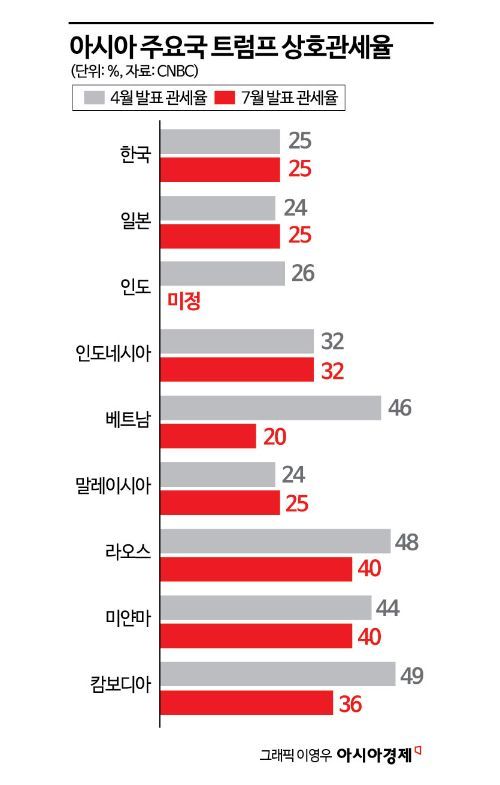
Recently, President Trump sent surprise tariff letters to about 20 major trading partners, including key Asian allies such as South Korea and Japan. The tariffs are as follows: South Korea 25%, Japan 25%, Indonesia 32%, Malaysia 25%, Laos 40%, Myanmar 40%, and Cambodia 36%. Previously, Vietnam concluded negotiations for a 20% tariff, and India is reportedly close to finalizing a similar agreement.
The New York Times pointed to South Korea as an example of the emerging trend of seeking new cooperation among Asian countries. President Lee Jaemyung has dispatched special envoys to Germany and Australia to discuss defense and trade issues and plans to send delegations to several other countries as well.
In addition, Indonesian President Prabowo Subianto held a joint press conference in Brussels, Belgium, with Ursula von der Leyen, President of the European Commission, announcing that they had reached a political agreement for a free trade agreement (FTA). The two sides have been negotiating an FTA since 2016 but had not reached an agreement until now. However, growing trade uncertainty appears to have accelerated the negotiations. Indian Prime Minister Narendra Modi, on July 8, held a summit with Brazilian President Luiz Inacio Lula da Silva in Brasilia, agreeing to triple the trade volume between the two countries.
Vietnam, even after agreeing to impose a 20% tariff on exports to the United States before receiving President Trump’s letter, is working to reduce its dependence on the U.S. market through other trade agreements.
Wendy Cutler, Vice President of the Asia Society Policy Institute, stated, "As more and more countries find it difficult to meet U.S. demands, their interest in cooperating with other countries will grow."
This is not the first time such a situation has occurred; during President Trump’s first administration, China retaliated against U.S. tariffs by reducing its purchases of American soybeans, instead turning to Brazil, which now supplies the majority of China’s soybean needs. As a result, American farmers have faced problems of overproduction and lack of sales channels.
Alexander Hynd, Associate Professor at the Asia Institute of the University of Melbourne, commented, "There is not yet a visible movement for Southeast Asian countries to unite and present a single, consolidated front. However, if the current pace of upheaval continues, the situation could change. The United States is rapidly dismantling the system it built, and this is surprising many people."
© The Asia Business Daily(www.asiae.co.kr). All rights reserved.
![Clutching a Stolen Dior Bag, Saying "I Hate Being Poor but Real"... The Grotesque Con of a "Human Knockoff" [Slate]](https://cwcontent.asiae.co.kr/asiaresize/183/2026021902243444107_1771435474.jpg)
















