Deliberation and Approval of Related Ordinance and Regulation Promulgation Bill
Thorough Management Near Large-Scale Underground Development
36% of Sinkholes in the First Half of the Year Occurred in the Gangnam Area
From now on, when large-scale underground development projects are carried out in Seoul, the city will be required to conduct cavity (underground void) inspections at least once a month. This policy is aimed at focusing on accident prevention amid the ongoing occurrence of sinkhole incidents.
On the 14th, the Seoul Metropolitan Government announced that it had held the 10th Ordinance and Regulation Review Committee meeting on the 8th, during which it deliberated and approved an ordinance and regulation promulgation bill containing these measures.
The deliberation and approval on this day also included a provision for mandatory monthly cavity inspections, as well as a requirement for prompt action in the event of ground subsidence on roads. To this end, "urban safety" has been added to the basic direction of urban planning and management, and members with expertise and experience in underground safety can now be appointed to the City Urban Planning Committee.
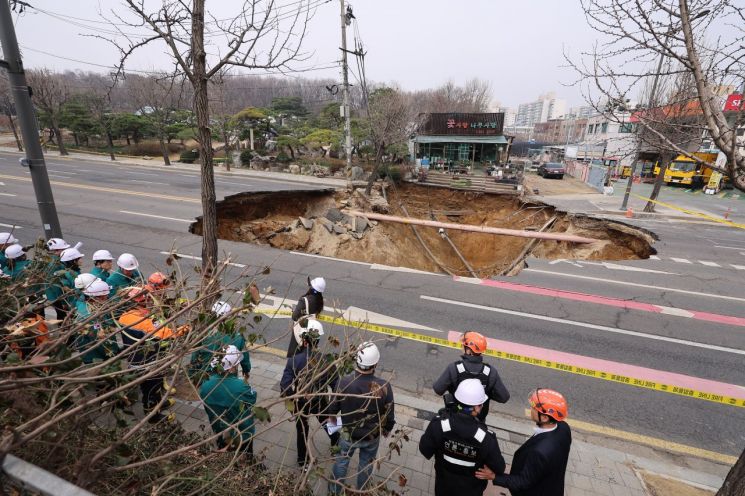 The scene of the large sinkhole that occurred on the road at Daemyeong Elementary School in Gangdong-gu last March. Photo by Yonhap News
The reason behind Seoul's decision to mandate cavity inspections is that areas with frequent large-scale excavation work tend to have weaker ground stability. According to Seoul Safety Nuri, the city's disaster and safety portal, there were a total of 72 ground subsidence incidents in Seoul between January 1 and June 30 of this year. Of these, 13 occurred in Gangnam-gu alone, where underground development such as subway construction is heavily concentrated.
In the three Gangnam districts?Gangnam, Seocho, and Songpa?there were 26 sinkhole incidents, accounting for 36% of the total. The city investigates the cause and discloses the results when an underground cavity is 0.8 square meters or larger and deeper than 0.8 meters, or when ground subsidence results in casualties.
In Gangdong-gu, where a large sinkhole occurred in Myeongil-dong last March, there were a total of five ground subsidence incidents in the first half of the year. Of these, three sinkholes were in Myeongil-dong, while the remaining two occurred in Seongnae-dong and Dunchon-dong. For the large Myeongil-dong sinkhole, the Ministry of Land, Infrastructure and Transport has formed a central underground accident investigation committee to determine the cause. The other incidents were attributed to poor compaction around underground utilities and soil loss due to aging of sewer manhole structures (Myeongil-dong), soil loss caused by leakage at the welded joint of a water supply pipeline air valve connection (Seongnae-dong), and poor compaction (Dunchon-dong).
The Seoul Metropolitan Government reports that out of a total of 10,866 kilometers of sewer lines, 6,029 kilometers (55.5%) are aged pipes over 30 years old, and cases of ground subsidence due to sewer line damage are expected to continue. Therefore, starting in the second half of this year and continuing through 2030, the city plans to repair 200 kilometers of old sewer lines annually. Funding will be secured by allocating 20 billion won from a special account, adding another 20 billion won from the disaster management fund, national government funds, and the general account, for a total of 40 billion won to be invested each year.
© The Asia Business Daily(www.asiae.co.kr). All rights reserved.
![Clutching a Stolen Dior Bag, Saying "I Hate Being Poor but Real"... The Grotesque Con of a "Human Knockoff" [Slate]](https://cwcontent.asiae.co.kr/asiaresize/183/2026021902243444107_1771435474.jpg)
















